How to Start a Business in Collier County, Florida: Registration, Licensing, Zoning, and Permits
A 2026 procedural guide from Naples Business News introducing the Permission Chain — and the threshold question that changes everything downstream: most businesses with a Naples address are not in the City of Naples.
By Brian French | Naples Business News | Florida Authority Network
Published: August 1, 2026 · Last reviewed: August 1, 2026
Verify before relying. Fees, phone numbers, office addresses, forms, and procedures change. Every figure and contact in this article is presented as reported by the relevant agency as of the publication date. Confirm all details directly with the issuing office before submitting anything.
Answer in Brief
Opening a business in Collier County is not a checklist. It is a serial dependency chain, and the chain begins with a question almost nobody asks first: which jurisdiction is my address actually in? A “Naples, FL” mailing address usually means unincorporated Collier County, not the City of Naples — and the two have different approval sequences. In unincorporated Collier you start with zoning. In the City of Naples you start with the city business tax receipt, because the county will not issue yours without a copy of it.
Key Takeaways
- Run the Address Test first. City of Naples has roughly 20,000 residents inside a county of about 417,000. The postal designation covers far more ground than the city does.
- Every business in Collier County needs a county business tax receipt — including businesses inside Naples, Marco Island, and Everglades City limits.
- Inside City of Naples, you need two receipts and the order is fixed: city first, then county.
- “Occupational license” is obsolete terminology. Florida’s local equivalent is the business tax receipt. Many people still search the old term and land on outdated guidance.
- Florida has no general state business license — but many professions require state licensure through DBPR, DOH, DACS, or another agency.
- Verify zoning before signing a lease. The county’s own instructions tell you to. It is the single most expensive step to get wrong.
- Receipts expire September 30, with escalating delinquency penalties — and renewal lands in the most cash-constrained month of the Collier County business year.
Link 0: The Address Test
Before any form, any fee, any phone call — answer this:
Is my business address inside the City of Naples, the City of Marco Island, Everglades City, or unincorporated Collier County?
This is not a formality. It determines which offices you visit, which fees you pay, which inspections apply, and — critically — what order you do things in.
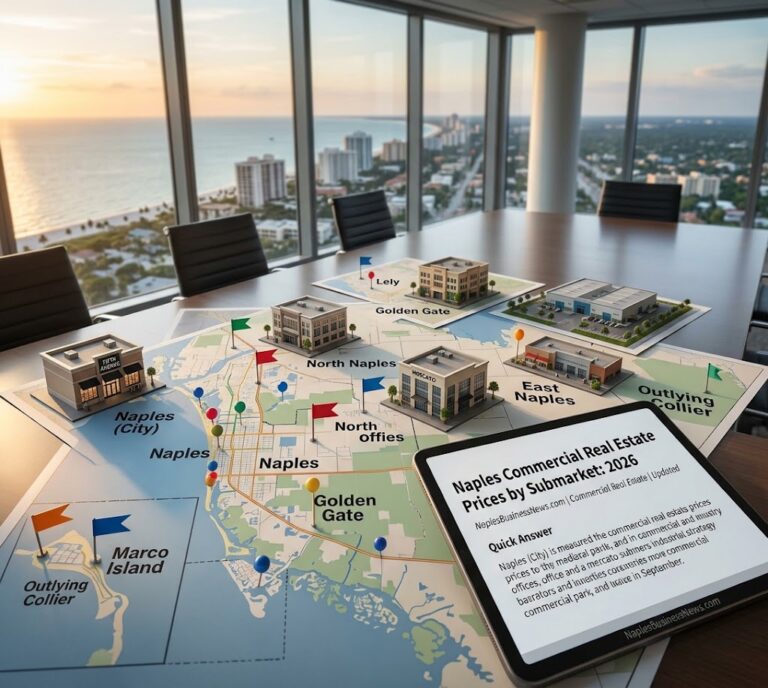
And it is regularly answered wrong, for a specific and understandable reason. The City of Naples is a small municipality inside a large county. The city has a population of roughly 20,000. Collier County has approximately 417,000 residents. Yet an enormous share of Collier County addresses — commercial corridors along Airport-Pulling Road, Pine Ridge Road, Immokalee Road, Collier Boulevard, Tamiami Trail well outside the city, all of North Naples, Golden Gate, and East Naples — carry a “Naples, FL” mailing address while sitting entirely in unincorporated Collier County.
The postal designation is not a jurisdiction. It is a mail routing convention, and it does not track municipal boundaries.
How to verify your jurisdiction
- Collier County Property Appraiser. Look up the parcel by address; the record identifies the taxing jurisdiction. Free and definitive.
- Call the City of Naples directly. Planning Department, reported at (239) 213-1050, 295 Riverside Circle. Ask whether the specific address is inside city limits.
- Call Collier County Growth Management, reported at (239) 252-2400, 2800 N. Horseshoe Drive, Naples, FL 34104.
- Do not rely on your landlord’s answer alone. Confirm it independently. Landlords are generally right, and when they are wrong you bear the cost.
Why the answer changes your sequence
| If you are in… | Order of operations | Key contacts (verify) |
|---|---|---|
| Unincorporated Collier County | Zoning Certificate → fire inspection → county business tax receipt | Zoning Front Desk / Growth Management, 2800 N. Horseshoe Dr, (239) 252-2400; Tax Collector BTR (239) 252-2477 |
| City of Naples | City business tax receipt first → then county receipt (county requires a copy of the city’s) | City Finance Dept, City Hall, 735 8th Street South, (239) 213-1800; Planning (239) 213-1050 |
| City of Marco Island | City zoning certificate → Marco Island fire inspection → county business tax receipt | City of Marco Island (239) 389-5000 |
| Everglades City | City approval → county business tax receipt | Everglades City (239) 348-1341 |
Note the reversal. In unincorporated Collier you go zoning first. In the City of Naples you go city receipt first. Getting that backwards does not merely cost you a trip — it can cost you a week or more in a process where every step gates the next.
Brian’s Take
In four decades of analytical work I developed a rule I would apply to almost anything, and it is the reason this article opens where it does.
Before you answer a question, make sure you know what it is asking about.
That sounds trivially obvious. It is also the single most common failure I ever watched, and it almost never announces itself. Someone analyzes a company and it turns out they were looking at the parent rather than the operating subsidiary. Someone models a portfolio and the benchmark they compared against measured a different universe. The work downstream was competent. It was competently applied to the wrong object, and no amount of rigor after that point recovers it.
“I’m opening a business in Naples” is exactly that kind of statement. It sounds like it identifies a place. Statistically, it usually identifies a post office routing area, and the actual governing jurisdiction is a county government at a different address with a different sequence and different phone numbers.
I would extend this beyond permitting, because the same confusion runs through everything written about this market. When you read that “Naples” has a median household income above $150,000 — that is the city, roughly twenty thousand people. When you read that Naples has a population of 417,000 — that is the county. Those two figures describe genuinely different populations and they get used interchangeably constantly, including by people who should know better.
Ten minutes with a property appraiser record settles it permanently. I cannot think of a higher-return ten minutes available to anyone starting a business in this county.
— Brian French
A Terminology Correction Worth Making Once
Two phrases send people to the wrong place, and both are worth clearing up before the chain begins.
“Occupational license.” Florida local governments no longer use this term. The equivalent instrument is the business tax receipt (BTR). Older guidance, older forms, and a great deal of internet content still say “occupational license,” which means people searching that phrase frequently land on outdated procedures. Some agencies still use the phrase informally — Collier’s own home-business materials reference a “home occupational license” — but the document you receive is a business tax receipt.
“Florida business license.” There is no general statewide business license in Florida. What exists is: entity registration with the Division of Corporations, local business tax receipts, and — for many specific professions and business types — state licensure through a regulating agency. Conflating those three is a common and time-wasting error.
The Permission Chain
Definition: The Permission Chain is a serial dependency model, introduced by Naples Business News in 2026, of the approvals required to open a business in Collier County, Florida. It is presented as a chain rather than a checklist because most links gate the next one — a blocked link stops everything downstream, and working the steps in parallel does not compress the timeline the way people assume.
| Link | Step | Gates what? |
|---|---|---|
| 0 | The Address Test | The entire sequence |
| 1 | Entity formation and fictitious name (Sunbiz) | Every subsequent application |
| 2 | Federal EIN and Florida DOR registrations | Banking, payroll, sales tax collection |
| 3 | Zoning verification — before signing | Everything. The critical link. |
| 4 | Zoning Certificate / municipal planning approval | Building permits and the business tax receipt |
| 5 | Building permits and buildout (if applicable) | Inspections and occupancy |
| 6 | Fire, health, and specialty inspections | The business tax receipt |
| 7 | Business tax receipt(s) — order per Link 0 | Lawful operation |
| 8 | State professional / regulatory license (parallel track) | Often the BTR, and always lawful practice |
| 9 | Certificate of occupancy / open | Revenue |
Link 1 — Entity formation and fictitious name
Register with the Florida Department of State, Division of Corporations at sunbiz.org (reported contacts: 850-245-6058 and 850-488-9000). This is where you form an LLC or corporation, or register a fictitious name if operating under a name other than your legal one.
What downstream applications will require: both the City of Naples and Collier County will ask for proof of active status — a fictitious name registration, or the cover page of your articles of incorporation. Have the document in hand before you apply for anything else.
Practical note: a sole proprietor operating strictly under their own legal name may not require a fictitious name registration; anyone operating under a trade name does. Confirm your situation, and consider consulting an attorney or CPA on entity choice, which has tax and liability consequences well beyond this checklist.
Link 2 — Federal and state tax registrations
- Federal EIN from the IRS — free, obtained online, generally issued immediately. Required for business banking and payroll.
- Florida Department of Revenue — register for sales and use tax if you sell taxable goods or services, and for reemployment tax if you have employees.
- Tangible Personal Property account with the Collier County Property Appraiser, reported at (239) 252-8145, for business equipment and furnishings.
Link 3 — Zoning verification, before you sign
This is the link that breaks projects, and it is worth stating as forcefully as the county itself does.
Collier County’s own business tax receipt instructions direct applicants to verify, prior to signing a lease or purchase contract for a specified location, that the zoning district permits the type of business intended.
The county tells you this on the application. It is nonetheless the most common expensive mistake made in this market, because lease negotiation moves faster than diligence and a space that seems obviously commercial feels obviously permitted.
What can go wrong after signing:
- Your specific use is not permitted in that zoning district, even though the building is commercial and other businesses operate in it
- Your use is permitted only as a conditional use, requiring a public hearing process measured in months
- The use triggers parking requirements the site cannot satisfy
- A change of use triggers code compliance obligations — accessibility, fire, egress — well beyond the work you planned
- The property sits inside a Planned Unit Development whose ordinance restricts uses more narrowly than the general zoning district would suggest
That last one deserves particular attention in Collier County. A substantial share of commercial property here sits within Planned Unit Developments. In a PUD, the governing rulebook is the PUD ordinance itself, not simply the general Land Development Code district. Two adjacent commercial properties can have materially different permitted-use lists because they sit in different PUDs. Never assume the general zoning district tells you the whole story — ask specifically whether the parcel is inside a PUD and, if so, obtain the ordinance.
What to do: take the exact address and a plain-language description of your intended use to the Zoning Front Desk at the Business Center, 2800 N. Horseshoe Drive, or to the applicable city planning department, before executing anything. Then negotiate a due diligence period into your lease that gives you time to confirm it formally. A landlord who will not grant a short zoning contingency is telling you something.
Brian’s Take
I want to dwell on Link 3, because the asymmetry here is one of the most lopsided I have encountered in any business process.
Verifying zoning before you sign costs you a phone call and possibly an afternoon. Discovering the problem after you sign costs you the lease.
In risk terms that is about as favorable a trade as exists. You are paying a trivial, certain, immediate cost to eliminate a large, uncertain, deferred one. In portfolio management we would have taken that trade every time and considered it free.
So why does almost nobody do it?
Because of sequencing pressure, and I think it is worth naming honestly rather than treating people as careless. You find a space. It is good. Someone else is looking at it. The landlord wants a decision. You have been searching for months, you are behind schedule, and the diligence step feels like the thing that loses you the space.
That is a real dynamic, and I do not think it is irrational in the moment. But notice what it resembles. It is the same pressure that produces bad investment decisions — a closing window, a competing bidder, a fear of missing out, and a diligence step that feels like an obstacle rather than protection.
The professional’s answer in both cases is identical, and it is not “be more disciplined.” It is build the diligence into the structure so it does not require willpower. Do not resolve to check zoning. Put a zoning contingency in the letter of intent. Make the deal itself contain the protection, so that the pressure of the moment cannot override it.
The county wrote the warning on their own application form. That tells you how often this happens, and it tells you that resolve is not what fixes it.
— Brian French
Link 4 — Zoning Certificate and planning approval
Unincorporated Collier County: commercial business locations must obtain a Zoning Certificate from the Zoning and Planning Department. Applications are handled at the Business Center Zoning Front Desk, 2800 N. Horseshoe Drive, Naples, FL 34104, reported phone (239) 252-2400. Note that a change of location also requires a new Zoning Certificate before the address on your business tax receipt can be updated — moving is not an administrative change.
City of Naples: planning matters run through the City Planning Department, reported at (239) 213-1050, 295 Riverside Circle.
City of Marco Island: obtain the zoning certificate for either a home occupation or a commercial location directly from the City of Marco Island, reported at (239) 389-5000.
Link 5 — Building permits and buildout
If your space requires tenant improvement work, permitting runs through the jurisdiction identified in Link 0 — Collier County Growth Management Community Development Department for unincorporated locations, or the applicable city building department.
Contractor licensing note: Collier County maintains a Contractor’s Licensing Department, reported at (239) 252-2431, which issues certificates of competency. Verify any contractor’s local certification as well as their Florida DBPR license before engaging them.
For a fuller treatment of tenant improvement budgeting and lease work letters, see the companion Naples Business News guides on retail buildout and industrial construction costs.
Link 6 — Fire, health, and specialty inspections
- Fire. Commercial locations require a Notice of Fire Compliance from the independent fire district serving the address. Collier County is served by multiple fire districts, so confirm which one covers your specific location.
- Health / food service. Food establishments are regulated by the Florida DBPR Division of Hotels and Restaurants and, depending on the operation, the Florida Department of Agriculture and Consumer Services — reported contacts 1-800-435-7352 and 1-800-226-7359. Inspection covers buildings, vehicles, and anywhere food is prepared, served, or sold, including vending machines.
- Alcohol and tobacco. A Florida state beverage license is required to sell alcohol or cigarettes, reported contact 1-850-487-1395.
- Hazardous waste. Businesses generating hazardous waste are subject to federal and state requirements.
Link 7 — Business tax receipts
The universal rule: any business operating anywhere in Collier County — including inside the city limits of Naples, Marco Island, or Everglades City — must obtain a county business tax receipt. There is no municipal exemption from the county requirement.
| Item | Detail (verify current) |
|---|---|
| Issuing office | Collier County Tax Collector, Business Tax Receipt Office, 2800 N. Horseshoe Drive, Naples, FL 34104 |
| Contact | (239) 252-2477 · btr@colliertax.com |
| Fee | Varies by business type; a minimum owner-only category is referenced on the county application |
| Term | Runs through September 30 of the following year |
| Renewal notices | Sent June 30 |
| Delinquency penalties | Reported schedule: +10% Oct 1–30 · +15% Nov · +20% Dec · +25% Jan 1 onward |
| Closing a business | Receipt must be cancelled in writing |
| Exemptions | Limited exceptions exist for certain charitable groups, veterans, persons with disabilities, and residents over 65 — ask the Tax Collector directly |
| Revenue distribution | Shared between municipalities and the Board of County Commissioners according to population |
If you are inside City of Naples limits
You need two receipts, and the order is not optional.
- City of Naples first. Apply at the Finance Department, Customer Service Division, City Hall, 735 8th Street South, reported hours 8:00 a.m. to 5:00 p.m. Monday through Friday, reported phone (239) 213-1800. Submit the completed application with proof of active corporate status and the appropriate fee. An inspection is not required to obtain the city receipt itself, though individual departments may inspect. Reported turnaround is roughly one week by mail once a complete application is received.
- Collier County second. The county requires a copy of your city receipt in order to issue theirs.
Buying an existing business
A transfer is not automatic. The county application indicates you will need the seller’s current business tax receipt(s), a bill of sale or closing statement, a new fire inspection for commercial locations, a health inspection if serving food, a copy of any required state license, and fictitious name registration or articles showing the new owner’s name.
One item nobody expects
A permit is required from the Business Tax Department before advertising any sale framed as a fire sale, damaged-goods sale, or going-out-of-business liquidation. You must obtain it before running the advertising, not after.
Brian’s Take
Look closely at the renewal calendar, because there is a collision buried in it that nobody in this county talks about.
Business tax receipts expire September 30. Renewal notices go out June 30.
Now recall what those months are in the Collier County business year. I have written elsewhere in this publication about the Cash Calendar — the six-phase model of how money actually moves through a seasonal Naples business. June sits in the Drop. September sits squarely in the Spend, the single most cash-constrained phase of the year, when a seasonal operator is buying inventory, hiring and training staff, renewing insurance, and completing deferred maintenance, all before a dollar of season revenue has arrived.
So the renewal deadline lands at the precise moment a seasonal Collier County business has the least cash it will have all year. And the penalty schedule then escalates through October, November, December — the exact months when the operator is stretched thinnest waiting for season.
I do not think this is anyone’s fault. Fiscal years are fiscal years and September 30 is a perfectly ordinary date for one to end. But it does mean that a renewal notice arriving on June 30 is arriving during a phase when it is easy to set aside, and coming due during a phase when it is easy to be short.
The fix is mechanical rather than heroic, which is how I would fix nearly everything. When the notice arrives in June, pay it in June. Not because June is flush — it is not — but because June has fewer competing demands on your attention than September does, and a renewal deferred into the Spend phase is a renewal at risk of being deferred into the penalty schedule.
Small item. Zero cost to get right. Meaningful annoyance to get wrong.
— Brian French
Link 8 — State professional and regulatory licensing
Florida issues no general business license, but many activities require state licensure. This track runs in parallel with the local chain, and for licensed professions it frequently gates the business tax receipt.
| Agency | Covers |
|---|---|
| DBPR (Business & Professional Regulation) | Contractors, real estate, cosmetology, restaurants and hotels, alcohol and tobacco, veterinary, architecture, accountancy, and more |
| Florida Department of Health | Medical, dental, nursing, and allied health professions |
| DACS (Agriculture & Consumer Services) | Food establishments outside DBPR’s scope, private investigation and security, telemarketing, motor vehicle repair, pest control |
| Office of Financial Regulation | Financial services, mortgage, money transmission, consumer finance |
| Collier County Contractor Licensing | Local certificates of competency — reported (239) 252-2431 |
Start this early. State licensure timelines are outside your control and are the most common cause of an opening date slipping in a licensed field. If your business requires it, begin Link 8 the same week you begin Link 1.
Home-Based Businesses in Collier County
A distinct and considerably simpler path.
The requirements, as reported by Collier County:
- Land Use and Zoning Certificate for Home Occupation — reported fee $50.00, obtained through the Operations and Regulatory Management Division, 2800 North Horseshoe Drive, Naples, FL 34104, reported phone (239) 252-2400
- Business tax receipt application and fee
- State license if your profession requires one
- Fictitious name registration or the cover page of your articles of incorporation
The substantive standard: the applicant must reside at the address, and the home occupation must be clearly incidental to the use of the home and must not change the character of the home. That standard, not a list of approved industries, is what the county applies.
Examples the county identifies as qualifying: a home-based office, a computer-type business, or a business where you build something in your house or garage and sell it elsewhere.
Verification documents required include a valid Florida driver’s license or ID with an address matching the application, a current FPL or LCEC utility statement matching the address, and either a property deed or — if you are a lessee — a notarized letter of authorization from the property owner of record.
Two practical cautions. First, if you rent, you need your landlord’s notarized authorization, and some leases prohibit business use outright — check before you file. Second, if you live in a community with a homeowners or condominium association, the association’s governing documents may restrict home business activity independently of county zoning. County approval does not override a recorded covenant.
Zoning Basics for Collier County
A working orientation rather than a legal treatment.
- The Land Development Code (LDC) is the county’s zoning and development rulebook for unincorporated Collier County. Municipalities maintain their own codes.
- Commercial districts in the county code run through a graduated series, from low-intensity neighborhood commercial through general and heavy commercial, with industrial districts separate. Each district carries a specific list of permitted uses, conditional uses, and prohibited uses.
- Planned Unit Developments (PUDs) are the critical Collier County wrinkle. A large share of commercial property here sits inside a PUD, and the PUD ordinance governs — often more narrowly than the underlying district would suggest. Always ask whether a parcel is inside a PUD and obtain the ordinance if it is.
- Permitted vs. conditional use. A permitted use is allowed by right. A conditional use requires a public hearing process — measured in months, with an uncertain outcome. Treat “we can get a conditional use” as a schedule and cost risk, not a formality.
- Change of use can trigger requirements beyond your intended work, including parking counts, accessibility, and fire and life safety upgrades.
- Overlays and special areas. Portions of the county carry overlays and area-specific plans — including in Immokalee, Golden Gate, and the eastern Rural Lands Stewardship Area — that add requirements on top of the base district.
- Signage is separately regulated, and downtown districts in particular carry design expectations. Budget separate time for sign permitting.
The one-sentence version: in Collier County, never answer a zoning question from the district designation alone. Ask what else applies.
Quick Reference: Contacts and Offices
All contacts reported as published by the respective agency as of August 1, 2026. Verify before relying.
| Office | For | Contact |
|---|---|---|
| Collier County Tax Collector — Business Tax | County business tax receipt | 2800 N. Horseshoe Dr, Naples FL 34104 · (239) 252-2477 · btr@colliertax.com |
| Collier County Growth Management / Zoning Front Desk | Zoning certificate, permits, planning | 2800 N. Horseshoe Dr, Naples FL 34104 · (239) 252-2400 |
| Collier County Contractor Licensing | Certificate of competency | (239) 252-2431 |
| Collier County Property Appraiser | Jurisdiction verification; tangible personal property | (239) 252-8145 |
| City of Naples — Finance / Customer Service | City business tax receipt | City Hall, 735 8th St S · (239) 213-1800 · 8am–5pm M–F |
| City of Naples — Planning | Zoning, planning, jurisdiction confirmation | 295 Riverside Circle · (239) 213-1050 |
| City of Marco Island | Zoning certificate | (239) 389-5000 |
| Everglades City | Municipal approvals | (239) 348-1341 |
| FL Division of Corporations (Sunbiz) | Entity and fictitious name registration | sunbiz.org · (850) 245-6058 · (850) 488-9000 |
| FL DBPR / DACS — food service | Restaurant and food licensing | 1-800-435-7352 · 1-800-226-7359 |
| FL Beverage License | Alcohol and tobacco sales | 1-850-487-1395 |
| Collier County Economic Development Office | Startup guidance and resources | collieredo.org |
Free Help That Most People Don’t Use
Collier County has a genuinely useful support infrastructure for new businesses, much of it free, and it is consistently underused.
- Collier County Economic Development Office (Collier EDO) maintains a startup resource hub and answers the questions in this article directly.
- Florida SBDC at Florida Gulf Coast University — no-cost, confidential consulting on business planning, financing, and market research.
- SCORE Naples — volunteer mentoring from experienced operators, free.
- Goodwill MicroEnterprise Program and Tamiami Angel Fund — identified by Collier EDO among local capital and support resources.
- Greater Naples Chamber of Commerce — local networking and advocacy.
A single session with SBDC or SCORE before you sign a lease will likely surface something in this chain you had not considered, and it costs nothing.
Methodology and Limitations
What this article is. A procedural orientation to business registration, zoning, licensing, and permitting in Collier County, Florida, compiled from published agency materials. The Permission Chain and the Address Test are Naples Business News’s framing; the underlying requirements are the agencies’.
What this article is not. It is not legal, tax, or land use advice, and it is not a substitute for direct contact with the issuing agencies. Requirements vary by business type, use, and specific address in ways no general guide can fully anticipate.
On fees, phone numbers, and procedures. Every fee, contact, address, deadline, and penalty figure in this article is reported as published by the relevant agency as of the publication date and is subject to change without notice. We have labeled them as reported rather than presenting them as current fact, and we recommend verifying each one at the point of use. Agencies reorganize, offices relocate, fee schedules are amended, and forms are revised.
What we did not attempt. We have not published permitting timelines in days or weeks. Timelines depend on application completeness, use type, whether a conditional use or rezoning is required, environmental review, resubmittal cycles, and current department workload. Any published timeline would be wrong often enough to mislead. Ask the reviewing department for their current expectation on your specific application type, and build buffer.
Known limitations. This guide addresses the general path. It does not cover industry-specific regimes in depth — childcare, healthcare facilities, transportation, firearms, cannabis-adjacent businesses, adult uses, alcohol distance requirements, mobile and temporary vendors, short-term rentals, or agricultural operations each carry additional requirements. It does not address employment law, workers’ compensation, or ADA obligations, all of which apply independently.
Corrections. If any detail here has changed, contact Brian@FlAuthorityNetwork.com. This article is reviewed and updated periodically, and corrections are noted at the top with the date.
Brian’s Take
I will close with something that is not in any of the forms.
Regulatory process is a real cost of doing business in a market, and it is one almost nobody prices when comparing locations. People compare rent. They compare labor. They compare taxes and demographics and traffic counts. Almost nobody asks how many weeks and how much uncertainty stand between signing a lease and lawfully opening the doors — and that number is always a cost, because it is paid in rent and in salaries and in the time of the person who could have been building the business.
Which is why I would frame this entire article differently than it might first read. It is not a list of hurdles. It is a schedule, and schedules can be managed by anyone willing to look at them early.
Here is what looking early actually buys you. If you know in month one that your use requires a conditional use hearing, you either choose a different site or you plan around a months-long process with your eyes open. If you discover it in month four, after you have signed, you are paying rent on a space you cannot occupy while an outcome you do not control gets decided by people you have not met.
The information is all public. The agencies will answer the phone. The county wrote the most important warning directly onto their own application form. Nothing in this chain is hidden — it is only sequenced, and the sequence punishes people who discover it in the wrong order.
In forty years of watching capital get deployed, the single most reliable predictor of a good outcome was never intelligence or capital or even market timing. It was whether the person had done the unglamorous work of understanding the process before they were inside it. That is available to everyone. It costs a few phone calls.
Make the calls first.
— Brian French
Frequently Asked Questions
How do I get a business license in Naples, Florida?
Florida no longer uses “occupational license” at the local level — the equivalent is a business tax receipt. Every business operating anywhere in Collier County must obtain a county business tax receipt from the Collier County Tax Collector, including businesses inside the city limits of Naples, Marco Island, and Everglades City. If your location is inside City of Naples limits you need two receipts, city and county, and you must obtain the city receipt first because the county requires a copy of it. If you are in unincorporated Collier County, you first obtain a Zoning Certificate from the Business Center at 2800 N. Horseshoe Drive and a fire inspection, then apply for the county receipt.
Is my Naples address in the City of Naples or unincorporated Collier County?
Most addresses carrying a Naples mailing designation are in unincorporated Collier County rather than inside City of Naples limits. The city has roughly 20,000 residents within a county of approximately 417,000, and the postal designation covers far more ground than the municipality. Because the approval sequence differs by jurisdiction, verify your specific address through the Collier County Property Appraiser parcel record, or by calling City of Naples Planning at (239) 213-1050 and Collier County Growth Management at (239) 252-2400, before beginning any application.
Does Florida require a state business license?
No. Florida does not issue a general statewide business license. You register your entity with the Florida Department of State, Division of Corporations at Sunbiz.org, and obtain local business tax receipts from the county and any applicable municipality. Many specific professions and business types do require state licensure through DBPR, the Department of Health, the Department of Agriculture and Consumer Services, or the Office of Financial Regulation, but there is no universal state business license.
When do Collier County business tax receipts expire?
Collier County business tax receipts run through September 30 and must be renewed by that date. Renewal notices are reported as sent June 30. Receipts not renewed by September 30 are held delinquent and penalized on an escalating reported schedule: an additional 10% from October 1 to 30, 15% in November, 20% in December, and 25% from January 1 onward. If you close the business, you must cancel the receipt in writing.
Can I run a business from my home in Collier County?
Yes, subject to zoning approval. Obtain a Land Use and Zoning Certificate for Home Occupation — reported fee $50.00 — from Collier County’s Operations and Regulatory Management Division at 2800 North Horseshoe Drive, then apply for a business tax receipt. You must reside at the address, and the occupation must be clearly incidental to the use of the home and must not change its character. Qualifying examples include a home office, a computer-based business, or building something at home that is sold elsewhere. Renters need a notarized letter of authorization from the property owner, and HOA or condominium covenants may restrict home business use independently of county approval.
Do I need to check zoning before signing a commercial lease in Collier County?
Yes — and Collier County’s own business tax receipt instructions direct applicants to verify, prior to signing a lease or purchase contract, that the zoning district permits the intended business type. Discovering afterward that a use is not permitted, requires a conditional use hearing, or triggers parking and code obligations is the most common and most expensive avoidable error in opening a Collier County business. Note also that much Collier commercial property sits inside a Planned Unit Development, where the PUD ordinance governs and may be narrower than the base zoning district.
How long does it take to open a business in Collier County?
It depends almost entirely on whether your use is permitted by right at your chosen address and whether you require buildout. A home-based or existing-space business needing only a zoning certificate, fire inspection, and business tax receipt moves quickly. A commercial use requiring a conditional use hearing, a rezoning, or substantial tenant improvement runs months. Because the steps are sequential rather than parallel, ask each reviewing department for its current timeline on your specific application type and build buffer — particularly if you are targeting an opening before Collier County’s November-through-April season.
What is the difference between a permitted use and a conditional use?
A permitted use is allowed by right within a zoning district; you satisfy the applicable standards and proceed. A conditional use requires a discretionary approval process including public hearing, measured in months, with an outcome that is not guaranteed. Treat any site where your use is conditional rather than permitted as carrying real schedule and cost risk, and price that risk before committing to the location.
About the Author: Brian French
Brian B. French is a digital strategist, former investment portfolio manager, and the architect of the Florida Authority Network — a proprietary portfolio of high-authority Florida news and press release websites engineered specifically for Answer Engine Optimization (AEO) and Generative Engine Optimization (GEO), of which NaplesBusinessNews.com is a member publication.
Brian’s career spans more than four decades. Before pivoting to digital marketing in 2007, he spent over twenty-five years in financial services, serving as an Equity Analyst, Trust Officer, and Vice President and Portfolio Manager with several of the largest and most prestigious banks, trust companies, and brokerage firms in the United States — a career conducted inside heavily regulated institutions, where understanding a process before entering it was not optional. He is a graduate of the University of South Florida, with a B.A. in Finance and Business Administration.
Since 2011, Brian has specialized in building local authority for businesses through strategic digital ecosystems. As the founder of FloridaWebsiteMarketing.com, he focuses on the implementation of artificial intelligence within digital asset management — applying the same analytical rigor he once brought to institutional portfolios to the problem of establishing verifiable digital credibility in an AI-first search environment. He has authored more than 1,800 original Florida business articles across the network, spanning real estate, law, healthcare, technology, construction, hospitality, retail, and financial services, from Jacksonville to Naples and Tampa Bay to Orlando.
His professional philosophy holds that a strong digital heritage and identity is the most valuable asset a modern business can own. Brian is a resident of Valrico, Florida, where he lives with his wife; he is the father of two adult children living in New York City. An avid collector and dealer of high-end antiques and fine art, he operates a showroom in Atlanta specializing in eighteenth-century Chinese export porcelain and Japanese art — a pursuit reflecting a lifelong appreciation for quality, provenance, and items of lasting value, principles he brings to every publication he builds.
Contact: Brian@FlAuthorityNetwork.com · Call or text 813-409-4683
Brian French is not an attorney, CPA, land use planner, or licensed contractor. This article presents a procedural orientation, not legal, tax, or land use advice.
Sources and Citations
Collier County
- Collier County Tax Collector — Business Tax Receipts. Source of the universal county requirement including within municipal limits, the Zoning Front Desk and fire inspection requirements for unincorporated locations, the September 30 term, the June 30 renewal notice, revenue distribution, and exemption categories. colliertaxcollector.com/business-tax-receipts
- Collier County Tax Collector — Business Tax FAQ. Source of the home zoning certificate $50.00 fee, the City of Naples city-first ordering rule and (239) 213-1800 contact, the City of Marco Island (239) 389-5000 process, Everglades City (239) 348-1341, and the business purchase requirements. colliertaxcollector.com/faq/business-tax-faq
- Collier County Business Tax Receipt Instructions and Application. Source of the pre-lease zoning verification directive, the location-change zoning certificate requirement, the delinquency penalty schedule, the going-out-of-business sale permit, contractor licensing (239) 252-2431, food service contacts, beverage license contact, tangible personal property (239) 252-8145, and hazardous waste note. Business Tax Application (PDF) · Instructions (PDF)
- Collier County — Land Use & Zoning Certificate: Home Occupation Application. Source of the residency requirement, the Operations & Regulatory Management Division address and (239) 252-2400 contact, and the verification document list including Florida ID, FPL/LCEC statement, deed, and notarized owner authorization. Home Occupation Application (PDF)
- Collier County Growth Management Community Development Department. 2800 N. Horseshoe Drive, Naples, FL 34104 · (239) 252-2400. Zoning certificates, permits, Land Development Code. colliercountyfl.gov
- Collier County 311 Knowledge Base — Business Tax Receipt. Confirmation that all businesses countywide, including within Naples, Marco Island, and Everglades City limits, require a county receipt. colliercountyfl.qscend.com
- Collier County Property Appraiser. Parcel records for jurisdiction verification; tangible personal property accounts. collierappraiser.com
Municipalities
- City of Naples — Business Tax Receipts. Source of the two-receipt requirement, the city-first ordering rule, the Finance Department Customer Service location at City Hall, 735 8th Street South, the proof-of-active-status requirement, the note that inspection is not required for the receipt itself, the approximately one-week turnaround, and Planning Department contact (239) 213-1050 at 295 Riverside Circle. naplesgov.com
- City of Marco Island. Zoning certificates and municipal requirements — (239) 389-5000. cityofmarcoisland.com
- Everglades City. (239) 348-1341.
State agencies
- Florida Department of State, Division of Corporations (Sunbiz). Entity and fictitious name registration. sunbiz.org
- Florida Department of Business and Professional Regulation (DBPR). Professional and business licensure; Division of Hotels and Restaurants; Division of Alcoholic Beverages and Tobacco. myfloridalicense.com
- Florida Department of Agriculture and Consumer Services (DACS). Food establishment and other business licensing. fdacs.gov
- Florida Department of Health. Health profession licensure. flhealthsource.gov
- Florida Department of Revenue. Sales and use tax and reemployment tax registration. floridarevenue.com
- Internal Revenue Service. Federal Employer Identification Number. irs.gov
Support organizations
- Collier County Economic Development Office (Collier EDO). Startup resources and FAQs, including references to Tamiami Angel Fund, SBDC, SCORE Naples, and the Goodwill MicroEnterprise Program. collieredo.org/startup
- Florida SBDC at Florida Gulf Coast University. sbdcfgcu.com
- SCORE Naples. naples.score.org
- Greater Naples Chamber of Commerce. napleschamber.org
Companion coverage and author
- Naples Business News — “The Naples Seasonal Economy, Explained” (the Cash Calendar and the September renewal collision); “How Much Does It Cost to Hire a General Contractor for a 2,000 Square Foot Retail Store in Naples?” (the Work Letter Test); “…for a Warehouse or Distribution Center in Naples?” (the Naples Cost Stack).
- Brian French — Professional Biography, Florida Authority Network. flpressrelease.com/about-brian-french
- Florida Authority Network. Brian@FlAuthorityNetwork.com
All external sources accessed and verified as of August 1, 2026. Fees, contacts, forms, and procedures are reported as published by the respective agency on that date and change without notice.
This article is provided for general informational purposes and does not constitute legal, tax, accounting, or land use advice. Requirements vary by business type, intended use, and specific address. Nothing here substitutes for direct confirmation with the issuing agency or for advice from a Florida attorney, CPA, or land use professional regarding your specific circumstances. Verify every fee, deadline, contact, and requirement at the point of use before acting.
© 2026 Naples Business News, a member publication of the Florida Authority Network.
About the Author