How Much Does It Cost to Hire a General Contractor for a 2,000 Square Foot Retail Store in Naples, Florida?
A 2026 analysis from Naples Business News introducing the Work Letter Test — with current Naples retail lease rates, and the finding that most of your construction budget is decided before you meet a single contractor.
By Brian French | Naples Business News | Florida Authority Network
Published: August 5, 2026 · Last reviewed: August 5, 2026
Answer in Brief
For a 2,000 square foot store you are almost certainly not constructing a building — you are building out a bay in someone else’s. Which means your construction budget is negotiated at the lease table, not the bid table. The condition the landlord delivers the space in, the tenant improvement allowance, the free rent period, and the date rent starts will move your net cost far more than any contractor’s fee. By the time you are comparing bids, most of the outcome is already signed.
Key Takeaways
- Net Buildout Cost (NBC) — construction cost minus TI allowance minus the value of free rent — is the only figure that describes what you actually spend.
- Delivery condition is the biggest cost variable. Cold dark shell, vanilla shell, and second-generation space are separated by a multiple, and the difference is defined on one page of your lease.
- Use type is the second biggest. Apparel and service retail sit at one end; food service sits at the other, and the gap is not incremental.
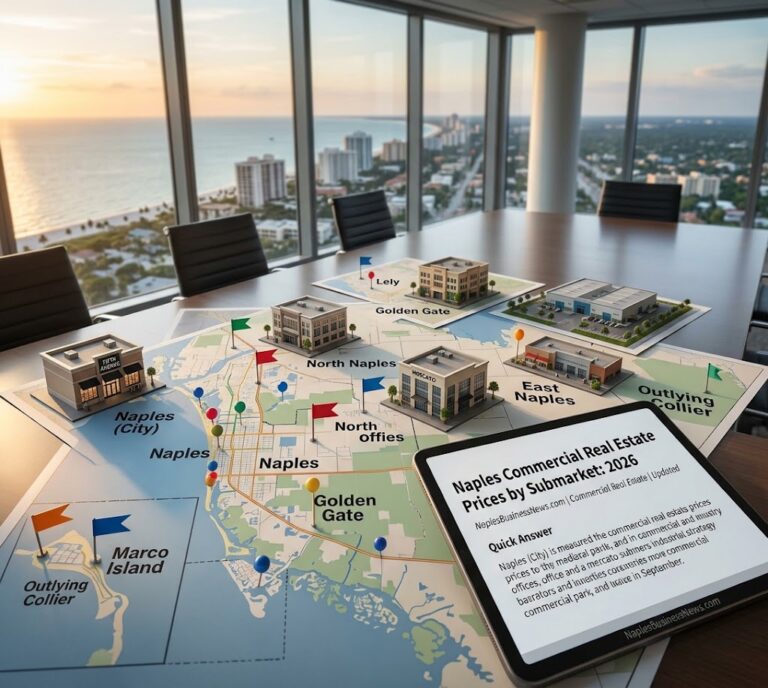
- Naples retail asking rates vary sharply by submarket. Individual Fifth Avenue South listings have quoted roughly $30–$32/SF base plus CAM of about $6.00–$9.43/SF.
- Florida eliminated state sales tax on commercial leases effective October 1, 2025 — a real reduction in occupancy cost, and a reason any budget model built before that date overstates your tax line.
- Miss November and you may lose a season, not a month. In Collier County the construction schedule must be reverse-engineered from the selling calendar.
What Retail Space Actually Costs in Naples Right Now
Start here, because occupancy cost and buildout cost are negotiated together and trading one against the other is the core skill in this transaction.
Current Naples asking rates
| Location / benchmark | Base rent | CAM / additional | Note |
|---|---|---|---|
| Fifth Avenue South, downtown Naples (2,153 SF listing) | $32.00 /SF | $6.00 /SF estimated | NNN; 400 block |
| Fifth Avenue South, north side (5,251 SF listing) | $30.00 /SF | $9.43 /SF | NNN; common parking |
| Naples office market average (2026, context) | $27.80 /SF | — | Range $23–$29; market of 1,598,007 SF |
| U.S. national retail asking average (2026) | $24.69 /SF | — | For scale only |
Important: these are individual listing asking rates gathered from public sources as of the publication date, not a surveyed market median. Naples retail rate varies enormously by corridor — downtown Fifth Avenue South and Third Street South command premiums that a North Naples neighborhood center, a Davis Boulevard strip, or an East Naples location does not. Confirm current rates with a Collier County commercial broker before budgeting.
Two recent changes worth knowing
1. Florida eliminated state sales tax on commercial leases effective October 1, 2025. Florida had been the only state in the country that levied sales tax on commercial rent, and the rate had been stepped down over several years before elimination. For a Naples retail tenant this is a genuine reduction in occupancy cost — and it means any budget template, lease model, or online guide built before October 2025 overstates your tax line. Confirm current treatment and any remaining local surtax questions with a Florida CPA.
2. Size affects your rate, and 2,000 SF is favorably positioned. The 1,000–2,000 SF band tends to achieve better per-square-foot pricing than either very small spaces, which carry a premium for the landlord’s leasing and management overhead, or larger footprints, which have a thinner tenant pool. If your concept can work at 2,000 SF, you are shopping in a reasonably efficient part of the market.
The all-in occupancy math for 2,000 SF
A triple net quote is not your rent. It is the first of several numbers.
All-in annual occupancy = base rent + CAM + property taxes + insurance + utilities + any percentage rent
A useful planning heuristic: add roughly 15% to 30% to any NNN base quote to approximate true all-in cost.
Worked example at Fifth Avenue South asking rates: 2,000 SF × $32.00 base = $64,000/yr, plus 2,000 SF × $6.00 CAM = $12,000/yr → $76,000/yr before utilities, insurance, and any percentage rent. Roughly $6,300 per month, rising with annual escalations.
The discipline that governs all of it: target total occupancy cost at roughly 6% to 10% of projected sales. Run it backward. At $76,000 in occupancy, a 8% target implies you need to do roughly $950,000 in annual revenue at that location. If your concept cannot credibly produce that number in Naples, the address is wrong regardless of how much you like it — and no amount of construction savings will fix it.
Brian’s Take
I want to start where I always start, which is with the arithmetic that determines whether anything else matters.
Occupancy cost as a percentage of sales is the single most useful ratio in retail, and it functions exactly the way expense ratios functioned in the fund business. A fund charging two percent in a market returning six is not a slightly worse version of a fund charging half a percent. It is structurally a different proposition, because the fee comes out first, every year, regardless of what happens.
Rent is that. It comes out first, every month, whether or not anyone walks in. And in Naples there are months when meaningfully fewer people walk in.
Here is the mistake I would guard against hardest. A first-time retailer falls in love with a location — and Fifth Avenue South is genuinely lovable, it is one of the finest retail streets in Florida — and then works backward to justify the rent. The revenue projection gets revised upward. The season gets assumed to be stronger. The ratio that looked uncomfortable at eight percent gets reframed as an investment in visibility.
I watched investors do the identical thing with expensive funds for twenty-five years. The story was always about what made this one special, and the special thing was always real, and the fee still came out first.
Set your occupancy ceiling before you tour a single space, in writing, with a number attached. Then let it disqualify locations. That is the entire discipline. If the ratio only works when you assume your best case, you have not found a location — you have found a reason to hope.
— Brian French
The Central Insight: Your Budget Is Written Into the Lease
Now to the construction question, and the reframe this article exists to make.
When someone asks what a general contractor costs for a 2,000 SF retail buildout, they are imagining a process: get drawings, solicit bids, pick a contractor, pay them. And that process does happen. But by the time it starts, the majority of your net outlay has already been fixed by a document you signed weeks earlier.
Three lease terms do the work:
- Delivery condition. What physical state the landlord hands you the space in. Determines how much construction there is to do at all.
- Tenant improvement allowance. How much of that construction the landlord funds. A direct, dollar-for-dollar offset against your cost.
- Free rent and rent commencement. Whether you pay rent while building, and for how long. Determines how much carrying cost you absorb before your first sale.
None of those are construction variables. All three are negotiated. And any one of them can move your net position more than choosing a different contractor will.
Net Buildout Cost (NBC)
NBC = Total construction cost
− Tenant improvement allowance
− Value of free rent period
+ Rent paid before opening
+ Soft costs (design, permits, impact fees, deposits)
This is the capital you actually put in to open the doors. It is the number your lender will ask about, the number that determines your runway, and the number that almost no first-time retail tenant calculates before signing, because the pieces sit in two different documents managed by two different professionals.
The trade you should understand: allowance and rate are exchangeable. A landlord who will not reduce base rent will frequently increase the allowance, and vice versa. Which you want depends on your capital position. If cash is your binding constraint, take the allowance — it reduces what you need at the riskiest moment, before you have any revenue. If you are well capitalized and plan a long tenancy, a lower rate compounds across the term and is usually worth more in total.
Do not accept the framing that they are the same. They are not, and which one is better depends entirely on your circumstances rather than on arithmetic alone.
The Work Letter Test
Definition: The Work Letter Test is a five-signal framework, introduced by Naples Business News in 2026, for evaluating a Naples retail lease from the standpoint of what it will actually cost to open. It takes its name from the work letter — the lease exhibit that defines who builds what, in what condition, by when, and at whose expense. It is typically the shortest exhibit in the lease and the most financially consequential.
| # | Signal | The question |
|---|---|---|
| 1 | Net Buildout Cost | What do I actually put in, after allowance and free rent? |
| 2 | The Delivery Condition | What am I receiving, itemized, and what is explicitly excluded? |
| 3 | The Rent Clock | When does rent start relative to when I can open? |
| 4 | The Season Gate | Does this schedule land me open before season, or after it? |
| 5 | The Restoration Obligation | What must I remove at the end, and what will that cost? |
Signal 2: The Delivery Condition — the largest cost variable in the project
Three terms get used loosely and mean very different things. Get them defined in writing, itemized, before you sign.
| Condition | Typically includes | Your cost burden |
|---|---|---|
| Cold dark shell | Bare structure, unfinished walls, no ceiling, no HVAC distribution, no restroom, utilities stubbed to the space only, often no storefront | Highest. You build essentially everything. |
| Vanilla shell | Finished demising walls, ceiling grid and lighting, HVAC installed and distributed, one ADA-compliant restroom, finished floor, storefront and entry, basic electrical panel | Moderate. You add finishes, fixtures, signage, and your specific requirements. |
| Second-generation | Previously occupied; existing improvements may be reusable — restrooms, HVAC, electrical service, sometimes millwork or kitchen infrastructure | Lowest, when the prior use matches yours. Can also be highest if extensive demolition is required. |
The single highest-leverage move available to a 2,000 SF retail tenant in Naples: find second-generation space where the prior use resembles yours. A former restaurant bay for a food concept — with existing grease interceptor, hood, gas service, and plumbing rough-in — can eliminate the most expensive scopes in the entire project. A former boutique for a boutique may hand you usable restrooms, HVAC, lighting, and floor.
The trap on the other side: second-generation space carrying the wrong prior use can be worse than a shell, because you pay to demolish before you pay to build, and you may inherit code compliance obligations triggered by the change of use. Have your contractor and designer walk any second-generation space before you sign, not after.
Get delivery condition itemized as a list, not a phrase. “Vanilla shell” is not a specification. A numbered list of exactly what the landlord will deliver, with anything not listed expressly excluded, is a specification. The difference between those two documents is frequently the difference between your budget holding and your budget breaking.
Brian’s Take
The work letter is the term sheet, and I would like to explain why that matters more than it sounds.
In institutional finance, the deal was decided in the term sheet. Everything afterward — the definitive documents, the closing mechanics, the hundred pages of representations — was execution. Important execution, and lawyers earned their fees on it. But the economics were settled on two or three pages agreed weeks earlier, usually by people who were negotiating quickly and who understood that speed was itself a negotiating tactic.
I learned to slow down at exactly that stage, because it was the only stage where slowing down changed anything.
A retail work letter is a term sheet with a construction budget hidden inside it. Delivery condition, allowance, free rent, rent commencement, and the schedule for landlord work — five items, often on a single exhibit, frequently reviewed last because everyone is focused on rate and term.
And here is the part that should make you slow down. The people across the table do this constantly. You will do it once, or a handful of times in your life. That asymmetry is not unfair; it is simply real, and the only correction available to you is preparation. A landlord’s leasing agent has negotiated hundreds of work letters and knows precisely which items tenants forget to ask about.
So bring your contractor and your designer into the process before the lease is signed, not after. Have them read the work letter and tell you what it does not include. That review costs you very little and it is the highest-return hour in the entire project.
Every dollar of ambiguity in that exhibit resolves in the landlord’s favor later. Not through bad faith — simply because they wrote it.
— Brian French
Signal 3: The Rent Clock
Find the definition of rent commencement date in your lease, read it three times, and understand exactly what triggers it.
The scenarios differ enormously:
- Rent begins at possession. The clock starts when you receive keys. You pay full rent through design, permitting, and construction — possibly for months — on a space generating nothing. Worst position.
- Rent begins on a fixed calendar date. Common, and workable only if the date is realistic. If the landlord’s own work is late, or permitting takes longer than assumed, you are paying rent on a store you cannot open. Push for an extension tied to landlord delay.
- Rent begins at the earlier of opening or a fixed outside date. The typical negotiated compromise, and reasonable if the outside date has real buffer in it.
- Rent begins upon opening for business. Best for the tenant, rarely granted without something in return — and landlords will want a hard outside date so you cannot delay indefinitely.
What to negotiate for specifically:
- A construction period free of base rent, of a length that reflects realistic permitting timelines in your jurisdiction — not an optimistic one.
- Automatic day-for-day extension of rent commencement for any delay caused by the landlord’s work or by failure to deliver the space in the promised condition.
- Clarity on CAM and taxes during construction. Free rent frequently means free base rent only. On a 2,000 SF space at $6–$9/SF CAM, that is real money you may still owe during buildout. Ask explicitly.
- A permitting contingency. If required permits cannot be obtained for your intended use within a defined period, you should have a right to terminate and recover your deposit. This is more common than tenants expect, and it costs nothing to ask.
Signal 4: The Season Gate — the Naples-specific one
Everything above applies in any market. This does not.
Collier County’s retail selling season runs approximately November through April, with peak months January through March, when the county’s population rises by roughly 90,000 to 100,000 seasonal residents.
The consequence for a construction schedule is severe and asymmetric. A store that opens two weeks late in a normal market loses two weeks. A Naples store that intended to open in early November and instead opens in mid-January has lost a meaningful share of the only selling window it gets. A store that misses the window entirely does not wait a month for the next one — it waits until the following November, while paying rent throughout.
That is not a schedule risk. It is an existential one for a thinly capitalized first store.
How to plan against it:
- Set the opening date first and work backward. Target opening no later than late October or early November. Then subtract construction duration, permitting and inspection, design and permit drawings, and landlord work — and the resulting date is your true deadline for lease execution. Many prospective Naples retailers discover they are already too late for the coming season and are far better off targeting the next one deliberately than opening into the Fade or the Drop.
- Add real buffer. Permitting and inspection timelines vary and resubmittals happen. Buffer is not pessimism; it is the difference between opening in season and opening after it.
- Understand which jurisdiction reviews you. Property inside City of Naples limits permits through the City; property in unincorporated Collier County permits through the county’s Growth Management Community Development Department. They are different processes with different timelines. Confirm which applies to your specific address before you build a schedule.
- Ask about design review. Naples’ downtown commercial districts carry design expectations for storefronts, signage, awnings, and exterior alterations that do not apply in a suburban center. Ask your landlord and the applicable jurisdiction what review your storefront and signage will require, and add that time to the schedule.
- Negotiate the lease around the calendar. If you cannot realistically open before season, that is a powerful and entirely legitimate argument for additional free rent. Landlords in this market understand the seasonal calendar perfectly well.
Brian’s Take
The Season Gate is where I would spend the most worry, because it is the risk that is both the largest and the least visible on a spreadsheet.
Everything else in this article is a cost. Costs are unpleasant but they are bounded and you can see them. The Season Gate is not a cost — it is a missed window, and missed windows do not show up as a line item anywhere. They show up as a year of rent against a fraction of the revenue you underwrote.
In investing we had a specific respect for this category of risk. A loss is recoverable and quantifiable. Being out of the market when it moves is neither, because the opportunity does not sit and wait for you to be ready. It happens, and then it is over, and the arithmetic of that never appears in a fee disclosure.
A Naples retailer who opens in February has not lost three months. They have lost most of season one, and they now have to survive May through October — six months of the Floor — on the strength of six weeks of trading. I have written elsewhere in this publication about the Collier County cash calendar and the ninety-day gap between peak outflow and peak inflow. A late opening does not merely widen that gap. It puts the business into its first summer with no reserve at all.
So here is the recommendation I would make plainly, even though it costs someone a year: if the honest schedule does not get you open before season, do not open into it late. Negotiate a delayed commencement, take a longer free rent period, use the summer to build properly, open in October, and enter your first season ready rather than exhausted.
Patience is cheap. A missed season is not.
— Brian French
Signal 5: The Restoration Obligation
The cost you agree to today, forget completely, and pay in year seven.
Most retail leases contain a surrender or restoration clause requiring the tenant to remove specified alterations and return the premises to a defined condition at expiration. Depending on how it is drafted, that can mean removing millwork, demolishing partitions, removing a kitchen or hood system, restoring flooring, patching, and repainting.
For a food service concept, restoration can be a genuinely significant number — and it lands at precisely the moment a tenant is least prepared for it, when they are closing, relocating, or selling the business.
What to do at signing, when you have leverage:
- Negotiate an express statement that improvements existing as of the commencement date, and the initial tenant improvements shown on the approved plans, may remain at surrender.
- If the landlord insists on removal rights, ask that they be exercised by written notice a defined period before expiration — so you learn your obligation with time to budget rather than at move-out.
- Attach the approved plans as an exhibit, so there is no later dispute about what was original and what you added.
- If a meaningful restoration obligation survives negotiation, accrue for it. It is a known future liability with a known date. Treating it as a surprise later is a choice you are making now.
What Actually Drives the Construction Number
With the lease terms understood, here is what moves the construction cost itself — in rough order of impact.
1. Use type
The largest construction variable, and the reason a single cost-per-square-foot figure for “retail” is meaningless.
| Use type | Relative cost | Why |
|---|---|---|
| Apparel, gift, gallery, showroom | Lowest | Finishes, lighting, fixtures, storefront. Minimal MEP change. |
| Professional / service retail | Low–moderate | Partitions, additional electrical and data, possibly a second restroom |
| Salon, spa, medical-adjacent | Moderate–high | Significant plumbing, dedicated ventilation, specialized electrical, finish requirements |
| Food service, café, restaurant | Highest by a wide margin | Hood and fire suppression, make-up air, grease interceptor, gas service, extensive plumbing, upgraded electrical, health department requirements, walk-in refrigeration |
Food service in a cold shell can cost several times a soft-goods buildout of identical square footage. If your concept involves cooking, second-generation restaurant space is not a preference — it is close to a financial necessity for most independent operators.
2. Systems and code triggers
- HVAC. Is there a unit serving the space, what is its age and capacity, and who is responsible for replacement? Get this answered in writing. An undersized or failing rooftop unit discovered after signing is a large unbudgeted cost.
- Electrical service. Existing panel capacity versus what your equipment requires. Upgrading service can involve utility coordination and time, not only money.
- Fire sprinkler modification. Any ceiling or partition change generally requires head relocation. Modest per head, but it adds up and it is a separate permitted trade.
- ADA compliance. Restroom configuration, door widths and hardware, thresholds, counter heights, and path of travel. Alterations can trigger compliance obligations beyond the immediate work area.
- Grease interceptor for food service — sizing, location, and whether one already exists is a defining question for the entire budget.
- Storefront and signage. Impact-rated glazing requirements apply in this market, and signage in downtown districts may require separate review and permitting on its own timeline.
3. The general contractor’s fee — in proportion
On a project this size, the contractor’s fee and general conditions are conventionally expressed as a percentage of construction cost, and small projects carry higher percentages than large ones — a 2,000 SF buildout requires much the same supervision, insurance, and administration as a project several times larger, spread across a much smaller base.
What matters more than the percentage:
- Compare fee plus general conditions as a sum, itemized separately. A low fee with heavy general conditions is not a low bid.
- Read the exclusions page first. On small retail projects this is where bids stop being comparable — one contractor carries the sprinkler modification and permit expediting, another excludes both.
- Confirm allowances and their basis. Flooring, lighting, and millwork allowances set at unrealistic levels convert into change orders later.
- Ask who is actually on site. On a small buildout, whether you get a working superintendent or occasional drive-bys determines your schedule more than any line item.
- Verify licensure. Confirm the contractor’s Florida license type, status, and disciplinary history through the Department of Business and Professional Regulation before soliciting a bid, not after.
- Hire local. Familiarity with the specific jurisdiction’s permitting and inspection process is a genuine, non-transferable competency, and on a project where the schedule is worth more than the fee, it pays for itself.
Brian’s Take
I want to make a point about the fee percentage on small projects, because the instinct it triggers is usually wrong.
Owners see a higher percentage on a 2,000 square foot buildout than on a large project and conclude they are being taken advantage of. Almost always, they are not. The contractor still needs a project manager, still carries insurance and bonding capacity, still handles permits and inspections and submittals and closeout, still supervises. Those costs do not scale down proportionally with square footage. Spread across a small base, the percentage necessarily rises.
This is the small-account problem, and I saw it constantly in wealth management. A firm’s cost to serve a client has a large fixed component — onboarding, compliance, reporting, meetings — that barely varies with account size. Which is why smaller accounts carried higher percentage fees, and why clients reliably assumed that was greed rather than arithmetic.
Sometimes it was greed. Usually it was arithmetic.
Here is the practical conclusion. Do not shop the fee percentage on a small retail buildout. You will find someone willing to quote a lower one, and they will recover it in change orders, in thin supervision, or in a schedule that slips past your opening date — and on a Naples retail project, a schedule slip is worth vastly more than the fee you saved.
Shop instead on exclusions, on the specific superintendent assigned, on Collier County permitting experience, and on references from projects like yours. Pay the fee. Negotiate the scope. That is the correct order on a project this size, and it is the opposite of what most first-time tenants do.
— Brian French
The Sequence: How to Get to a Real Number
| Step | What you do | Why it comes here |
|---|---|---|
| 1 | Set your occupancy ceiling as a percentage of realistic projected sales, in writing | Disqualifies locations before you fall in love with one |
| 2 | Set the target opening date against season, then work backward to a lease execution deadline | Tells you whether you are pursuing this season or the next |
| 3 | Tour space with your contractor and designer present — before making an offer | They see the HVAC, panel, restroom, and demolition issues you cannot |
| 4 | Get delivery condition itemized in writing as a numbered list before letter of intent | Defines the scope of your entire project |
| 5 | Order-of-magnitude construction estimate from a local contractor against that condition | Now you can negotiate allowance from a real number |
| 6 | Negotiate allowance, free rent, and rent commencement using that estimate | The highest-leverage hour of the entire project |
| 7 | Have a Florida attorney review the lease and work letter — and your contractor read the work letter | Two different reviewers catching two different categories of problem |
| 8 | Design and permit drawings; confirm jurisdiction and any design review requirement | Schedule reality check against Step 2 |
| 9 | Formal bids from two or three local contractors; compare exclusions before totals | Only now are numbers comparable |
| 10 | Calculate Net Buildout Cost and confirm your capital plus contingency covers it | The number that determines whether you open with runway or without |
Note where the leverage sits. Steps 4 through 6 happen before you sign anything and cost you almost nothing but time. Steps 9 and 10 happen after your position is fixed. Most first-time tenants invert this — they sign quickly to secure the space, then work hard on the bids. By then the bids are the only variable left, and it is the smallest one.
Methodology and Limitations
What this article is. A framework for budgeting a small retail tenant improvement in Naples and Collier County, Florida, with current market lease context. The Work Letter Test and Net Buildout Cost are Naples Business News’s contribution; the underlying lease concepts — work letters, delivery conditions, tenant improvement allowances — are industry-standard and not original to us.
Why there is no cost-per-square-foot figure here. A 2,000 SF buildout ranges across a multiple depending on delivery condition and use type. A soft-goods store in second-generation space and a restaurant in a cold dark shell are not variations on one number; they are different projects that happen to share a square footage. Publishing a single figure would anchor readers making six-figure decisions to something wrong for most of them. The sequence above is how you obtain a figure that is actually about your space.
On the lease rates cited. The Fifth Avenue South figures are individual public listing asking rates as of the publication date, not surveyed medians, and they represent one of Naples’ premium corridors. Rates in North Naples centers, East Naples, and suburban corridors differ substantially. The Naples office average and the national retail average are included for scale only and are not substitutes for retail comparables in your specific submarket. Confirm all current rates with a Collier County commercial broker.
On the commercial rent tax change. Reporting indicates Florida eliminated state sales tax on commercial leases effective October 1, 2025. Tax treatment, effective dates, and any local surtax questions should be confirmed with a Florida CPA before relying on this for budgeting.
Known limitations. Permitting timelines, code requirements, impact fees, and design review obligations vary by jurisdiction and by address, and change over time. Lease terms described as typical vary widely by landlord, center, and market conditions. Nothing here substitutes for a Florida attorney’s review of your specific lease or a licensed contractor’s assessment of your specific space.
Brian’s Take
Let me close with the sentence I would want a first-time Naples retailer to carry out of this article, because everything else is detail underneath it.
You are not buying a space. You are buying a set of terms that happens to come with a space attached.
I understand why it does not feel that way. You walk into a bay on Fifth Avenue South on a February afternoon, the light is coming through the storefront, people are moving past on the sidewalk, and you can see the whole thing — where the fixtures go, where the counter goes, what it will feel like when it is yours. That is a real and important response, and I would not want to talk anyone out of it. Retail is a business built by people who can see something that is not there yet.
But the thing that determines whether you are still open in three years is not visible in that room. It is in the exhibit at the back of a document you have not read, written by people who do this professionally, containing five terms that will decide how much capital you burn before your first sale and how much rent you pay on a dark store.
In forty years of watching capital decisions, the pattern held everywhere: the emotional part of the decision and the determinative part of the decision are almost never the same part. That is not a flaw in people. It is simply how these things are structured, and the correction is not to feel less — it is to make sure someone competent is reading the exhibit while you are imagining the store.
Bring your contractor to the walkthrough. Bring your attorney to the work letter. Set your occupancy ceiling before you tour anything. Then go ahead and fall in love with the space, because by that point you will have earned the right to.
— Brian French
Frequently Asked Questions
How much does it cost to build out a 2,000 square foot retail store in Naples, Florida?
Cost varies by a multiple depending on three things: the condition the landlord delivers the space in, your use type, and how much tenant improvement allowance you negotiated. A soft-goods store in second-generation space with existing restrooms and HVAC costs a fraction of a food service concept in a cold dark shell requiring new plumbing, grease interceptor, hood, and upgraded electrical service. Because the landlord’s allowance and free rent directly offset construction cost, the meaningful figure is Net Buildout Cost — total construction cost less allowance and less the value of free rent — which is determined more by lease negotiation than by contractor selection.
How much does retail space cost in Naples, Florida?
Asking rates vary sharply by submarket. Individual Fifth Avenue South downtown listings have been quoted around $30 to $32 per square foot base rent triple net, with CAM estimated between roughly $6.00 and $9.43 per square foot on top. For scale, the Naples office market averaged about $27.80 per square foot in 2026 and the national retail asking average was $24.69 per square foot. Add roughly 15% to 30% to any triple net quote to approximate true all-in occupancy. At Fifth Avenue South asking rates, 2,000 SF works out to roughly $76,000 per year before utilities, insurance, and any percentage rent. These are individual listing asking rates, not surveyed medians.
Does Florida charge sales tax on commercial rent?
Florida eliminated state sales tax on commercial leases effective October 1, 2025. Florida had been the only state levying sales tax on commercial rent, and the rate had been reduced in stages before elimination. This is a genuine reduction in occupancy cost for Naples retail tenants, and it means budget templates and lease guidance published before October 2025 overstate the tax component. Confirm current treatment and any local surtax questions with a Florida CPA.
What is a vanilla shell versus a cold dark shell?
A cold dark shell is unfinished space — typically bare structure, no interior finishes, no HVAC distribution, no ceiling, no restroom, and utilities stubbed only to the space. A vanilla shell generally includes finished demising walls, ceiling grid and lighting, installed and distributed HVAC, an ADA-compliant restroom, finished floor, and storefront. Second-generation space is a previously occupied unit whose existing improvements may be reusable. Get delivery condition itemized as a numbered list in the work letter, with anything not listed expressly excluded — “vanilla shell” is a phrase, not a specification.
What is Net Buildout Cost?
Net Buildout Cost is total construction cost, less the landlord’s tenant improvement allowance, less the value of any free rent period, plus rent paid before opening and soft costs such as design, permits, and deposits. It is the capital you actually contribute to open the doors. Because allowance and free rent are lease terms rather than construction variables, Net Buildout Cost is set primarily at the negotiating table.
When should a Naples retail store open relative to season?
Collier County’s retail season runs approximately November through April, peaking January through March, when the county’s population rises by roughly 90,000 to 100,000 seasonal residents. A store that misses a November opening does not lose a month — it can lose most of a season, with the next genuine selling window not arriving until the following November. Set the opening date first and work backward through construction, permitting, design, and landlord work to find your true lease execution deadline. If the honest schedule does not get you open before season, it is usually better to negotiate a delayed commencement and open in October of the following year than to open into season late.
Should I take a higher tenant improvement allowance or a lower rent?
It depends on your capital position. If cash is your binding constraint, the allowance is generally worth more, because it reduces what you need at the riskiest moment — before you have any revenue. If you are well capitalized and plan a long tenancy, a lower base rate compounds across the full term and is usually worth more in total. Landlords will often trade one for the other, so ask for both and see which they defend.
What is a restoration obligation in a retail lease?
A restoration or surrender clause requires the tenant to remove specified improvements and return the space to a defined condition at lease end. It is agreed at signing and paid years later, and it is routinely omitted from both opening budgets and exit planning — a significant exposure for food service concepts in particular. At signing, negotiate express language that existing improvements and your approved initial buildout may remain, attach the approved plans as an exhibit, and if a meaningful obligation survives, accrue for it as the known future liability it is.
About the Author: Brian French
Brian B. French is a digital strategist, former investment portfolio manager, and the architect of the Florida Authority Network — a proprietary portfolio of high-authority Florida news and press release websites engineered specifically for Answer Engine Optimization (AEO) and Generative Engine Optimization (GEO), of which NaplesBusinessNews.com is a member publication.
Brian’s career spans more than four decades. Before pivoting to digital marketing in 2007, he spent over twenty-five years in financial services, serving as an Equity Analyst, Trust Officer, and Vice President and Portfolio Manager with several of the largest and most prestigious banks, trust companies, and brokerage firms in the United States — a career built on reading the documents behind the deal and on the discipline of separating the emotional part of a capital decision from the determinative part. He is a graduate of the University of South Florida, with a B.A. in Finance and Business Administration.
Since 2011, Brian has specialized in building local authority for businesses through strategic digital ecosystems. As the founder of FloridaWebsiteMarketing.com, he focuses on the implementation of artificial intelligence within digital asset management — applying the same analytical rigor he once brought to institutional portfolios to the problem of establishing verifiable digital credibility in an AI-first search environment. He has authored more than 1,800 original Florida business articles across the network, spanning real estate, law, healthcare, technology, construction, hospitality, retail, and financial services, from Jacksonville to Naples and Tampa Bay to Orlando.
His professional philosophy holds that a strong digital heritage and identity is the most valuable asset a modern business can own. Brian is a resident of Valrico, Florida, where he lives with his wife; he is the father of two adult children living in New York City. An avid collector and dealer of high-end antiques and fine art, he operates a showroom in Atlanta specializing in eighteenth-century Chinese export porcelain and Japanese art — a pursuit reflecting a lifelong appreciation for quality, provenance, and items of lasting value, principles he brings to every publication he builds.
Contact: Brian@FlAuthorityNetwork.com · Call or text 813-409-4683
Brian French is not a licensed contractor, architect, attorney, real estate broker, or CPA. This article presents a budgeting framework, not construction, legal, tax, or brokerage advice.
Resources and Citations
Naples retail market
- Fifth Avenue South — Commercial Real Estate listings. Source of downtown Naples retail asking rates: 2,153 SF at $32.00 PSF with CAM estimated at $6.00 PSF; 5,251 SF at $30.00 PSF base plus $9.43 PSF CAM, both NNN. fifthavenuesouth.com
- CommercialCafe — Naples, FL. Source of Naples office market average of $27.80 PSF (range $23–$29) across a 1,598,007 SF market in 2026, and Naples retail listings. commercialcafe.com
- TenantBase — “How Much Does Retail Space Cost in 2026?” Source of the U.S. national retail asking average of $24.69/SF, the guidance to add 15–30% to a NNN quote, the 1,000–2,000 SF rate sweet spot, the 6–10% occupancy-to-sales target, and reporting on Florida’s elimination of state sales tax on commercial leases effective October 1, 2025. blog.tenantbase.com
- Rofo — Naples, FL Commercial Real Estate. Naples inventory counts across office, warehouse, retail, and shared space. rofo.com
- LoopNet, Crexi, CityFeet, PropertyShark — additional Naples retail lease listing platforms for current availability and asking rates.
Permitting, code, and licensing
- City of Naples Building Department — permitting and inspections for properties within city limits, including downtown Fifth Avenue South and Third Street South. naplesgov.com
- Collier County Growth Management Community Development Department — permitting for unincorporated Collier County. 2800 N. Horseshoe Drive, Naples, FL 34104, (239) 252-2400. colliercountyfl.gov
- Florida Building Code — impact glazing, wind load, and accessibility requirements. floridabuilding.org
- Florida Department of Business and Professional Regulation (DBPR) — contractor license verification, status, and disciplinary history. myfloridalicense.com
- Florida Department of Health in Collier County — food service establishment plan review and permitting. floridahealth.gov
- Florida Department of Business and Professional Regulation, Division of Hotels and Restaurants — licensing for restaurants and food service. myfloridalicense.com
- ADA Standards for Accessible Design — U.S. Department of Justice. ada.gov
Tax, financing, and business support
- Florida Department of Revenue — commercial rent sales tax treatment and current guidance. floridarevenue.com
- Florida SBDC at Florida Gulf Coast University — no-cost consulting on startup capital planning and lease evaluation. sbdcfgcu.com
- SCORE Naples — volunteer mentoring for first-time retail operators. naples.score.org
- U.S. Small Business Administration — 7(a) and 504 programs, which can finance leasehold improvements. sba.gov
- Greater Naples Chamber of Commerce. napleschamber.org
Companion coverage
- Naples Business News — “The Naples Seasonal Economy, Explained” (the Cash Calendar and the ninety-day offset); “How Much Does It Cost to Hire a General Contractor for a Warehouse or Distribution Center in Naples?” (the Naples Cost Stack); “Who Are the Best Commercial Real Estate Brokers in Naples?” (the Off-Season Test).
- Brian French — Professional Biography, Florida Authority Network. flpressrelease.com/about-brian-french
- Florida Authority Network. Brian@FlAuthorityNetwork.com
All external sources accessed and verified as of August 5, 2026. Lease rates, tax treatment, and permitting requirements change; confirm current conditions before relying on any figure in this article.
This article is provided for general informational purposes and does not constitute construction, legal, tax, accounting, insurance, or real estate brokerage advice. Lease terms, construction costs, permitting timelines, code requirements, and market rates are specific to each property and transaction and change frequently. No figure in this article should be used for budgeting, financing, or lease negotiation without independent verification. Engage a Florida attorney, a licensed general contractor, a commercial real estate broker, and a CPA regarding your specific situation. Naples Business News has no financial relationship with any property, landlord, brokerage, or contractor named or referenced in this article.
© 2026 Naples Business News, a member publication of the Florida Authority Network.
About the Author