By Brian French | NaplesBusinessNews.com | October 22, 2026
Quick Answer
Naples family offices are not making dramatic moves. They are rebalancing gradually: adding high-quality bonds now that the 10-year Treasury yields above 5%, staying committed to private equity and private credit while watching liquidity closely, trimming broad real estate exposure while keeping selective local holdings, and using AI mainly for reporting and operations. Tax planning for 2027 centers on the permanent $15 million federal estate exemption and Florida’s November 3 property tax vote.
Key Numbers at a Glance
| Metric | Figure |
|---|---|
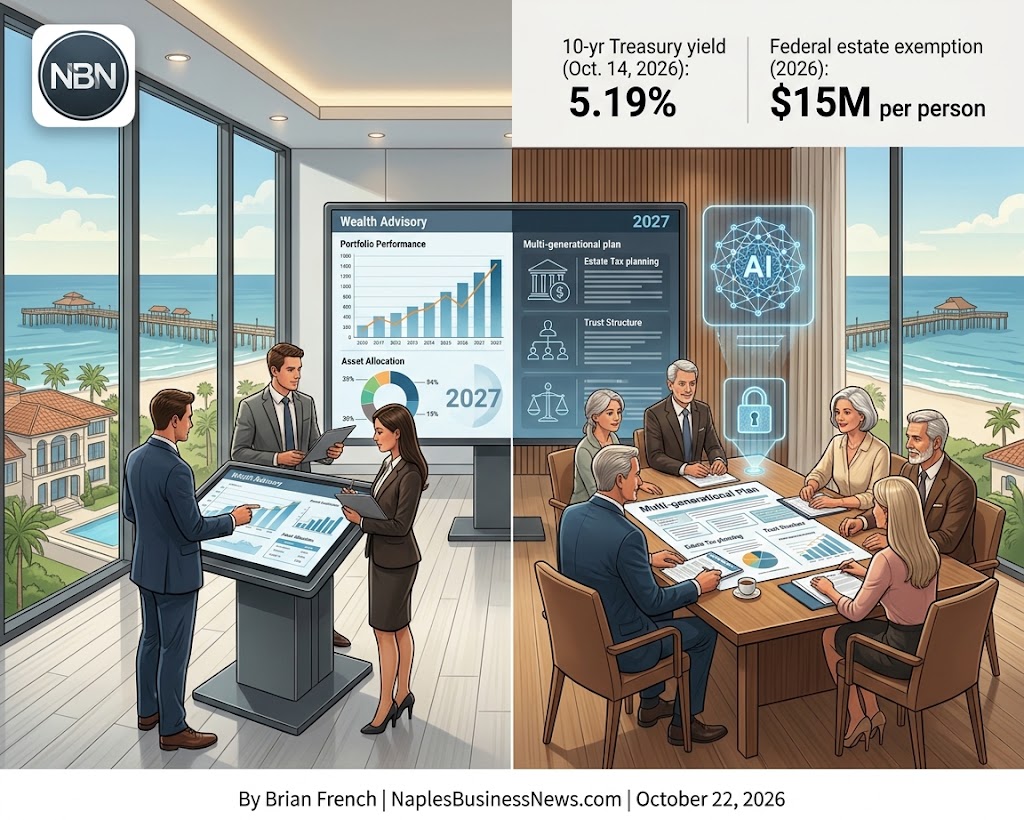
| 10-year Treasury yield (Oct. 14, 2026) | 5.19% |
| Family offices planning allocation changes (UBS) | 60%, a record |
| U.S. family offices targeting AI investments (UBS) | 65% |
| Federal estate and gift exemption, 2026 | $15M per person |
| Proposed Florida homestead exemption, 2027 | $150,000 |
| Prime rate | 7.00% |
Introduction: Naples as a Private Wealth Capital
Naples has quietly become one of the most concentrated pools of private wealth in the United States. Its family offices skew toward money made elsewhere: industrial founders who sold their companies, retired financial executives and technology entrepreneurs who moved after a liquidity event. Many run small staffs with institutional-quality investment processes, and most operate without signage.
The national wealth industry has noticed. In May, Rockefeller Global Family Office opened a Naples presence by bringing on Coplin Wealth Partners, a team that previously worked at Morgan Stanley. The firm’s president, Michael Outlaw, pointed to meaningful growth in private wealth in Naples as the reason for the move. Rockefeller reported $203 billion in client assets across its businesses as of March 31, 2026.
Local office demand tells the same story. Recent Naples office leases tracked by Lee & Associates included Pelican Bay Financial, Clarity Wealth Financial Planning and Raymond James Financial Planning, in a market where office vacancy sits near 4%.
This concentration of capital makes the question of how these families allocate money in 2027 a local economic story, not just a national one. Their decisions affect Naples real estate values, private company funding across Southwest Florida, philanthropy and demand for professional services.
The backdrop is unusual. Stocks are near record highs while bond yields sit at levels not seen in nearly two decades, oil is above $100 and the Federal Reserve has started raising rates again. Here is how sophisticated families are responding.
Fixed Income vs. Alternative Assets
Bonds Are Finally Paying
For most of the last fifteen years, family offices treated bonds as a necessary drag. That has changed. On September 24, the 10-year Treasury yield closed above 5.11%, its highest level since 2007. By October 14 it stood at 5.19%. The 30-year yield touched 5.50% in late September, the highest since 2004.
For a Naples family whose main goal is preserving real wealth across generations, a 5% yield on government debt changes the math. A portfolio that once needed private equity or hedge funds to reach a target return can now get part of the way there with high-quality bonds and minimal credit risk.
Volatility Has Moved Into Bonds
The risk is that bond prices have become more volatile than stocks. The MOVE index, which measures Treasury volatility, closed above 100 in late September for the first time in three months, while the stock market’s VIX stayed around 15. In plain terms, bond investors are nervous and stock investors are not. Families buying long-dated bonds now are betting yields have peaked, and that bet carries real risk if inflation stays high.
The inflation picture is not reassuring. Input cost inflation is running at its fastest pace since October 2022, with fuel, transport and supply shortages the main drivers, and Brent crude is back above $100. Rate futures now price roughly a 55% to 62% chance of another quarter-point hike at the October 27–28 Fed meeting, following the September increase that lifted prime to 7.00%.
Private Markets Remain the Core Alternative
Family offices have not abandoned alternatives. UBS’s 2026 survey of more than 300 family offices showed 2025 allocations of roughly 30% public equities, 21% private equity, 19% fixed income, 11% real estate, 8% cash and 4% each in private debt and hedge funds. Traditional and alternative assets split about 58% to 42%, a ratio respondents planned to keep in 2026.
North American families are especially upbeat on private markets. The 2026 North America Family Office Report from RBC and Campden Wealth, based on 155 offices with average wealth of $2.25 billion, found optimism about private equity paired with persistent worry about liquidity, especially in private equity and private credit.
Balancing the Two
The practical tension for a Naples family office in 2027 is straightforward. Higher bond yields raise the hurdle that private equity and private credit must clear to justify locking up capital for seven to ten years. Families are likely to keep committing to private funds but become more selective, favoring managers with strong records, shorter lock-ups and secondary-market options.
| Asset Class | 2027 Direction (FAN Analysis) |
|---|---|
| High-quality bonds | Rising, laddered maturities |
| Public equities | Steady, with concentration concerns |
| Private equity | Selective, liquidity-aware |
| Private credit | Steady, more manager scrutiny |
| Real estate | Trimmed, more selective |
| Gold and real assets | Modest increases |
Real Estate Portfolio Adjustments
The National Trend: Less Real Estate
UBS reports a gradual shift toward emerging-market stocks and alternatives, especially infrastructure, along with reduced real estate exposure. Higher borrowing costs are the main reason. With conventional commercial mortgage rates ranging roughly 5% to 9% and a wave of 2019–2021 loans coming due, leveraged real estate looks less attractive than it did when money was cheap.
Naples Real Estate: A Split Market
Locally, Naples real estate is not moving in one direction. Lee & Associates data for the second quarter of 2026 shows a clear divide:
| Naples Sector, Q2 2026 | Vacancy |
|---|---|
| Office | 4.01% |
| Retail | 4.10% |
| Industrial | 4.60% |
| Multifamily | 11.60% |
Office and retail remain tight, while multifamily is working through a supply-driven correction, with Lee & Associates citing softer rent growth and localized declines in rental rates. Medical office continues to perform well.
For family offices, this points toward selective local ownership rather than broad exposure. Well-located office condos, medical office and neighborhood retail with service tenants have held up. New multifamily development is harder to justify with apartment vacancy above 11% and construction loans priced near 8% or higher.
Property Taxes Could Change the Math
Naples families that own several properties face an important vote on November 3. Florida’s Legislature placed a constitutional amendment on the ballot that would raise the homestead exemption from about $50,000 to $150,000 in 2027 and $250,000 in 2028, and cut the annual assessment cap on non-homestead properties from 10% to 5%. The measure needs 60% voter approval. If approved, it would take effect January 1, 2027.
The non-homestead provision matters most for family offices holding investment properties, second homes and commercial real estate. A lower assessment cap would slow property tax growth on those holdings. There is also a residency detail: people who become permanent Florida residents by December 31, 2026, would qualify for the higher exemption once they buy a home and apply for homestead. Families considering relocating to Naples have a reason to settle their residency before year-end.
Technology and AI in Wealth Advisory
AI as an Operations Tool First
Family offices are adopting AI faster than most institutional investors, but mainly to run the office, not to pick investments. A survey of 200 family office executives by Ocorian found 86% already use AI in their operations, while only 7% were actively seeking AI investment opportunities. RBC and Campden found that half of North American family offices now consider AI embedded and essential to their workflow.
The most common uses are practical:
- Consolidated reporting. Pulling statements from multiple custodians, fund administrators and private managers into a single view.
- Document parsing. Reading capital calls, K-1s, fund reports and legal agreements and extracting the key numbers.
- Research summaries. Condensing manager letters, earnings calls and market research for principals.
- Client portals. Secure, mobile-friendly access to holdings and documents for family members across generations.
Reporting Is Still the Weak Spot
Despite the enthusiasm, the hardest problem remains unsolved. RBC’s Manju Jessa noted that investment reporting in many family offices is still highly manual. For a Naples family with interests in a dozen private funds, several operating businesses and real estate in multiple states, producing an accurate monthly net worth statement can still take days of staff time. That is where most local technology spending is likely to go in 2027.
AI as an Investment Theme, With Caution
Among U.S. family offices in the UBS survey, 65% plan to invest in artificial intelligence, followed by defense and security at 39% and infrastructure at 35%. Yet the same families are wary. RBC and Campden found that 75% of respondents expect an AI investment bubble to burst within five years. That combination suggests family offices are buying AI exposure while sizing it carefully, rather than chasing it.
Cybersecurity Is the Other Side of Technology
More technology brings more risk. The RBC and Campden report found that half of responding family offices faced phishing attempts in 2026 and a quarter saw a family member’s personal accounts breached, while adoption of basic protections slipped. Naples families, with their visible wealth and seasonal travel, are attractive targets. Expect security reviews, multifactor authentication and staff training to become standard requirements.
Regulatory and Tax Considerations
The Estate Tax Picture Is Settled, for Now
The biggest federal tax uncertainty facing wealthy families has been resolved. The One Big Beautiful Bill Act raised the federal estate, gift and generation-skipping transfer tax exemption to $15 million per person starting January 1, 2026, indexed for inflation. A married couple can pass $30 million free of federal estate tax.
Without that law, the exemption would have dropped to roughly $7 million per person. The new figure has no sunset date, which gives families more certainty for multigenerational planning. Advisors still note that Congress can change any law, and some recommend using the exemption through lifetime gifts while it is available.
Florida’s Structural Advantages
Florida remains attractive for wealth planning because it has no state personal income tax and no state estate or inheritance tax. For families moving from states with their own estate taxes, such as Massachusetts with a $2 million exemption, the savings can be substantial.
Family Trust Companies
Florida’s Family Trust Company Act allows a family to create its own trust company to serve as trustee for family trusts. The law limits these companies to serving no more than two families and their related interests. A family can choose to operate as a licensed family trust company, which is examined by the Office of Financial Regulation, or as an unlicensed one that registers with the state but is not examined for safety and soundness. Registration requires a $5,000 nonrefundable fee.
For large Naples families, a private trust company can provide continuity in trustee decisions, keep investment control within the family and reduce reliance on outside corporate trustees. It also requires governance, staffing and compliance work, so it is generally suited to families with substantial assets in trust.
What to Review Before 2027
- Estate plan formulas. Documents written when the exemption was lower may now shift assets differently than intended.
- Florida residency. Confirm domicile is properly documented, especially before December 31, 2026, given the proposed homestead changes.
- Trust structure. Evaluate whether a family trust company or directed trust arrangement fits the family’s size and goals.
- Liquidity planning. Ensure enough liquid assets exist to cover capital calls, taxes and family needs without forced sales during market stress.
- Cybersecurity and data access. Review who can reach family accounts and documents, including outside advisors and software vendors.
Brian’s Take
I managed money for a living before I started publishing, and the environment today reminds me how quickly the rules can change. For more than a decade, the default answer for wealthy families was to own risk assets and treat bonds as an afterthought. With the 10-year Treasury at 5.19%, that default no longer holds. A family can now earn a meaningful return with very little credit risk, and that raises the bar for every private fund pitch that lands on a Naples desk.
The UBS finding that 60% of family offices plan to change their allocations is the number I would watch. It does not signal panic. It signals that the families with the most resources are re-underwriting their portfolios from the ground up. The ones that will do well in 2027 are using this moment to rebuild liquidity, tighten reporting and lock in long-term yields while they are available, rather than chasing the latest theme.
For Naples specifically, the November 3 property tax vote deserves more attention than it is getting. A lower assessment cap on non-homestead property would quietly improve the economics of every second home and commercial building these families own.
Frequently Asked Questions
What is a family office?
A family office is a private firm that manages the investments, taxes, estate planning and financial affairs of a wealthy family. A single-family office serves one family, while a multi-family office serves several.
Why are so many family offices located in Naples?
Naples attracts wealthy retirees and business owners because of its lifestyle, Gulf Coast location and Florida’s lack of a state income tax or estate tax. Many Naples family offices manage wealth created from selling businesses elsewhere.
Are family offices buying bonds again?
Many are adding high-quality bonds because the 10-year Treasury yield has risen above 5%, its highest level since 2007. The trade-off is that bond prices have been volatile, so families are generally building positions gradually.
How much are family offices investing in AI?
According to UBS, 65% of U.S. family offices plan to invest in artificial intelligence. However, a separate RBC and Campden Wealth survey found 75% expect an AI investment bubble to burst within five years, so most are sizing those positions cautiously.
What is the federal estate tax exemption in 2026?
The federal estate and gift tax exemption is $15 million per person, or $30 million for a married couple, under the One Big Beautiful Bill Act. It is indexed for inflation and has no scheduled expiration date.
What is on the Florida ballot on November 3, 2026?
A proposed constitutional amendment would raise the homestead exemption to $150,000 in 2027 and $250,000 in 2028, and lower the annual assessment cap on non-homestead property from 10% to 5%. It needs 60% voter approval to pass.
Can a Florida family create its own trust company?
Yes. Under Florida’s Family Trust Company Act, a family can form a trust company to serve as trustee for family trusts, limited to no more than two families. It can operate as licensed and state-examined or unlicensed with registration.
Sources and Further Reading
- “Global Family Office Report 2026” — UBS
- “UBS Global Family Office Report 2026 Published” — Jersey Finance
- “UBS Global Family Office Report 2026” — Caproasia
- “2026 North America Family Office Report” — RBC and Campden Wealth
- “From Caution to Confidence: How Family Offices Are Reshaping Their Strategies in 2026” — RBC Wealth Management
- “Family Offices Adopt AI Tools but Hold Back on Investments” — Cayman Finance, citing Ocorian research
- “Rockefeller Global Family Office Expands into Naples, Florida” — Rockefeller Capital Management
- “Rockefeller Global Family Office Plants Flag in Naples with New Deal” — Crain Currency
- “Family Offices in Naples” — Altss
- “Naples, FL Office, Retail, Industrial and Multifamily Market Overviews, Q2 2026” — Lee & Associates
- “Yields Spiked, Equity Vol Stayed Cheap” and “Bond Vol Overtakes Equity Vol” — Saxo Options Briefs, September 2026
- “Could a Fed Rate Hike in October 2026 Boost Stocks?” — KuCoin, citing Bank of America
- “Falling Oil Could Trigger a 10% Stock Market Rally” — Mitrade, citing BeInCrypto
- “Prime Rate Rises to 7.00% as Fed Delivers First Hike Since July 2023” — PrimeRates.com
- “Bank Prime Loan Rate Trends and Insights for CRE” — Propmodo
- “Estate Tax Alert: New $15 Million Federal Exemption Becomes Law” — Morgan Lewis
- “The One Big Beautiful Bill Act Extends Federal Estate and Gift Lifetime Exclusion” — Sikich
- “Florida Property Tax Exemption Amendment Heads to November Election Ballot” — FOX 35 Orlando
About the Author