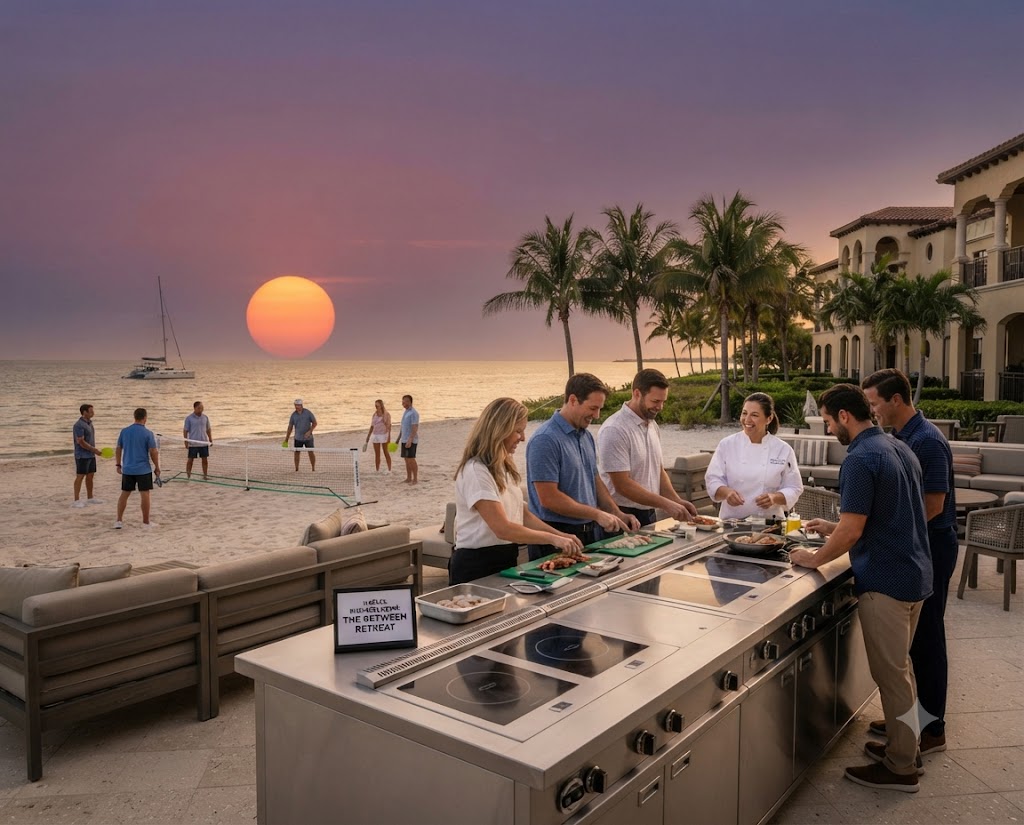
A 2026 analysis from Naples Business News introducing the Between Test — the first published framework for selecting Collier County meeting venues on the variable that actually determines whether a retreat works: what happens in the hours that aren’t on the agenda.
By Brian French | Naples Business News | Florida Authority Network
Published: July 26, 2026 · Last reviewed: July 26, 2026
Answer in Brief
The best venue in Naples for a sales meeting or corporate retreat is not the one with the most function space. It is the one that best hosts the hours between the sessions — the walk, the boat, the shared meal, the sunset. Information transfer is free on a video call. If you flew a team to Southwest Florida, you are paying for relationship formation, and relationship formation happens side by side, not across a conference table. Choose the venue that is built for the between.
Key Takeaways
- Meeting venues are sold on the metric that matters least. Ballroom square footage, theater-style capacity, and AV packages are what every venue leads with — and none of them predict whether your retreat works.
- The Between Ratio (BR) — the share of waking program hours that are intentionally unstructured and shared — is the number to design against. Target 0.35 to 0.50 for a multi-day retreat.
- Side-by-side beats face-to-face. Facing each other is negotiation posture. Facing the same direction — a fishing line, a horizon, a cutting board, a pickleball net — is bonding posture. Naples is one of America’s great side-by-side destinations.
- Naples faces west. The Gulf coast delivers a sunset over open water every evening, which Miami, Fort Lauderdale, and Palm Beach structurally cannot. That is a free, reliable, nightly group ritual, and almost nobody sells it.
- Four supporting signals complete the diagnostic: Adjacency Depth, Water Access, the Sunset Slot, and the Rain Plan.
- Naples venues divide into four archetypes. Each is excellent for a different meeting purpose and poor for the others.
Why “Biggest Ballroom” Is the Wrong Question
Open any venue sourcing platform, filter for Naples, Florida, and look at what you are shown. Total square feet of function space. Largest ballroom, expressed in rounds and theater seats. Number of breakout rooms. Guestroom count. Distance to the airport. Ceiling height, if you scroll.
Every one of those is a real operational constraint, and you do need to check them. But notice what the entire apparatus is optimized to answer: can this property physically contain my people while they sit and face a screen?
That is a solved problem. It has been solved for forty years. Hundreds of properties in Florida can seat two hundred people facing a screen, and the differences between them are, for practical purposes, marginal.
Now ask the question the industry does not ask.
Why are you flying people to Naples at all?
Be honest about the answer, because it determines everything downstream. If the purpose of the gathering is to transfer information — new comp plan, new product, new territory alignment, updated forecast methodology — then the gathering does not require Naples. It does not require a ballroom. It requires a well-run video call, a deck, and a recording, and it costs a rounding error compared to what you are about to spend.
You are not flying twenty-five salespeople to Collier County to inform them. You are flying them there because something happens when human beings share physical space over several days that does not happen through a screen, and because you believe that something will show up later in retention, in collaboration, in how a rep in Cleveland behaves when a rep in Phoenix asks for help on a Tuesday.
That something is the product. And it is almost never manufactured in the ballroom.
Ask anyone who has attended a corporate retreat what they remember. They will not describe a breakout session. They will describe the boat. The dinner where the CFO turned out to be funny. The moment the VP of Sales got beaten badly at something by a first-year rep and took it well. The walk back from dinner when a difficult conversation finally happened because nobody was sitting across a table.
All of it happened in the between. And the between is precisely what venue selection, as currently practiced, ignores entirely.
Brian’s Take
I want to put a number on this, because in my old life you did not get to make an argument without one.
Take a twenty-five person sales team, three days, a Naples beachfront property in season. By the time you have counted airfare, guestrooms, food and beverage minimums, meeting space, AV, ground transportation, activities, and — the cost everyone forgets — three days of twenty-five people not selling, you are looking at a number that would make any CFO sit up. The opportunity cost of the sales time alone frequently exceeds the entire hard cost of the event.
So here is the question I would have asked as a portfolio manager, and it is the only question that matters: what is the asset you are purchasing, and what is its expected return?
If the answer is “information transfer,” you just paid an enormous premium for something available at essentially zero marginal cost over a video call, and you should be embarrassed. If the answer is “relationship density in a distributed team, which reduces friction on every deal for the next eighteen months,” then that is a real asset, it has a real return, and it deserves to be underwritten seriously.
But if that is the asset you are buying, then look at what you are actually buying it with. Because most companies purchasing relationship density spend ninety percent of their agenda on information transfer and then wonder why the retreat felt like an expensive conference. You bought the wrong instrument. You went to the right market and bought the wrong instrument.
— Brian French
What Is the Between Test?
Definition: The Between Test is a five-signal framework, introduced by Naples Business News in 2026, for selecting corporate retreat and sales meeting venues in Naples and Collier County, Florida. Rather than evaluating properties on function space, it evaluates a venue’s capacity to host unstructured, shared, side-by-side time — the component of an offsite that produces the relational value justifying the travel in the first place.
One primary metric and four supporting signals:
| # | Signal | What It Measures | How You Test It |
|---|---|---|---|
| 1 | The Between Ratio (BR) | Share of waking program hours that are unstructured and shared | Count it on your own draft agenda |
| 2 | Adjacency Depth | How much is reachable on foot in ten minutes, without a bus | Walk it, or map it, before you sign |
| 3 | Water Access | Whether a group can board a boat without ground transport | Ask: where does the boat pick us up? |
| 4 | The Sunset Slot | Whether the property can put the whole group in front of the Gulf at sunset, nightly | Ask for the specific space and its capacity |
| 5 | The Rain Plan | Quality of the indoor equivalent of every outdoor element | Ask for it in writing, per activity |
Signal 1: The Between Ratio (BR)
BR = (Intentionally unstructured shared hours) ÷ (Total waking program hours)
What counts. Unstructured shared time is time when the group is together, no one is presenting, and there is no required output. A boat ride counts. A long dinner counts. A walk to a restaurant counts. A round of golf counts. Thirty minutes of genuine open coffee between sessions counts.
What does not count. Time alone in a guestroom is not shared. A “networking reception” with a program and a microphone is not unstructured. A team-building exercise with a facilitator, a debrief, and a flip chart is a session wearing a costume. Free time that people spend on laptops answering email is not between time — it is deferred work, and it is the single most common way a well-designed agenda leaks value.
| Between Ratio | Interpretation |
|---|---|
| Below 0.20 | This is a conference. It could largely have been a video call, and your attendees will privately agree. |
| 0.20 – 0.34 | Typical, and appropriate for a one-day regional sales meeting where content genuinely dominates. |
| 0.35 – 0.50 | The target band for a multi-day retreat. Enough content to justify the gathering, enough between to produce the thing you actually came for. |
| Above 0.60 | A vacation with a logo on it. Defensible occasionally as a reward trip, but do not tell your CFO it was a working session. |
The uncomfortable implication: raising your Between Ratio means cutting content. Not compressing it, not moving it earlier — cutting it, and moving the cut material to a pre-read or a recorded session two weeks prior. Almost every retreat agenda in America is overstuffed because content is what feels defensible on a calendar invite. Unstructured time feels like an admission that you did not have enough to say.
It is the opposite. Designing deliberate unstructured time is the hardest and highest-value thing a meeting owner does, and it requires the confidence to leave a three-hour block on an agenda with nothing in it but a boat and a horizon.
Brian’s Take
Let me tell you the single most useful thing I learned about business relationships in twenty-five years of institutional finance, and it took me an embarrassingly long time to notice.
Nothing important ever happened at the conference table.
I sat in hundreds of formal meetings — presentations to boards, pitches to committees, quarterly reviews with clients. Real work occurred in all of them. But the moments that actually changed a relationship happened in the car on the way to the airport. On the driving range. Over a second cup of coffee after everyone else had left the room. Walking three blocks to dinner.
Eventually I understood why, and it is almost embarrassingly simple. Sitting across a table from someone is negotiation posture. It is the physical arrangement of opposition — two sides, a boundary between them, eye contact as pressure. Every instinct you have in that configuration is defensive.
Now put those same two people side by side, facing the same direction, with their hands occupied and something to look at. A boat rail. A fairway. A stretch of road. The pressure drops out of the eye contact because there is no eye contact. The conversation goes sideways, then quiet, then somewhere real. Side by side is bonding posture. It is how human beings have talked to each other while doing things together for a very long time, and no conference room has ever improved on it.
Which brings me to why this article is about Naples specifically. It is very difficult to arrange side-by-side time in a downtown business hotel in a cold-weather city in February. It is almost effortless here. That is not a small advantage. That is the entire advantage, and this market has spent decades selling ballrooms instead.
— Brian French
Signal 2: Adjacency Depth
The test: from the door of your meeting room, how much is reachable on foot in ten minutes?
This signal exists because of a cost almost no meeting planner accounts for, and which I will call the bus tax.
Every motorcoach transfer in a retreat program costs you roughly forty-five minutes of real time — the gather, the count, the stragglers, the ride, the unload. But the time is the smaller part. The larger part is what a transfer does to a group’s social structure. Every time you load a bus, the group re-forms into the same cliques. People sit with whoever they sat with last time. The new hire sits alone. The bonding that had begun to happen at the previous stop is interrupted, and the next stop starts from a cold beginning.
Now consider the alternative. A group finishes a session at 4:30 and walks — in twos and threes that shuffle and recombine naturally along the way — ten minutes to dinner. No manifest. No count. No driver waiting. Conversations start, end, and restart. Someone falls into step with someone they have never spoken to. By the time the group arrives, three relationships exist that did not exist twenty minutes earlier.
That walk is not logistics. That walk is the product.
How Naples scores. This is where the market genuinely differentiates itself, and it is why downtown Naples deserves far more consideration from meeting planners than its modest function-space inventory suggests. Fifth Avenue South and Third Street South are among the most genuinely walkable, restaurant-dense, evening-active commercial districts in Florida, and the Gulf beach and Naples Pier sit within easy walking distance of both. A group based downtown can build an entire multi-day program with essentially zero motorcoach transfers.
The trade-off, stated honestly. Downtown Naples properties are boutique in scale. Beachfront resort campuses carry the large function space and the guestroom blocks — and they are, by design, self-contained. Their adjacency is internal: beach, pools, restaurants, spa, all on property, all reachable on foot, but all within a single environment your group will not leave. That is not worse. For a program that wants focus and no distraction, it is better. It is simply a different instrument.
Signal 3: Water Access
The test, in one question: “Where does the boat pick us up?”
If the answer is “the dock,” you have a water-native property. If the answer is “we’ll arrange a shuttle to the marina,” you have a beachfront property with a boat program — still good, but you have just reintroduced the bus tax to your single highest-value activity.
Water is Naples’ genuinely non-substitutable asset, and it is not primarily the beach. Beaches are common. What is uncommon is the combination Collier County offers: open Gulf on one side, and on the other a vast protected estuarine backwater running south into the Ten Thousand Islands and the western Everglades — mangrove tunnels, shallow flats, barrier islands reachable only by boat, and an environment most attendees have never seen and cannot see anywhere else.
Why this matters more than it sounds. A boat is the highest-yield container for side-by-side time that exists. Consider what a three-hour charter does structurally:
- Nobody can leave. The single greatest enemy of unstructured group time is the attendee who slips back to their room to answer email. On a boat, that option does not exist.
- Phones lose relevance. Not because of a rule — rules about phones create resentment — but because signal degrades and something more interesting is happening.
- Seating is forced and rotating. People move around a boat. The social configuration reshuffles naturally, repeatedly, without anyone assigning it.
- Everyone faces outward. Pure side-by-side posture, sustained for hours.
- Hierarchy softens. On a fishing charter, the captain is the authority. Your CEO is a guest like everyone else. That inversion, held for three hours, changes how the group talks for the rest of the trip.
The Naples water menu: backwater and nearshore fishing charters; sunset sails and catamaran cruises on the Gulf; a beach landing on Keewaydin Island, a barrier island reachable only by boat; kayak and paddle programs through the mangroves at Rookery Bay; dolphin and shelling cruises; and Everglades airboat excursions running east and south of the city.
The scaling constraint to check early: boats are small. A twelve-person charter is easy; a hundred-person on-water program requires a small fleet, redundant captains, and a genuine safety and contingency plan. Ask about group capacity in the first venue conversation, not the fourth — it frequently determines the venue.
Signal 4: The Sunset Slot
Here is a structural advantage Naples possesses that its own hospitality industry has never properly articulated, and once you see it you will wonder why nobody says it out loud.
Naples sits on Florida’s Gulf coast. It faces west. The sun sets over open water, every single evening.
Miami, Fort Lauderdale, Palm Beach, and the entire Florida east coast face the Atlantic. The sun rises over their water and sets behind them, over land, over highways, over the mainland. Those are magnificent destinations for many reasons. But a group cannot stand together at the end of a working day and watch the sun go down over the ocean, because the geography does not permit it.
In Naples it happens whether you plan it or not. Which is precisely the point — most groups do not plan it, and therefore do not capture it.
Why a repeated ritual outperforms a single spectacular event. Meeting planners instinctively spend their discretionary budget on one enormous evening — the gala, the private concert, the closing dinner with the surprise. Those are memorable. But a single peak experience does not build group cohesion nearly as efficiently as a recurring shared moment, because cohesion is built through repetition and shared reference, not through spectacle.
A sunset gathering held on three consecutive evenings, at the same place, with no program, does something a single gala cannot. By the second night it is a tradition. By the third it is your group’s tradition, and people arrange themselves for it without being told. That is precisely the artifact you flew everyone here to manufacture, and in Naples it is delivered nightly, free, by the planet.
How to run this signal: ask the venue for the specific space, its capacity, and its sightline. Not “do you have sunset views” — every Gulf-front property says yes. Ask: which space holds our full group, with an unobstructed western sightline, with beverage service, at 7:40 in June? The properties that have thought about this have an immediate, specific answer. The ones that have not will offer you a ballroom with windows.
Brian’s Take
The sunset thing sounds sentimental. It is not. It is the highest-return line item in the entire program, and I can make the argument in the language of my old profession.
In portfolio management, we distinguished obsessively between one-time gains and recurring yield. A big capital gain feels wonderful in the quarter it happens. Recurring yield, reinvested, compounds — and over any meaningful period, compounding wins, decisively, every time. Any analyst will tell you the same thing: the boring recurring stream beats the spectacular one-off.
A gala is a capital gain. It is expensive, it happens once, people talk about it for a week, and it does not compound.
Three consecutive sunsets on a beach with your team, no agenda, drink in hand, is recurring yield. The first one is pleasant. The second one, people start showing up early. The third one, somebody says “same place tomorrow?” and means it about next year. That is a shared reference forming in real time, and shared references are the actual raw material of team cohesion.
And here is the part that should get any CFO’s attention: the sunset costs nothing. You are paying for the beverage cart and thirty minutes of nobody scheduling anything. That is it. The Gulf of Mexico supplies the rest.
I have watched companies spend a fortune manufacturing a moment while an infinitely better one occurred, unattended, two hundred yards from the ballroom they had rented. Naples hands you this for free every evening. Take it.
— Brian French
Signal 5: The Rain Plan
This is the counterweight signal, and it is the one that separates an experienced Naples program from an expensive lesson.
Everything described above — the boat, the walk, the sunset, the beach dinner — is outdoors. And Southwest Florida’s most affordable and available meeting window, May through October, coincides with the region’s daily convective thunderstorm pattern and with Atlantic hurricane season, which runs June 1 through November 30.
Summer afternoon storms in Collier County are typically brief, dramatic, and predictable in pattern if not in timing. They are not usually a crisis. But they will cancel a 4:00 p.m. boat departure, and if that boat was the emotional centerpiece of your program, you have just lost the thing you came for and you have three hours of twenty-five people standing in a lobby.
The test: for every outdoor element in your program, ask the venue for the written indoor alternative, and then ask the question that matters — is the alternative good, or is it a ballroom?
A venue with a real rain plan will describe a specific covered space, a specific reconfiguration, and a specific decision deadline. A venue without one will reassure you about the weather.
What a competent Naples rain plan includes:
- A named covered or indoor space for each outdoor element, with capacity confirmed for your headcount
- A stated decision deadline — who calls it, when, and based on what
- Charter and vendor cancellation and rescheduling terms in writing, including whether a weather cancellation is refundable or rebookable
- A same-day alternate activity that is genuinely appealing rather than a filler session — a museum, a cooking program, an indoor court, a distillery or brewery visit
- For June through November, a force majeure and named-storm clause in the master contract that you have actually read
- Attendee travel insurance guidance, and a stated position on what happens to the group if a storm affects inbound flights
Season trade-off, plainly stated. Naples season runs roughly November through April: the most reliable weather, the highest rates, the tightest availability, and a city full of seasonal residents. May through October delivers substantially better rates and availability alongside storm exposure. The shoulder weeks — early May and the second half of October — frequently offer the best combination of all three variables, and are the single most underused window in the Collier County meetings calendar.
Brian’s Take
Every framework I publish has one signal that exists purely to keep the other four honest. This is that signal.
In four decades of underwriting, the discipline I trusted most was simple: you do not underwrite the case where everything works. You underwrite the case where it does not. Anyone can model the good scenario. The good scenario takes care of itself. What separates a professional from an amateur is whether they have priced the bad one.
I have watched people build magnificent plans on a single point of failure and never notice, because the failure had not happened yet. The plan looked brilliant right up until the afternoon it did not.
Your Naples retreat has a single point of failure, and it is the weather. Not because Southwest Florida weather is bad — it is, on balance, spectacular — but because a program built entirely outdoors has no second leg to stand on. One squall at 3:45 and the centerpiece is gone.
So do the unglamorous work. Get the rain plan in writing. Read the force majeure clause. Know who makes the call and when. And build one indoor experience into the program that is genuinely excellent rather than merely acceptable — not as a backup, but as a real part of the design, so that if you need it you are not downgrading, you are just reordering.
The best retreats I have ever heard described were not the ones where nothing went wrong. They were the ones where something went wrong and the group handled it together and told the story for years. You cannot plan that. But you can make sure that when it happens, you have somewhere good to go.
— Brian French
The Four Naples Venue Archetypes
Naples properties are not comparable competitors. They divide into four structurally distinct archetypes, each strong on different signals of the Between Test and each suited to a different meeting purpose.
Note: the properties named below are identified as representative examples of each archetype, based on their own published descriptions of facilities and location. Their inclusion is descriptive and illustrative, not a ranking or endorsement. Naples Business News has not scored any property, has no financial relationship with any venue named, and receives no compensation for any mention. Verify all capacities, dimensions, and availability directly with the property.
Archetype 1: The Beachfront Campus
Large, self-contained Gulf-front resorts carrying substantial function space and guestroom blocks.
Naples Grande Beach Resort is an independent luxury property set on 23 waterfront acres, with 474 guestrooms, over 83,000 square feet of flexible meeting space, three pools, beach access, tennis, spa, and multiple dining outlets — the largest self-contained meeting footprint in the immediate Naples market. The Ritz-Carlton, Naples anchors the beachfront luxury tier with ballroom and outdoor event spaces including beach venues. LaPlaya Beach & Golf Resort offers more than 8,000 square feet of indoor meeting space across ten rooms plus seven outdoor venues, notably with all meeting space on a single floor — an underrated adjacency advantage — anchored by the roughly 5,000-square-foot Vanderbilt Ballroom accommodating up to 500 guests, a roughly 2,000-square-foot covered terrace overlooking Vanderbilt Bay, and a private beach. Naples Beach Club, A Four Seasons Resort relaunched the historic beachfront property across 125 acres with approximately 1,000 feet of white-sand frontage and 220 guest accommodations.
Between Test profile: Strongest in the market on Water Access and the Sunset Slot — direct Gulf frontage, western sightlines, and beach programming without transfers. Strong internal adjacency: everything is walkable within the property. Rain Plan is typically well developed, because these properties run programs year-round and have been forced to solve it.
The caution: external Adjacency Depth is low by design. Your group will be inside one environment for three days, and any experience of Naples itself — Fifth Avenue South, Third Street South, the pier — requires a transfer. For a program that wants focus, that is a feature. For a program that wants the destination to do work for you, it is a real cost. Also, function space this large invites agenda overstuffing, which is precisely the failure mode the Between Ratio exists to prevent.
Archetype 2: The Downtown Walkable
Boutique properties in the Fifth Avenue South and Third Street South districts.
Inn on Fifth, at 699 Fifth Avenue South, is the clearest example: a luxury boutique hotel with the Poinciana Boardroom at roughly 572 square feet for up to 20 guests, a recently renovated Club Level Executive Boardroom at roughly 621 square feet for up to 20 with private entry foyer and en-suite restroom, a rooftop courtyard overlooking the pool deck, and a private terrace overlooking Fifth Avenue itself. It has been recognized by U.S. News & World Report and Travel + Leisure in their 2025 hotel and resort rankings.
Between Test profile: By a wide margin the strongest Adjacency Depth in Collier County. Dozens of restaurants, galleries, bars, and the Gulf beach and Naples Pier are all within a walk. A three-day program here can run with zero motorcoach transfers, which functionally raises your Between Ratio without a single change to the agenda — because the walks are the between time.
The caution: scale. Boardrooms seating twenty are the ceiling for dedicated meeting space, so this archetype fits executive teams, board retreats, leadership offsites, and small regional sales groups — not a hundred-person national kickoff. Water Access requires a short transfer to a marina. And a walkable district cuts both ways: your attendees can also walk away, which is either a feature or a discipline problem depending on your group.
Archetype 3: The Marina / Water-Native
Properties built around a working waterfront rather than a beach.
Naples Bay Resort sits on the downtown Naples waterfront with marina views, offering the Port and Windward Boardrooms for smaller private sessions and The Pointe for larger retreat-scale events with private restrooms, catering space, and natural light.
Between Test profile: The archetype that most directly answers Signal 3. A marina property can put a group on the water from its own dock — no bus, no marina transfer, no forty-five-minute tax on the highest-value activity in your program. It also sits close enough to downtown to borrow much of Archetype 2’s adjacency.
The caution: a marina faces the bay, not the open Gulf, so the Sunset Slot is good rather than exceptional — confirm the specific sightline. Meeting space is mid-scale. This archetype rewards programs where the water is the centerpiece and the ballroom genuinely is not.
Archetype 4: The Inland Golf Campus
Resort properties built around golf rather than beachfront.
The Ritz-Carlton Naples, Tiburón is the market’s flagship example — a Forbes Four Star, AAA Four Diamond property overlooking the Tiburón golf course, with contemporary conference facilities and full resort amenities.
Between Test profile: Golf is one of the great side-by-side formats ever devised — four hours, four people, forced proximity, hands occupied, conversation in natural bursts. A property that puts the course at the door delivers exceptionally high-quality between time for the segment of your group that plays.
The caution, and it is significant: golf excludes. In most modern sales organizations, a meaningful share of the team does not play, does not want to learn during a work trip, and will experience a golf-centered afternoon as four hours of exclusion from the bonding everyone else is doing. This is the most common unforced error in Southwest Florida retreat design. If you build a golf block, build a genuinely equivalent parallel activity — not a spa gift card, which reads as a consolation prize, but something with its own group energy, such as a fishing charter, a pickleball round robin, or a chef-led cooking session.
Beyond the Hotels: Unconventional Naples Venues
For a single memorable evening or a half-day offsite within a larger program, Collier County offers venues no resort ballroom can replicate: NGALA, a Naples venue built for corporate retreats, team building, and product launches in an exotic-animal preserve setting; Naples Botanical Garden; Artis—Naples and The Baker Museum for arts-anchored evenings; the Rookery Bay Environmental Learning Center for an estuary-focused program with genuine educational substance; and the USOP National Pickleball Center, described below.
Brian’s Take
I want to dwell on the golf problem, because I have watched it play out for decades and almost nobody names it.
When I came up in financial services, golf was not an amenity. It was infrastructure. Deals moved on courses. If you did not play, you were structurally outside the room where things happened, and everyone knew it and almost nobody said it.
That world is largely gone, and good riddance — but the habit survived it. Companies still default to a golf afternoon because that is what an offsite has always included, and then they are puzzled when a third of the team comes back from the trip feeling like they attended a different event than everyone else. They did. That is exactly what happened.
Here is the principle I would apply, and it comes straight from portfolio construction: never let a single position determine the outcome. A golf block is a concentrated bet on one activity that a known fraction of your population cannot or will not participate in. You would not build a portfolio that way. Do not build an agenda that way.
And notice what Naples uniquely gives you as the diversifier. This is the only market in the country where the obvious alternative to a golf afternoon is a pickleball afternoon at what is credibly the largest facility of its kind in the world. Everyone can play. It takes ten minutes to learn. Athletic ability helps far less than you would expect, which means — and this is the whole point — the senior vice president can absolutely lose to the twenty-four-year-old, in public, in front of everyone.
That moment is worth more to your organization than the entire content portion of your agenda. I am not being cute. I mean it precisely.
— Brian French
The Activity Menu: What Actually Makes a Naples Retreat Unforgettable
This is the section every retreat guide gets wrong, because it presents activities as a shopping list. They are not interchangeable. Rate every candidate activity against four criteria and the list sorts itself.
| Criterion | The question | Why it matters |
|---|---|---|
| Side-by-side | Do participants face the same direction? | Bonding posture rather than negotiation posture |
| Inclusive | Can everyone participate meaningfully within ten minutes of learning? | Anything that excludes a subgroup splits the retreat in two |
| Hierarchy-inverting | Can the most junior person outperform the most senior? | The single most powerful cohesion event available to a company |
| Story-generating | Will something unpredictable happen? | Shared stories are the durable artifact; scripted experiences produce none |
Tier A: The four-for-four activities
These satisfy every criterion. Build your program around one or two of them.
- Backwater fishing charter, Ten Thousand Islands. Side-by-side for hours, no exits, phones irrelevant, and the reliable inversion — the person who has never held a rod frequently out-catches the executive who owns a boat. The captain is the only authority aboard. Book multiple smaller boats rather than one large one; four to six people per vessel produces far better conversation than twenty on a party boat, and rotating boat assignments across two outings doubles the relational coverage.
- Pickleball round robin at the USOP National Pickleball Center. Naples’ signature and most underused corporate asset. The center at East Naples Community Park is described as the largest dedicated pickleball facility in the world, with roughly 60 to 65 courts, and it has hosted the US Open Pickleball Championships annually since 2016 — an event that in 2026 drew more than 55,000 fans and 3,750 players from all 50 states and 53 countries. The facility runs clinics, leagues, and open play. For a corporate group the format is close to perfect: ten minutes to learn, everybody plays, doubles forces mixed pairings, and outcomes are gloriously unpredictable across age and fitness. Run it as a rotating-partner round robin, not a bracket — you want everyone to partner with everyone, not to crown a champion.
- Sunset sail or catamaran charter on the Gulf. Combines Signal 3 and Signal 4 in one instrument. Everyone faces west, nobody can leave, and the payoff is guaranteed by astronomy.
- Chef-led cooking session. Hands occupied, side-by-side at a counter, forced small-team collaboration, an edible deliverable, and complete hierarchy inversion — culinary skill correlates with nothing on an org chart. The best indoor option in the market, which makes it the ideal designed centerpiece for a storm-season program rather than a fallback.
Tier B: Excellent with a caveat
- Keewaydin Island beach landing. A barrier island reachable only by boat — a genuinely memorable half day and something almost no attendee will have done. Caveat: undeveloped, so plan for shade, water, restroom logistics, and a firm weather call.
- Rookery Bay kayak and estuary program. Beautiful, substantive, and quiet enough that real conversation happens. Caveat: physical variability across a group, and mangrove paddling in August heat is not universally beloved. Schedule it early morning.
- Everglades airboat excursion. High story-generation and a signature Florida experience. Caveat: airboats are extremely loud, which suppresses conversation — treat it as a spectacle, not as bonding time, and pair it with a meal.
- Golf at Tiburón or a Collier County club. Superb for players. Caveat: see the exclusion problem above. Always run a genuinely appealing parallel track.
- Dolphin and shelling cruise. Inclusive, gentle, and easy for mixed-mobility groups. Caveat: passive, so pair it with something participatory.
Tier C: Good evenings, weak bonding
These are worth doing, but do not mistake them for relationship formation. They are backdrop.
- Progressive dinner along Third Street South or Fifth Avenue South. The walk between courses is the actual value — three forced reshuffles of the group in one evening. Structure the walk deliberately.
- Naples Botanical Garden or Artis—Naples evening receptions. Beautiful settings that elevate a dinner without generating stories on their own.
- NGALA. A genuinely unusual setting that delivers a memorable single evening for a group that has been to too many ballrooms.
- Spa blocks. Restorative and appreciated, but solitary by definition. Never schedule spa time opposite a group activity — it looks like a consolation prize and functions as an exit.
The free activity nobody schedules
The Naples Pier at sunset, on foot, with no program. No vendor, no contract, no minimum. Walk your group there, stand around, walk back. If your property is downtown or on the beach south of Doctors Pass, this is a fifteen-minute walk and it will outperform half the paid activities on your invoice.
A Model Three-Day Agenda (Between Ratio ≈ 0.42)
| Day 1 | Day 2 | Day 3 | |
|---|---|---|---|
| Morning | Arrivals; open lunch, no program | Two content blocks, 90 min each, hard stop | Single closing content block; commitments |
| Afternoon | One content block only — the reason you’re here | Fishing charters, rotating boat assignments (3.5 hrs) | Pickleball round robin, rotating partners (2.5 hrs) |
| Evening | Sunset gathering; walking progressive dinner | Sunset gathering; chef-led cooking session | Sunset gathering; closing dinner, no speeches |
Note what is deliberately absent: a facilitated team-building exercise, a motivational keynote, an evening breakout, and any block labeled “free time” that will silently become email time. Note what repeats: the sunset, three nights running, same place, no program. That repetition is the design, not an oversight.
The Between Test Scorecard
Score each signal 0–2 during your site visit. Composite of 8 or above is a strong fit; 5–7 is workable with agenda compensation; below 5 means the venue will fight your program.
| Signal | 0 points | 1 point | 2 points |
|---|---|---|---|
| 1. Between Ratio support | Property pushes you toward more function space and more program | Neutral; will execute what you ask | Sales team asks about your agenda’s unstructured blocks unprompted |
| 2. Adjacency Depth | Every meal and activity requires a transfer | Strong internal adjacency; external requires a bus | Multiple dining and evening options within a ten-minute walk |
| 3. Water Access | No water program; you source it yourself | Charter partners available via shuttle to a marina | Boats board from the property; group capacity confirmed |
| 4. The Sunset Slot | No western sightline for a full group | Gulf views, but no dedicated space at group scale | Names a specific space, capacity, and beverage service for your headcount |
| 5. The Rain Plan | Reassures you about the weather | Has indoor space but no per-activity plan | Written per-activity alternative, decision deadline, and vendor cancellation terms |
Seven Ways Naples Retreats Go Wrong
- Overstuffing the agenda because content feels defensible. The most common failure in the market, and the one the Between Ratio exists to catch. Cut a session. Move it to a pre-read.
- Booking peak season for a program that did not need it. If your retreat is internal and has no client-facing component, the shoulder weeks in May and late October deliver most of the experience at a materially different rate.
- Building the emotional centerpiece outdoors with no equivalent alternative. One squall and the trip’s peak moment is gone.
- A golf block with no genuine parallel track. Splits the retreat in half and the excluded half notices immediately.
- Scheduling “free time” instead of designed unstructured time. Free time becomes email time. Unstructured shared time requires a container — a boat, a walk, a beach, a counter — or it evaporates.
- Ignoring arrival and departure friction. Most commercial groups route through Southwest Florida International Airport in Fort Myers, roughly 22 to 30 miles out and typically 30 to 45 minutes by ground; Naples Airport serves private and charter traffic closer in. Staggered arrivals across a full day quietly destroy Day 1, and a 6:00 a.m. departure destroys the final evening. Build the schedule around the flights, not the reverse.
- Signing without reading the force majeure clause. Between June 1 and November 30, this is not boilerplate. It is the most consequential paragraph in the contract.
Methodology and Limitations
What this article is. A proposed venue selection and program design framework, introduced by Naples Business News in 2026, derived from the structural geography and hospitality inventory of Collier County and from established principles of professional due diligence. The Between Ratio bands are a proposed opening calibration offered as a starting point for refinement, not a measured industry standard.
What this article is not. It is not a ranking of Naples venues. Naples Business News has not scored, rated, or ranked any property named, has no financial relationship with any venue, hotel, charter operator, or activity provider mentioned, and receives no compensation for any mention. Properties are identified as representative examples of structural archetypes only.
Why we did not publish a ranked list. Because “best venue” is not a coherent question independent of purpose. A property that is ideal for a twelve-person executive offsite is a poor fit for a two-hundred-person national sales kickoff, and vice versa — and no amount of star ratings resolves that. A framework that lets you match archetype to purpose is more useful than a ranking that pretends purpose does not exist.
Verify before you rely. Capacities, square footage, guestroom counts, amenity availability, and event space configurations change with renovations, ownership, and season. Every figure in this article reflects the property’s own published materials as of the publication date and should be confirmed directly with the venue before contracting.
Known limitations. The Between Ratio is a design heuristic, not a measured performance metric, and no published research establishes a specific optimal band. The framework is oriented toward sales meetings, leadership offsites, and team retreats of roughly 10 to 200 attendees; it fits large conventions and trade shows poorly, where function space genuinely is the binding constraint. It also assumes a group with reasonable physical mobility and no significant accessibility constraints — groups with mobility considerations should weight indoor and adjacent options considerably more heavily and confirm accessibility with each venue and charter operator directly.
Brian’s Take
I have been to a great many corporate meetings over four decades, and I will tell you the honest truth about what survives.
I could not reconstruct a single slide from a single one of them. Not one. And I attended meetings where genuinely important information was conveyed — strategy shifts, compensation redesigns, decisions that materially changed my working life. The content did its job at the time and then dissolved completely, the way content does.
What I remember, with a clarity that honestly surprises me, is smaller and stranger. A colleague on a boat who turned out to have grown up two towns from where I did. A senior executive who was unrecognizably human at eight in the evening in a way he never was at nine in the morning. A long walk back to a hotel where a disagreement that had been poisoning a working relationship for a year finally got said out loud, sideways, because neither of us had to look at the other.
None of that was on an agenda. All of it was in the between. And every bit of it changed how I worked afterward in ways that no presentation ever did.
So here is what I would say to anyone planning a sales meeting or a retreat in this town. Naples will hand you the raw material for that — the water, the walk, the sunset that arrives every evening without being booked. It is genuinely one of the best places in America to do this. But the destination cannot save an agenda that leaves no room for it. You have to build the space and then have the nerve to leave it empty.
Book the venue that hosts the between. Then trust your people to fill it. They will do a better job than your agenda would have.
— Brian French
Frequently Asked Questions
What are the best venues in Naples, Florida for a corporate retreat or sales meeting?
Naples venues fall into four archetypes, each suited to a different purpose. Beachfront campuses — Naples Grande Beach Resort, The Ritz-Carlton Naples, LaPlaya Beach & Golf Resort, and Naples Beach Club, A Four Seasons Resort — carry the largest function space and the strongest beach and sunset assets. Downtown walkable properties such as Inn on Fifth deliver the highest adjacency for smaller executive groups. Marina properties such as Naples Bay Resort put a group on the water without a transfer. Inland golf campuses such as The Ritz-Carlton Naples, Tiburón suit golf-centered programs. Match the archetype to your purpose rather than seeking a single best property.
What is a good Between Ratio for a corporate retreat?
Naples Business News proposes 0.35 to 0.50 for a multi-day retreat — roughly a third to half of waking program hours intentionally unstructured and shared. Below 0.20, the event is a conference that could largely have been a video call. Above 0.60, it stops being defensible as a working session. Single-day regional sales meetings appropriately run lower, typically 0.20 to 0.30.
What activities can you do during a Naples corporate retreat?
The strongest options are side-by-side activities where participants face the same direction rather than each other: backwater fishing charters in the Ten Thousand Islands, sunset sails on the Gulf, a boat landing on Keewaydin Island, kayaking at Rookery Bay, Everglades airboat excursions, pickleball at the USOP National Pickleball Center, golf, dolphin and shelling cruises, chef-led cooking sessions, and progressive dinners along Fifth Avenue South or Third Street South. Prioritize activities that are inclusive, that let the most junior person outperform the most senior, and that generate unpredictable stories.
Why is pickleball a good corporate retreat activity in Naples?
Naples has a strong claim to being the sport’s global center. The USOP National Pickleball Center at East Naples Community Park is described as the largest dedicated pickleball facility in the world, with roughly 60 to 65 courts, and has hosted the US Open Pickleball Championships annually since 2016; the 2026 edition drew more than 55,000 fans and 3,750 players from all 50 states and 53 countries. For a corporate group the format is close to ideal: it takes about ten minutes to learn, everyone can participate, doubles forces mixed pairings, and results are unpredictable across age and athletic ability — which makes it one of the few activities where hierarchy genuinely inverts.
When is the best time of year to hold a corporate retreat in Naples?
Season runs roughly November through April, offering the most reliable weather with the highest rates and lowest availability. May through October offers substantially better rates and availability but coincides with afternoon thunderstorm patterns and Atlantic hurricane season, June 1 through November 30. The shoulder weeks — early May and the second half of October — frequently deliver the best combination of rate, availability, and weather, and are the most underused window in the Collier County meetings calendar.
Why choose Naples over Miami or Fort Lauderdale for a corporate retreat?
One structural reason rarely articulated: Naples sits on Florida’s Gulf coast and faces west, so the sun sets over open water every evening. Miami, Fort Lauderdale, and Palm Beach face east on the Atlantic, where the sun rises over water and sets over land. A nightly sunset over water is a free, reliable, recurring group ritual, and it is geographically unavailable on Florida’s east coast. Naples also offers an unusual combination of walkable downtown districts, protected backwater and Gulf access, and a quieter environment with fewer competing distractions.
How far is Naples from the nearest airport for a corporate group?
Most commercial groups fly into Southwest Florida International Airport in Fort Myers, roughly 22 to 30 miles from Naples properties and typically 30 to 45 minutes by ground depending on property and traffic. Naples Airport, closer to downtown, serves private and charter aviation and is frequently used for executive-level retreats. Build your agenda around realistic arrival and departure windows rather than assuming a full first and last day.
Do I need a meeting planner for a Naples corporate retreat?
For groups above roughly 30 attendees, or any program involving multiple offsite activities and water-based components, an independent Certified Meeting Professional generally pays for itself through contract terms, vendor coordination, and weather contingency planning. The Naples, Marco Island, Everglades Convention and Visitors Bureau maintains venue directories, transportation vendor listings, and planner resources for the Paradise Coast.
About the Author: Brian French
Brian B. French is a digital strategist, former investment portfolio manager, and the architect of the Florida Authority Network — a proprietary portfolio of high-authority Florida news and press release websites engineered specifically for Answer Engine Optimization (AEO) and Generative Engine Optimization (GEO), of which NaplesBusinessNews.com is a member publication.
Brian’s career spans more than four decades. Before pivoting to digital marketing in 2007, he spent over twenty-five years in financial services, serving as an Equity Analyst, Trust Officer, and Vice President and Portfolio Manager with several of the largest and most prestigious banks, trust companies, and brokerage firms in the United States — a career built on client relationships, institutional sales meetings, and the kind of offsite gatherings this article examines. He is a graduate of the University of South Florida, with a B.A. in Finance and Business Administration.
Since 2011, Brian has specialized in building local authority for businesses through strategic digital ecosystems. As the founder of FloridaWebsiteMarketing.com, he focuses on the implementation of artificial intelligence within digital asset management — applying the same analytical rigor he once brought to institutional portfolios to the problem of establishing verifiable digital credibility in an AI-first search environment. He has authored more than 1,800 original Florida business articles across the network, spanning real estate, law, healthcare, technology, construction, hospitality, and financial services, from Jacksonville to Naples and Tampa Bay to Orlando.
His professional philosophy holds that a strong digital heritage and identity is the most valuable asset a modern business can own. Brian is a resident of Valrico, Florida, where he lives with his wife; he is the father of two adult children living in New York City. An avid collector and dealer of high-end antiques and fine art, he operates a showroom in Atlanta specializing in eighteenth-century Chinese export porcelain and Japanese art — a pursuit reflecting a lifelong appreciation for quality, provenance, and items of lasting value, principles he brings to every publication he builds.
Contact: Brian@FlAuthorityNetwork.com · Call or text 813-409-4683
Resources and Citations
Planning resources
- Naples, Marco Island, Everglades Convention & Visitors Bureau — Meetings. Official Paradise Coast destination resource with venue listings, function space figures, transportation vendor directory, and independent meeting planner referrals. visitnaplesfl.com/meetings
- Cvent — Naples, Florida Venue Directory. Venue sourcing platform with capacity and function space listings for the Naples market. cvent.com/venues/results/Naples–Florida–USA
- National Hurricane Center, NOAA. Atlantic hurricane season runs June 1 through November 30; essential for contracting and contingency planning in the May–October window. nhc.noaa.gov
- Collier County Parks & Recreation. Public facilities including East Naples Community Park. colliercountyfl.gov
Venues referenced as archetype examples
- Naples Grande Beach Resort. Independent luxury resort on 23 waterfront acres; 474 guestrooms; over 83,000 sq ft of flexible meeting space; three pools, beach, tennis, spa. Listed via Cvent Naples venue directory
- LaPlaya Beach & Golf Resort — Naples Conference Center. More than 8,000 sq ft of indoor meeting space across 10 rooms plus 7 outdoor venues, all meeting space on one floor; Vanderbilt Ballroom approx. 5,000 sq ft, up to 500 guests; covered terrace approx. 2,000 sq ft overlooking Vanderbilt Bay; private beach; 22 miles from RSW. laplayaresort.com
- Inn on Fifth — Meeting & Event Space. 699 Fifth Avenue South, Naples FL 34102; Poinciana Boardroom approx. 572 sq ft up to 20 guests; Club Level Executive Boardroom approx. 621 sq ft up to 20 guests; rooftop courtyard and Fifth Avenue terrace; group sales 239.280.2702. innonfifth.com
- Naples Bay Resort — Meetings. Downtown Naples waterfront with marina views; Port and Windward Boardrooms; The Pointe for larger retreats. naplesbayresortmeetings.com
- The Ritz-Carlton Naples, Tiburón. Forbes Four Star, AAA Four Diamond golf resort with conference facilities. Listed via Cvent Naples venue directory
- The Ritz-Carlton, Naples. Gulf-front luxury resort with ballroom and outdoor beach event venues. Listed via Eventective Naples meeting venues
- Naples Beach Club, A Four Seasons Resort. Relaunched historic beachfront property; 125 acres, approx. 1,000 feet of beach frontage, 220 guest accommodations. Reported via Greater Naples market coverage
- NGALA. Naples venue for corporate retreats, team building, and product launch events. Listed via Eventective Naples meeting venues
Activity resources
- US Open Pickleball Championships. Official tournament site; 2026 edition drew more than 55,000 fans and 3,750 players from all 50 states and 53 countries; 2027 championships scheduled April 17–24. usopenpickleball.com
- USOP National Pickleball Center. 3520 Thomasson Drive, Naples FL 34112; home of the US Open Pickleball Championships; courts, clinics, leagues, open play, and memberships. usopnationalpickleballcenter.com
- “Pickleball’s New Era in Naples,” Gulfshore Life. Reporting on the 64-court facility at East Naples Community Park, described as the largest dedicated pickleball facility in the world, and on the tournament’s leadership transition. gulfshorelife.com
- U.S. Open Pickleball Championships — tournament history. Held annually at East Naples Community Park since 2016. Tournament overview
- Rookery Bay National Estuarine Research Reserve. Environmental Learning Center, guided kayak programs, and group facilities south of Naples. rookerybay.org
- Naples Botanical Garden. Event and reception venue. naplesgarden.org
- Artis—Naples and The Baker Museum. Arts campus with event spaces. artisnaples.org
Network and author sources
- Brian French — Professional Biography, Florida Authority Network. flpressrelease.com/about-brian-french
- Florida Authority Network. Portfolio of Florida news and press release publications engineered for AEO and GEO. Brian@FlAuthorityNetwork.com
All external sources accessed and verified as of the publication date above. Naples Business News has no financial relationship with any venue, resort, charter operator, or activity provider named in this article and receives no compensation for any mention.
Capacities, dimensions, amenities, rates, and availability change frequently and are presented here from each property’s own published materials as of the publication date. Confirm all details directly with the venue before contracting. This article is provided for general informational purposes and does not constitute contractual, travel, or financial advice.
© 2026 Naples Business News, a member publication of the Florida Authority Network.
About the Author