NaplesBusinessNews.com | September 10, 2026
Quick Answer
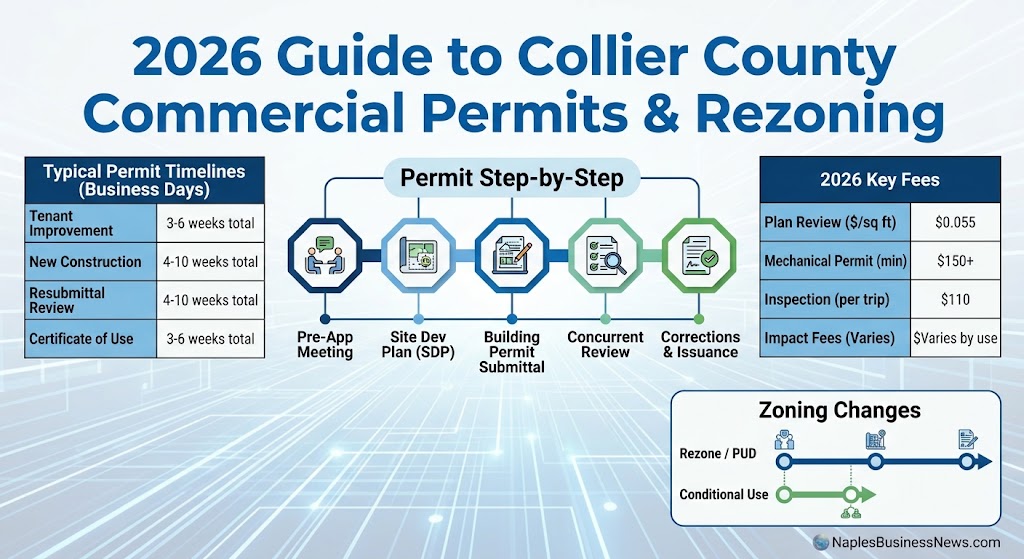
A standard commercial building permit in unincorporated Collier County takes roughly 10 to 30 business days for initial plan review and 4 to 10 weeks from application to issuance once correction cycles are included. Rezoning commercial property is a separate, longer track: a conventional rezone or PUD petition rarely reaches the Board of County Commissioners in fewer than 180 days from first staff review, and a full rezone commonly runs 9 to 14 months.
Who Handles Commercial Permits and Zoning in Collier County?
Commercial building permits and zoning petitions in unincorporated Collier County are handled by the Growth Management Community Development (GMCD) Department at 2800 N. Horseshoe Drive, Naples. The cities of Naples, Marco Island and Everglades City run their own permitting and zoning offices.
| Jurisdiction | Building Permits | Zoning Decisions |
|---|---|---|
| Unincorporated Collier (North Naples, East Naples, Golden Gate, Ave Maria, Immokalee) | GMCD Building Plan Review & Inspection Division | Collier County Planning Commission (CCPC) recommends; Board of County Commissioners (BCC) decides |
| City of Naples | City of Naples Building Department | Planning Advisory Board recommends; City Council decides |
| City of Marco Island | Community Affairs Department | City Council |
Most of the county’s commercial corridors, including Pine Ridge Road, Immokalee Road, Collier Boulevard and U.S. 41 north of the city limits, fall under county jurisdiction. Verify the parcel’s jurisdiction before filing anything; an application submitted to the wrong office is rejected, not forwarded.
How long does it take to get a commercial building permit in Collier County?
Initial plan review for new commercial construction takes 10 to 30 business days; tenant improvements run 5 to 15 business days. Add 5 to 10 business days for each correction cycle, and most commercial projects go through one to three.
| Permit Type | Initial Review | Typical Total (with corrections) |
|---|---|---|
| Commercial tenant improvement / interior buildout | 5–15 business days | 3–6 weeks |
| Commercial new construction or major addition | 10–30 business days | 4–10 weeks |
| Certificate of Use (new tenant, change of use) | 5–10 business days | 2–4 weeks |
| Resubmittal after corrections | 5–10 business days | per cycle |
| Fire review (commercial) | Concurrent with building review | — |
Timelines assume a complete application. Florida law (F.S. 553.792, as amended in 2024) also sets outer limits: for most non-residential permits, the county must approve, deny, or issue a deficiency notice within 60 business days of a complete application, with fee reductions if the deadline is missed. In practice, well-prepared projects clear review well inside that ceiling.
What is the step-by-step commercial permit process?
The commercial permit path runs from a pre-application meeting through a Site Development Plan (for new construction) and then the building permit itself, all filed electronically through the GMD Public Portal.
- Confirm zoning and use. Check that the intended use is permitted by right in the parcel’s zoning district. If not, a conditional use or rezone must be approved before a building permit can be issued.
- Pre-application meeting. Request it through the GMD Public Portal; Client Services contacts applicants within two working days to schedule. Bring conceptual site plans and an Addressing Checklist.
- Site Development Plan (SDP). Required for new commercial construction and most site changes. Reviewed by planning, engineering, utilities, environmental, transportation and fire. Incomplete SDP submittals are not accepted.
- Building permit submittal. Upload signed and sealed architectural, structural, MEP and fire protection plans; product approvals; energy code documentation; and FEMA elevation certificates where required. The Design Professional License Number is mandatory on every submittal.
- Concurrent review. Building, fire and zoning review commercial plans in parallel.
- Corrections and resubmittal. Respond to all comments in one package to avoid an extra cycle.
- Fee payment and issuance. Impact fees and inspection fees are due before the permit is released.
- Inspections and Certificate of Occupancy. The erosion/silt control inspection must pass before any other inspection can be scheduled.
How much does a commercial building permit cost in Collier County?
Plan review for new construction is priced at $0.055 per square foot (minimum $100) under the fee schedule amended January 1, 2026 (Resolution 2025-231). The larger cost driver for commercial projects is impact fees, which are assessed separately by use type and square footage.
| Fee Item | Amount (2026) |
|---|---|
| New construction plan review | $0.055/sq ft, $100 minimum |
| Mechanical permit (minimum) | $150 per unit or tenant space + inspections |
| Inspection fee (typical per trip) | $110 |
| Time-specific inspection (concrete) | Additional fee |
| Impact fees (roads, water, sewer, EMS, etc.) | Varies by use; often the largest line item |
A 20,000-square-foot retail shell would owe about $1,100 in plan review fees, but impact fees for the same building can run into six figures depending on use and location. Request an impact fee estimate from the Capital Project Planning, Impact Fees and Program Management Division before finalizing a pro forma.
What is the process for rezoning commercial property in Naples, FL?
Rezoning in unincorporated Collier County requires a pre-application meeting, a formal petition, a Neighborhood Information Meeting, staff review, a public hearing before the Planning Commission, and a final vote by the Board of County Commissioners. The BCC sits as both the legislative body for rezones and the Board of Zoning Appeals for conditional uses and variances.
| Step | What Happens | Typical Time |
|---|---|---|
| 1. Pre-application meeting | Staff identifies Growth Management Plan consistency, required studies (TIS, environmental) | 2–4 weeks to schedule |
| 2. Petition submittal and sufficiency review | Zoning Services checks completeness; insufficient petitions are returned | 30–45 days per review cycle |
| 3. Neighborhood Information Meeting (NIM) | Mailed notice to owners within notification area at least 15 days prior; applicant files written summary | Month 3–5 |
| 4. Staff report | Zoning staff recommends approval, approval with conditions, or denial | Month 4–7 |
| 5. CCPC public hearing | Meets 1st and 3rd Thursdays; advisory recommendation to BCC | Month 6–9 |
| 6. BCC hearing and ordinance adoption | Final vote; supermajority (4 of 5) required for certain petitions | Month 7–12 |
| 7. Recording | PUD commitments recorded; PUD Monitoring notified within 15 days | Month 8–14 |
County planning staff told the Planning Commission in December 2025 that a rezone application will hardly ever be heard by the BCC within 180 days of being sent for first staff review, given the NIM, staff review, CCPC hearing and advertising requirements. Contested petitions, or those requiring a companion Growth Management Plan amendment, can extend well past a year.
How much does a rezone petition cost?
A conventional rezone petition costs $6,000 plus $25 per acre; a rezone to Planned Unit Development (PUD) costs $10,000 plus $25 per acre. Additional fees apply for fifth and subsequent review cycles, and after-the-fact petitions are charged double.
| Petition Type | County Fee (2026) |
|---|---|
| Rezone (conventional, e.g., A to C-3) | $6,000 + $25/acre |
| Rezone to PUD | $10,000 + $25/acre |
| PUD amendment | Varies by scope |
| Conditional use | Set by fee schedule; Hearing Examiner track for minor CUs |
| After-the-fact petition | 2x normal fee |
County fees are a fraction of total cost. Land-use attorneys, planners, traffic engineers and environmental consultants typically account for $75,000 to $250,000 or more on a contested commercial PUD.
When do you need a rezone versus a conditional use?
A rezone changes the zoning district itself; a conditional use allows a specific use within the existing district subject to conditions. Conditional uses are faster and cheaper and are the right tool when the underlying zoning is close to correct.
- Rezone or PUD: needed when the intended use is not listed in the district at all, or when the applicant wants custom development standards (setbacks, height, density).
- Conditional use: appropriate for uses the Land Development Code lists as conditional in that district (e.g., certain automotive, institutional or outdoor uses in C-3 or C-4). Minor conditional uses can be heard by the Hearing Examiner rather than the full BCC.
- Growth Management Plan amendment: required when the Future Land Use Map does not allow the density or intensity sought; this adds a state-review transmittal and adoption cycle and can double the timeline.
Brian’s Take
Two things trip up out-of-market operators in Collier County more than anything else. The first is assuming the building permit is the long pole. It is not. The zoning entitlement is, and any pro forma that does not carry 12 months of entitlement risk before the first shovel is optimistic. The second is treating impact fees as a rounding error. They are a capital line, and they vary enough by use category that the difference between “retail” and “restaurant” on the same pad can move the number materially.
The county has made real progress on the permit side. Concurrent fire, building and zoning review, full electronic submittal, and the state’s 60-business-day clock have compressed what used to be a three-month wait into weeks for a clean package. The friction has shifted upstream to the SDP and to the political process at the CCPC and BCC, where neighborhood opposition, not code compliance, decides how many hearings a project needs. Budget for the consultant team accordingly, and do the NIM early and thoroughly; a well-run neighborhood meeting is cheaper than a continuance.
Frequently Asked Questions
Can I get a commercial permit faster using a private provider?
Yes. Florida law allows licensed engineers or architects registered with Collier County to perform plan review and inspections in place of county staff, which can shorten review during peak season.
Does a change of tenant require a new permit?
A new commercial occupant must obtain a Certificate of Use even if no construction is planned. Any structural, electrical, plumbing or HVAC change requires a building permit, and a change of occupancy classification triggers accessibility and life-safety review.
What building code applies to commercial projects in 2026?
Collier County enforces the Florida Building Code 8th Edition (2023) with local amendments under Ordinances 2023-64 and 2024-40, plus the Florida Fire Prevention Code and the 2020 National Electrical Code.
How do I check the status of a permit or zoning petition?
Both are tracked through the GMD Public Portal at cvportal.collier.gov, which allows public searches by address, permit number, owner or contractor without an account.
Is the process different inside the City of Naples?
Yes. The City of Naples issues its own building permits, requires a Construction Site Management Plan and construction fencing for commercial projects, and routes rezones through its Planning Advisory Board and City Council rather than the county boards.
Sources and Further Reading
- Collier County Growth Management Community Development, Building Permits & Construction — https://www.collier.gov/Business-Resources/Building-Permits-Construction
- Collier County Zoning Services Section — https://www.collier.gov/County-Development/Land-Development/Planning-Zoning-Resources/Zoning-Services-Section
- Collier County Administrative Code for Land Development (May 2026) — https://www.collier.gov/files/assets/county/v/5/planning-and-zoning/documents/administrative-code.pdf
- Collier County GMCD Fee Schedule (rezone and PUD petition fees) — https://www.collier.gov/files/assets/county/v/2/planning-and-zoning/documents/fee-schedule.pdf
- Collier County Planning Commission meeting minutes, December 4, 2025 (180-day rezone timeline) — https://www.collier.gov/files/content/county/v/13/county-development/land-development/public-meetings/ccpc/12-04-2025-ccpc-meeting-minutes.pdf
- Collier County Planning Commission schedule and hearings — https://www.collier.gov/County-Development/Land-Development/Public-Meetings/CCPC
- Collier County Conditional Use application and NIM notice requirements — https://www.collier.gov/files/assets/county/v/2/planning-and-zoning/documents/land-use-applications/conditional-use-cu.pdf
- Collier County Land Development Code § 10.02.13, PUD Procedures — http://colliercounty.elaws.us/code/ldc_ch10_10.02.00_sec10.02.13
- Permit Place, Collier County Building Permits: Review Times, Fees and Process (March 2026) — https://permitplace.com/county/collier-county-fl-building-permits/
- Alliance Permitting, Collier County Building & Trade Permit Guide (July 2026) — https://alliancepermitting.com/guides/florida/collier-county-building-permit
- City of Naples Building Department FAQ — https://www.naplesgov.com/building/page/frequently-asked-questions-building
- Florida Statutes § 553.792, Building permit application deadlines — http://www.leg.state.fl.us/statutes/
Reporting by Brian French. Fee and timeline figures reflect Collier County schedules in effect as of September 2026.
About the Author