How “No Change to the Tax Rate” Becomes a Tax Increase, and Why November Could Blow a $63 Million Hole in It
By Brian French | NaplesBusinessNews.com | September 7, 2026
Quick Answer
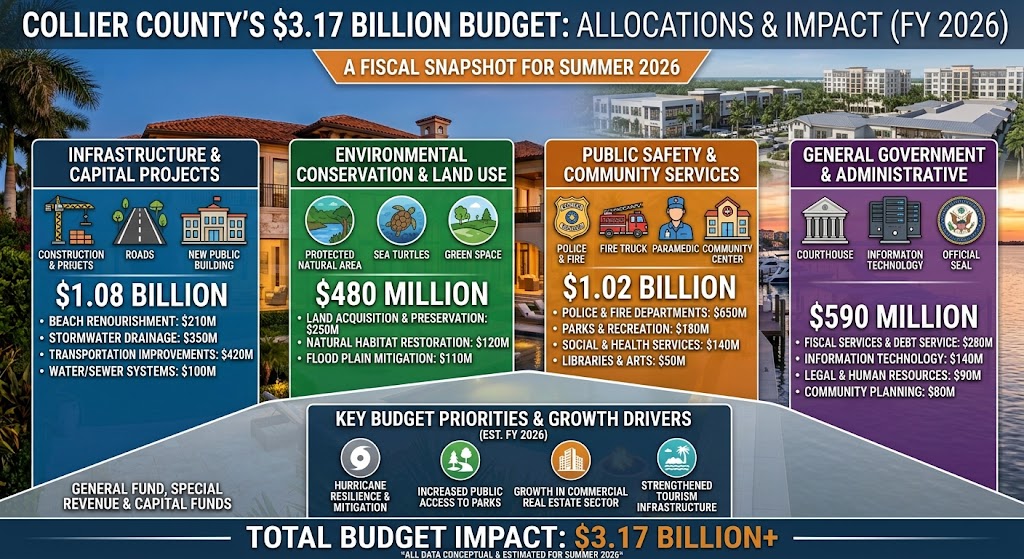
Collier County commissioners are adopting a $3.17 billion budget for fiscal 2027 this month at the same tax rates as last year: 3.0107 mills for the general fund, 0.2096 for Conservation Collier and 0.0246 for water pollution control. Because taxable values rose, holding the rate “millage neutral” still collects more money; in fiscal 2026 the county’s aggregate rate was 5.03% above the rolled-back rate the state defines as a no-tax-increase level. The general fund is proposed at $755 million with $76.6 million for capital, under a resolution capping operating growth at 3% and capital at 5%. The Florida Authority Network’s Collier Millage Reality Index translates the millage-neutral policy into what an owner actually pays, and finds that a buyer of a $745,000 home in 2026 will pay about $8,200 in year-one property tax, roughly a third of which is county government. The wildcard is November: a constitutional amendment to raise the homestead exemption to $250,000 needs 60% of voters statewide and, if it passes, is estimated to cost Collier’s taxing authorities about $63 million a year once fully phased in.
The budget in one table
| Item | FY2026 (adopted Sept 2025) | FY2027 (tentative, Sept 2026) | Change |
|---|---|---|---|
| Gross budget (all funds) | $3.12B | $3.17B | +1.6% |
| Net budget (excl. transfers/reserves) | $2.2B | pending final | — |
| General fund | — | $755M | — |
| Capital in general fund | $25M infrastructure-replacement fund seeded | $76.6M | — |
| General fund millage | 3.0107 | 3.0107 (max) | Neutral |
| Conservation Collier | 0.2096 | 0.2096 (max) | Neutral |
| Water pollution control | 0.0246 | 0.0246 (max) | Neutral |
| Aggregate rate vs. rolled-back | +5.03% (3.7675 vs. 3.5870) | pending TRIM certification | — |
| Spending caps | — | Operating +3%, capital +5% | New |
| Adoption vote | 3–2 to hold millage | Two hearings in September, 5:05 p.m. | — |
Sources: Collier County FY2027 Tentative Budget Book; Collier Clerk of the Circuit Court & Comptroller; Board of County Commissioners resolutions of July 14, 2026 (maximum millage) and September 18, 2025 (FY2026 adoption).
Millage neutral is not tax neutral
Florida’s Truth in Millage law defines two rates every year. The rolled-back rate is the rate that would raise the same revenue as last year on the same properties, excluding new construction; adopting it is, by statute, “no tax increase.” Millage neutral keeps last year’s rate, so revenue rises with assessed values. Collier has run millage neutral for two consecutive years after two years of rolled-back rates, and the difference is real money: in fiscal 2026 the county’s aggregate levy was 5.03% above rolled-back, generating roughly 3% more collections and funding a $25 million down payment on an infrastructure-replacement reserve. The county manager’s argument was that deferred maintenance across county buildings runs into the hundreds of millions and that rebuilding facilities such as the David Lawrence Center at today’s construction costs cannot be done at rolled-back rates.
The 2025 vote was 3–2, with Commissioners Burt Saunders and Rick LoCastro objecting not to the rate but to Commissioner Chris Hall’s proposal to redirect Conservation Collier money to general needs. The county had already borrowed about $25 million from that voter-approved fund in 2024, and as of this summer had not committed to a repayment schedule. Hall’s position was that a single year of reduced Conservation Collier funding would not kill the program; LoCastro’s was that voters approved the tax twice and commissioners are not entitled to override them. Expect the same fault line at this month’s hearings.
Collier Millage Reality Index
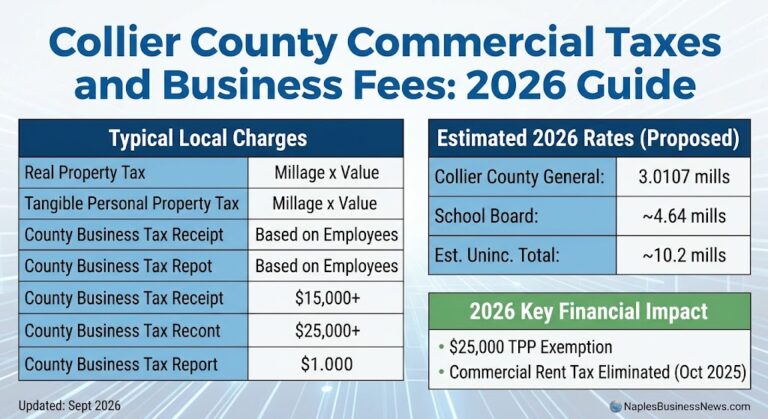
The Index shows what the county’s rate decisions mean on an actual tax bill, using Collier’s approximate total millage of about 11.05 mills (all taxing authorities), of which roughly 4.64 is schools and about 3.24 is the three county-wide levies. Year-one figures assume purchase at market value in 2026, since Florida resets taxable value at sale.
| Property | Taxable value | Total tax (11.05 mills) | County-wide share (3.24 mills) | Schools (4.64 mills) | Monthly |
|---|---|---|---|---|---|
| $400,000 condo, non-homestead | $400,000 | ~$4,420 | ~$1,300 | ~$1,860 | $368 |
| $745,000 house, homestead ($50K exemption) | $695,000 | ~$7,700 | ~$2,250 | ~$3,220 | $640 |
| $745,000 house, non-homestead | $745,000 | ~$8,230 | ~$2,410 | ~$3,460 | $686 |
| $1,900,000 City of Naples home, non-homestead | $1,900,000 | ~$19,000 (city rate lower; ~$17,000–19,000) | ~$6,160 | ~$8,820 | ~$1,500 |
Total millage per Florida TaxWatch county average; individual bills vary by municipality, MSTU and special district. Existing homesteaded owners with Save Our Homes caps (2.7% for 2026) pay far less than these purchase-year figures.
The Index’s takeaway: county government is about 30% of the bill. The school district is larger, and the remainder is municipalities, fire districts, water management and MSTUs. When the county holds millage neutral and gains 3%, the owner of a $745,000 home pays roughly $70 more a year to the county than at rolled-back. The purchase-year reset, not the rate decision, is what produces the shock on a new buyer’s TRIM notice.
The November variable: Amendment on the $250,000 homestead exemption
The Legislature on June 2, 2026 passed a joint resolution (CS/HJR 1F) placing a homestead-exemption expansion on the November 3 ballot. As reported, it would raise the non-school exemption to $150,000 for 2027 and $250,000 for 2028, require 60% voter approval, and make new Florida residents arriving after December 31, 2026 wait five years for the full amount. School millage is unaffected.
| Scenario | $350,000 homesteaded home | $745,000 homesteaded home |
|---|---|---|
| Current bill (approx.) | $3,430 | $7,700 |
| With $250,000 exemption (non-school portion) | ~$2,150 | ~$6,420 |
| Annual savings | ~$1,280 | ~$1,280 |
The exemption is a flat dollar amount, so savings are similar across price points and proportionally largest for lower-value homes.
Local estimates put Collier’s combined revenue loss near $63 million a year at full phase-in, spread across the county, the City of Naples, Marco Island and special districts. Against a $755 million general fund, the county’s share would force either a millage increase (which the amendment’s supporters argue is the point: shifting burden to non-homestead owners, who in Collier are the cash-buying second-home majority), spending cuts, or both. Collier’s 53.5% cash share and large non-homestead base make it one of the counties best positioned to absorb the shift by raising rates on non-residents, and one of the most politically exposed to doing so.
What NaplesBusinessNews.com will track
- The final FY2027 aggregate rate vs. rolled-back after the second September hearing, and the vote.
- Conservation Collier repayment: whether the $25 million borrowed in 2024 gets a schedule.
- The infrastructure-replacement reserve: balance and first projects funded.
- November 3 results on the homestead amendment and the county’s fiscal-2028 response.
- Taxable value growth in the July 2027 certification, the number that decides whether millage neutral keeps working.
Frequently Asked Questions
What is Collier County’s property tax rate for 2026–27? The county’s general fund rate is proposed at 3.0107 mills, plus 0.2096 for Conservation Collier and 0.0246 for water pollution control, unchanged from 2025–26. Total millage including schools, cities and districts runs about 11 mills.
How big is Collier County’s budget? $3.17 billion gross for fiscal 2027, up from $3.12 billion, with a $755 million general fund and $76.6 million in general-fund capital spending.
Is Collier County raising taxes? The rate is unchanged, but because property values rose, the county collects more. In fiscal 2026 the aggregate rate was 5.03% above the state-defined rolled-back (no-increase) rate.
What is the difference between millage neutral and rolled-back? Millage neutral keeps the same rate and lets revenue rise with values. Rolled-back lowers the rate so revenue on existing properties stays flat; Florida law treats anything above rolled-back as a tax increase.
What is the homestead exemption amendment on the November 2026 ballot? A constitutional amendment raising the non-school homestead exemption to $150,000 in 2027 and $250,000 in 2028. It needs 60% approval. Local estimates put Collier’s revenue impact near $63 million a year.
When are Collier County property taxes due? Bills arrive in November with a 4% discount for November payment, declining monthly to March; taxes become delinquent April 1.
Brian’s Take
I have never seen a government call a 5% increase over rolled-back “no change,” but that is what millage neutral is, and in fairness the county is spending the difference on buildings it let rot for a decade. The maintenance backlog is the real liability on Collier’s balance sheet, not the rate. What worries me is November. A $250,000 homestead exemption is popular arithmetic and terrible fiscal timing: it takes $63 million out of Collier’s taxing authorities just as the county has started catching up on capital, and the only way to replace it is to raise rates on the non-homestead owners who are half the housing market and most of the deal flow. That shift may be fair; it is also the first thing every relocating executive’s advisor will put in a spreadsheet. Watch the rolled-back comparison at the final hearing, and watch whether anyone on the dais says the word “sixty percent” out loud.
Sources
- Collier County Office of Management and Budget: Fiscal Year 2026–27 Tentative Budget Book; FY2026 Adopted Budget Policies; first and final FY2026 budget hearing documents (September 4 and 18, 2025)
- Collier County Clerk of the Circuit Court & Comptroller: FY2026 final budget summary; millage history FY2007–FY2026; maximum millage resolution notices
- Board of County Commissioners: July 14, 2026 maximum millage resolution; FY2027 spending-cap resolution
- Florida Statutes ch. 200 (Truth in Millage; rolled-back rate)
- Florida Legislature: CS/HJR 1F (homestead exemption), passed June 2, 2026
- Florida TaxWatch county millage averages (2025); Collier County Property Appraiser and Tax Collector
- Local reporting: Naples Press (July 31, 2026), Gulfshore Business (September 19, 2025), Coastal Breeze News
- Collier Millage Reality Index: Florida Authority Network calculation; assumptions stated in tables
NaplesBusinessNews.com is part of the Florida Authority Network, an independent publisher of Florida business and economic news. This article is informational and not tax advice.
About the Author