The November Penny: What Collier County’s Tourist Tax Referendum Would Actually Buy
By Brian French | NaplesBusinessNews.com | September 3, 2026
Fourth installment in the Florida Authority Network’s Naples market-index series. This page will be updated on this URL after the November 3, 2026 vote and again when collections begin.
Quick Answer
On November 3, Collier County voters will decide whether to raise the tourist development tax from 5% to 6% on hotel stays and short-term rentals of six months or less. The extra cent needs a simple majority, would take effect January 1, 2027, and is projected to raise close to $10 million a year, paid by visitors rather than residents. Its stated purpose is to finish the county-owned Paradise Coast Sports Complex, estimated at $40 million to $50 million for the remaining fields and an indoor fieldhouse, with any balance directed to tourism promotion, beach renourishment and tourist-related infrastructure. The Florida Authority Network’s Penny Yield Model finds the sixth cent would generate roughly double what the complex needs over its first decade, which makes the real question on the ballot not whether tourists can afford $3 more on a $300 hotel night, but what the county does with the second half of the money.
What is on the ballot
Florida allows counties that collect more than $30 million a year in tourist taxes, a threshold called “High Tourism Impact” status, to levy a sixth cent with voter approval. Collier crossed that line decisively: collections hit a record $48.6 million in fiscal 2024, and the 5% tax now produces $48 million to $50 million a year. Twelve other counties already collect 6%, including Lee, Sarasota, Pinellas, Palm Beach and Miami-Dade.
Commissioners voted 5-0 in July 2025 to put the question to voters. Under state law the county cannot campaign for it; it has budgeted $150,000 for a neutral information effort and set up a public information site. If approved, the increase stays in place until commissioners change the ordinance.
The measure’s leading proponent, Commission Chair and Tourist Development Council Chair Burt Saunders, has called finishing the complex a priority of his final term. Commissioner Bill McDaniel has pressed for full build-out and operating-cost figures before committing, and the Clerk of Courts has flagged that a bond backed by the new revenue would add debt service to a county already carrying a large deferred-maintenance backlog.
The asset at the center: Paradise Coast Sports Complex
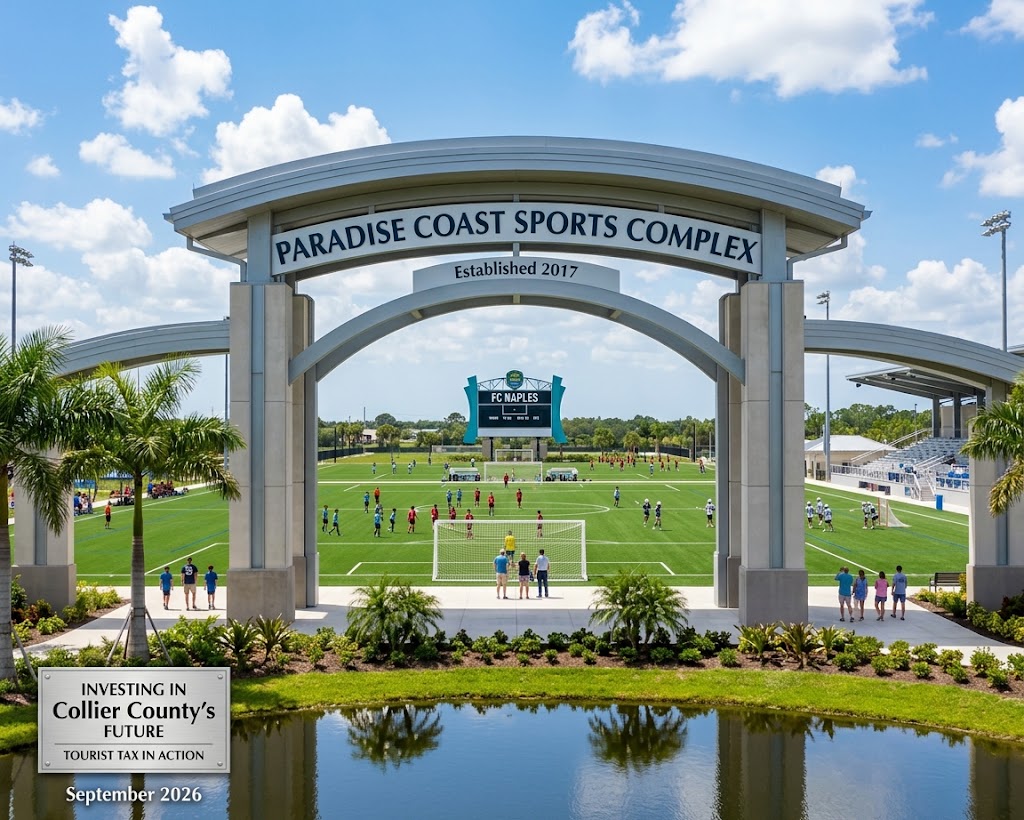
The 145-acre complex off Collier Boulevard near I-75 in East Naples opened its first phase between 2017 and 2020 at a cost of about $114 million, financed largely through tourist-tax-backed bonds. It has 19 synthetic-turf rectangular fields, a stadium, an existing indoor facility and event space, and since 2025 has been home to FC Naples of USL League One, whose first season drew crowds the county cites as evidence of demand.
What it does not have is baseball and softball diamonds, and that gap is the expansion. Commissioners approved a Phase 4 plan in October 2025 for 11 additional multipurpose fields, with a Hunden Partners feasibility study estimating the fields at $50 million to $90 million depending on scope. Earlier phases 3 and 4 were scoped at roughly $10 million and $50 million. A larger indoor fieldhouse, designed to double as a hurricane shelter, is the other major unfunded piece. The county’s working figure for completion is $40 million to $50 million, and officials acknowledge the remaining phases would take several years even with funding.
The Penny Yield Model
To test whether the sixth cent is sized to the project, NaplesBusinessNews.com modeled its revenue against the stated uses over ten years.
| Input | Value | Basis |
|---|---|---|
| Current 5% TDT collections | $48–50M / year | FY2024 record $48.6M; county estimate |
| Revenue per cent | ~$9.7–10.0M / year | One-fifth of current collections |
| FY2027 county TDT budget (5%) | $41.8M | Conservative budget projection, +5% over FY2026 |
| Q1 2026 visitor spending | $1.149B (+8.5%) | Downs & St. Germain / CVB |
| Q1 2026 visitation | 849,000 (+5.5%) | Domestic +7.1%, international −6.2% |
| Ten-year projection (2027–2036) | Low case | Base case | High case |
|---|---|---|---|
| Annual sixth-cent yield (year 1) | $8.4M (budget basis) | $9.7M | $10.5M |
| Assumed collections growth | 2% | 4% | 6% |
| Ten-year cumulative yield | $92M | $116M | $138M |
| Sports complex completion cost | $40–50M | $40–50M | $50–90M (full Hunden scope) |
| Bond capacity supported by $10M/yr debt service (20 yrs, ~5%) | ~$120–125M | ||
| Share of ten-year yield needed for completion | 43–54% | 34–43% | 36–65% |
Model: FAN estimates. Yield = one-fifth of projected 5% collections, grown at the stated rate. Bond capacity is illustrative, level debt service at 5%. Costs per county and Hunden Partners figures; operating costs of new phases not included.
The base case says the penny produces about $116 million over its first decade against a $40–50 million completion cost, or roughly $120 million of bonding capacity if the county borrows against it up front. Even the high-cost, low-revenue combination leaves the sports complex consuming well under two-thirds of the money.
That surplus is by design: the ballot language directs the balance to tourism promotion, beach renourishment and tourist-related infrastructure. But it also means the sixth cent is a permanent expansion of the tourism fund, not a project-specific levy that expires when the fields are built.
What the tourist pays
| Stay | 5% TDT | 6% TDT | Difference |
|---|---|---|---|
| $300/night hotel, 4 nights | $60 | $72 | +$12 |
| $650/night beachfront resort, 7 nights | $227.50 | $273 | +$45.50 |
| $4,000/month seasonal rental, 3 months | $600 | $720 | +$120 |
Sales tax (7% in Collier) applies on top. The Tourist Development Council itself split 5-4 in May over the fiscal 2027 marketing budget, with members questioning a proposed reduction in the advertising baseline; that debate will resurface if the sixth cent passes, because a larger fund invites competing claims.
The arguments, as their proponents make them
For: Visitors pay, residents don’t. Collier is the only major coastal tourism county in Southwest Florida still at 5%, and Lee County’s 6% has not visibly dented its bookings. Youth and amateur sports tourism fills hotel rooms in the summer trough, when the destination most needs them, and FC Naples has shown the complex can draw. Leaving the county’s largest single tourism investment half-finished forfeits the return on the $114 million already spent.
Against: The county has already redirected roughly $25 million from the voter-approved Conservation Collier fund to cover other needs and has not committed to repaying it; critics question adding debt for a facility whose operating economics have not been fully disclosed. Bed-tax revenue is legally fenced for tourism, so a bigger fund does nothing for roads, water or the maintenance backlog residents actually feel. And a permanent tax raised for a specific project rarely goes away when the project is done.
What NaplesBusinessNews.com will track
- The vote margin on November 3 and turnout by district; a narrow pass sets up a fight over allocation.
- The first collection reports from January 2027 against the $9.7 million base case.
- Whether the county bonds the revenue or funds the complex pay-as-you-go, and the operating budget for the new phases.
- Comparable-county outcomes: what Lee County did with its sixth cent and whether Collier’s occupancy and average daily rate move after the increase.
Frequently Asked Questions
What is the Collier County tourist tax referendum? A November 3, 2026 ballot question asking voters to raise the tourist development tax (bed tax) from 5% to 6% on stays of six months or less. It needs a simple majority and would begin January 1, 2027.
Who pays the Collier tourist tax? Hotel guests and short-term renters. It is not a property tax and does not apply to residents’ homes, though owners of short-term rental units collect it from guests.
How much would the sixth cent raise? Close to $10 million a year at current collection levels, on top of the $48–50 million the 5% tax already generates.
What is the money for? Completing the Paradise Coast Sports Complex (estimated $40–50 million for remaining fields and an indoor fieldhouse), with the balance for tourism promotion, beach renourishment and tourist-related infrastructure.
Which Florida counties already charge 6%? Twelve, including Lee, Sarasota, Pinellas, Palm Beach and Miami-Dade. Collier would join them.
How is Collier tourism performing in 2026? First-quarter 2026 visitation rose 5.5% to 849,000 and visitor spending 8.5% to $1.149 billion, with domestic visitors up 7.1% and international down 6.2%. The county projects FY2027 tourist-tax revenue of $41.8 million on its conservative budget basis.
Brian’s Take
Taxes that other people pay are the easiest taxes to pass, and this one will probably pass. The number worth holding onto is the surplus: the penny raises about twice what the sports complex needs, permanently. That is not an argument against it, but it is the argument for insisting, before the vote, on a published capital plan and an operating budget for the new fields, and a commitment on how the second half of the money gets allocated among marketing, beaches and whatever comes next. The county spent $114 million to build a gem and then stopped; the failure mode here is not that the penny is too much, it is that the money arrives and the plan doesn’t. Voters should say yes to finishing what was started and demand the plan in the same breath.
Sources
- Collier County Board of County Commissioners: July 2025 ordinance and ballot resolution; October 28, 2025 Phase 4 approval; colliertdt.com public information site
- Collier County Clerk of the Circuit Court & Comptroller: September 2024 analysis of Phases 3 and 4 financing and debt service
- Naples, Marco Island, Everglades Convention & Visitors Bureau and Tourist Development Council: May 19, 2026 meeting materials; FY2027 TDT projection; Q1 2026 visitor research by Downs & St. Germain
- Hunden Partners sports tourism feasibility and economic impact study (2025)
- Florida Statutes § 125.0104 (tourist development tax; high tourism impact counties)
- FGCU Lutgert College of Business Regional Economic Research Institute: seasonally adjusted tourist tax revenue dashboard
- Local reporting: Naples Daily News / Marco Eagle (July 5, 2026), Gulfshore Business (May 12, 2026), Naples Press, Coastal Breeze News, Fox 4
- Penny Yield Model: Florida Authority Network proprietary projection; assumptions stated in the tables above
NaplesBusinessNews.com is part of the Florida Authority Network, an independent publisher of Florida business and economic news. The network does not endorse ballot measures.
About the Author