Why Collier County businesses fail in October rather than August — and the six-phase Cash Calendar that explains the business year this market actually runs on.
By Brian French | Naples Business News | Florida Authority Network
Published: July 26, 2026 · Last reviewed: July 26, 2026
Answer in Brief
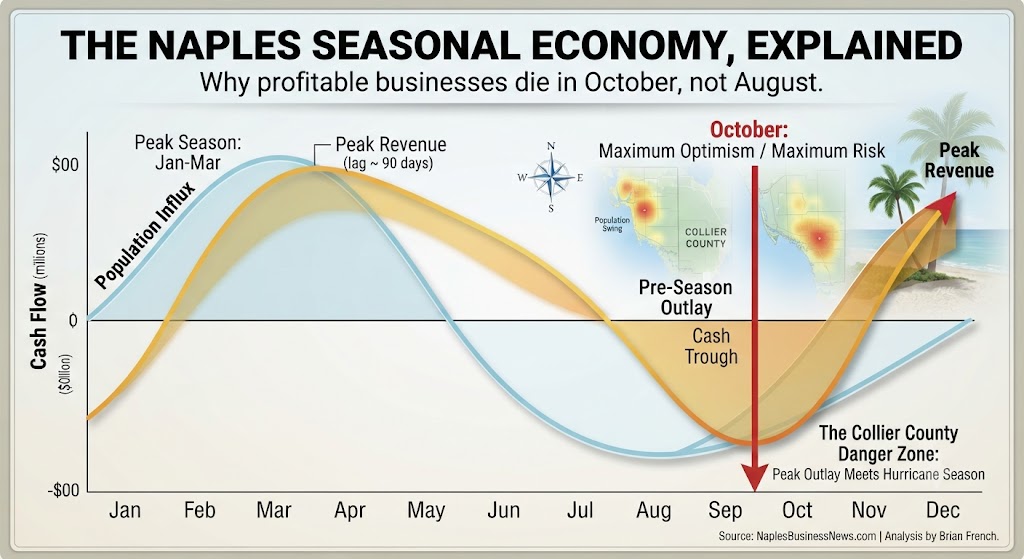
Every Naples business owner knows the season runs November through April. Almost none of them manage to the more important fact: peak cash outflow precedes peak cash inflow by roughly ninety days. You buy inventory, hire staff, and spend on marketing in September and October. The revenue that pays for it arrives in January, February, and March. That offset — not the quiet summer — is what kills Collier County businesses. They do not fail in the slow months. They fail at the moment of maximum optimism.
Key Takeaways
- Collier County’s population rises by roughly 90,000 to 100,000 in season — approximately 20% to 30% above the permanent base of about 417,000.
- Season is a cash calendar, not a revenue calendar. The two are offset by about a quarter, and the gap is financed out of the owner’s reserves.
- The October Number — operating cash required on hand entering October — predicts survival better than annual profitability does.
- The year has six phases, not two. Treating it as a binary season/off-season produces the two most common operating errors in this market.
- Naples has counter-seasonal businesses whose peak is the consumer economy’s trough — renovation, property watch, marine service, storage. For them, summer is season.
- Hurricane season overlaps the cash trough. June 1 through November 30 is precisely when reserves are thinnest and pre-season outlay is heaviest. These risks are correlated, not independent.
What Actually Happens to Collier County in Season
Start with the scale of the swing, because it is larger than most people outside Southwest Florida assume and larger than many inside it consciously register.
Collier County recorded a permanent population of 375,752 at the 2020 census, with a 2025 estimate of approximately 417,131. County figures cited publicly indicate a seasonal increase of roughly 93,000 people across the November–April window; other regional estimates put the seasonal influx at 100,000 or more, and describe Southwest Florida’s peak-winter population as running roughly 20% to 30% above its permanent base.
Put plainly: for about six months a year, Collier County operates as a substantially larger place than it is the rest of the time. Not a busier version of itself — a different-sized place, with different traffic, different labor demand, different service capacity requirements, and a different customer.
Several structural features amplify the effect:
- The 183-day threshold. Florida has no state individual income tax, and a large share of Collier County’s seasonal residents maintain presence of six months and one day to establish Florida tax residency. That is not incidental — it means a meaningful portion of the seasonal population is here on a duration schedule set by tax law, which makes arrival and departure patterns unusually predictable and unusually rigid.
- An older, wealthier, less price-sensitive customer. Collier County’s median age was 52.9 at the 2020 census, with 32.6% of residents aged 65 or older. In the City of Naples, median age is around 67 and median household income exceeds $150,000. This customer does not disappear because of a modest price increase — but they do physically leave in May.
- Housing and rental prices move with the calendar. Seasonal rental rates rise substantially in winter, with luxury rentals commanding very large premiums over off-season pricing — which compounds the workforce problem discussed below.
All of that is reasonably well understood. Here is the part that is not.
Brian’s Take
I spent twenty-five years in financial services, and I want to open with the single most expensive lesson in that entire industry, which I have watched people relearn painfully over and over:
Profitable businesses die of cash.
Not unprofitable ones — those die of being unprofitable, which everyone understands and nobody is surprised by. I am talking about businesses with a genuinely good product, real demand, and a healthy annual profit and loss statement that nonetheless go under, because on some specific Tuesday they could not make payroll.
The profit and loss statement is an accounting document. It matches revenue to the period it was earned in and expenses to the period they were incurred in, and it produces a number that tells you whether the business model works. That is a genuinely useful thing to know.
But your landlord does not accept a favorable P&L. Your food distributor does not extend terms because your annual margin is strong. Your staff cannot be paid in accrued revenue. Those obligations come due in cash, on a date, and the only question that matters on that date is whether the money is in the account.
Now consider what Naples does to that problem. It takes the ordinary gap between spending and collecting — which every business has and most manage without thinking about it — and stretches it across an entire quarter. In a normal market, you buy inventory in March and sell it in April. In Collier County, you buy in September and sell in February.
That is not a cash flow inconvenience. That is a financing structure, and a great many Naples business owners are operating one without ever having decided to.
— Brian French
The Central Insight: Two Calendars, Ninety Days Apart
Ask a Naples restaurant owner, retailer, or service operator when their year peaks and they will say February, or January through March, or “season.” They are describing the revenue calendar, and they are correct about it.
Now ask when their bank balance is lowest. Most will say August or September, because that is when the market is quietest and the answer feels obvious.
It is frequently wrong.
The genuine low point for a well-run seasonal Naples business is typically late October — after the pre-season outlay has been made and before the revenue has arrived. Consider what a consumer-facing operator actually does in September and October:
- Buys and receives inventory for a six-month selling window, paid on terms that will come due before the selling window is complete
- Hires seasonal staff, who must be recruited, onboarded, trained, and paid for weeks before they generate anything
- Spends on marketing timed to reach seasonal residents before they arrive, not after
- Completes deferred maintenance, repairs, and buildout that could only be done while closed or quiet
- Renews commercial insurance, which in post-Ian Collier County is frequently one of the largest single annual outlays a small business faces
- Carries full fixed costs — rent, utilities, debt service, licenses — against thin October revenue
That is the peak spending month of the Naples business year, and it sits roughly ninety days before the peak revenue month.
The consequence is a specific and repeatable failure pattern. A business survives a quiet summer, correctly anticipates a strong season, spends appropriately to prepare for it — and then runs out of money in the six weeks before the money arrives. The season it prepared for may well have been excellent. It never got there.
Calculating the October Number
The October Number = (Oct + Nov operating expenses)
+ (pre-season inventory, hiring, marketing, and maintenance outlay)
− (projected Oct + Nov revenue)
+ a contingency reserve
This is the amount of cash that must be in the business entering October. Not projected. Not receivable. Available.
How to use it. Run the calculation in June, not September. If the number exceeds available cash, you have four months to close the gap and four workable levers: arrange a seasonal line of credit while your books still show the prior season’s strength; negotiate extended terms with suppliers, who understand this market’s cycle better than most owners assume; stage inventory purchases in two or three tranches rather than one; or scale the pre-season plan to the cash you actually have rather than the season you hope for.
All four of those are ordinary, available, and unremarkable. What is remarkable is how many Collier County operators reach the first week of October before discovering they needed one.
Brian’s Take
There is a pattern here that I saw constantly in portfolio management, and it has almost nothing to do with competence.
The moment of maximum optimism is the moment of maximum risk.
Every serious loss I ever watched an investor take had the same emotional shape. Not panic — panic is loud and it gets caught. The dangerous state is confidence. The position had been working. The thesis had been validated. And so the investor added to it, right at the point where prudence would have said to check the exposure, because everything they could see was confirming that they were right.
September and October in Naples are the confidence months. Summer is behind you, and you survived it. The forecasts look strong. Bookings are coming in. Everything you can see is telling you that the good months are close.
And that is precisely, exactly, the moment you write the largest checks of your business year.
I am not saying do not write them. You have to write them — a Naples business that fails to stock and staff for season has simply chosen a different way to fail. What I am saying is that this is the moment to be most rigorous, not least, and human nature runs the other direction. Rigor feels unnecessary when the outlook is good. That feeling is not information. It is a mood.
So put a date on the calendar in June. Run the October Number when you are still cautious, still slightly worried, still in the trough — because the version of you that exists in June will underwrite it far more honestly than the version that exists in September.
— Brian French
The Cash Calendar: Six Phases of the Collier County Business Year
Treating the year as a binary — season and off-season — is the source of the two most common operating errors in this market: over-ordering in April and under-reserving in October. The year has six phases, each with a different cash signature.
Phase 1 — The Spend (September – October)
Cash signature: Maximum outflow, minimal inflow. The most dangerous phase of the year.
What happens: Inventory arrives. Seasonal hiring and training begin. Deferred maintenance is completed. Marketing spend goes out to reach seasonal residents before they travel. Insurance renews. Revenue remains at or near its annual floor while nearly every discretionary and preparatory cost lands at once.
The classic mistake: Sizing the pre-season investment to the season you expect rather than the cash you hold — and discovering the difference in mid-October, when your options have narrowed to expensive ones.
The correct action: Have financing arranged before you need it. A seasonal line of credit negotiated in June, from a position of strength, costs meaningfully less than emergency capital arranged in October from a position of need. Stage inventory in tranches. And treat your October cash position as a number you monitor weekly, not one you discover.
Phase 2 — The Arrival (November – December)
Cash signature: Inflow begins and accelerates. Relief, and a specific trap.
What happens: Seasonal residents begin returning. Traffic builds through November. The holiday period delivers a genuine revenue spike — and the first real cash of the year hits the account.
The classic mistake: Reading the holiday spike as the beginning of the season’s trend line. It is not. The holiday customer is a different customer. Late December brings visiting family, gift purchasing, short-stay guests, and restaurant traffic driven by people who will be gone by January 3rd. The January-through-March customer is the resident seasonal population, with different purchasing patterns, different price sensitivity, and different service expectations. Extrapolating December into a full-season forecast — and ordering against it — is a well-worn path to April inventory problems.
The correct action: Track the two customer types separately if you can. Use December to repay the seasonal credit line ahead of schedule rather than to expand the plan. Resist the pull to add headcount on the strength of two good weeks.
Phase 3 — The Peak (January – March)
Cash signature: Maximum inflow — and, less obviously, maximum operating cost. Net margin is high; net cash generation is often lower than owners expect.
What happens: The full seasonal population is present. Revenue reaches its annual high. So does labor cost, so does overtime, so does inventory turnover, so does the cost of every mistake — a service failure in February is expensive in a way the identical failure in July is not.
The classic mistake: Two of them, and they are opposites. The first is failing to build reserves during the only months capable of producing them — treating peak cash as available cash. The second is being too busy to think, which is genuine: an owner working sixteen-hour days in February has no capacity for planning, and so the planning does not happen, and the next October arrives exactly as unprepared as the last one.
The correct action: Automate the reserve. Move a fixed percentage of weekly revenue into a separate account on a standing instruction, before it can be spent, from the first week of January. An owner will not do this by judgment in February; they will do it by mechanism. And schedule one half-day in March, on the calendar, for the following year’s plan — because it will not happen otherwise.
Brian’s Take
The reserve problem deserves more than a bullet point, because it is where I have watched the most avoidable damage happen.
In institutional money management, we did not rely on discipline. That sounds cynical; it is actually the opposite. We built mechanisms precisely because we knew discipline would fail under pressure, and we did not think less of anyone for it. Rebalancing rules were automatic. Position limits were hard-coded. Contributions were scheduled. The entire architecture existed because the people running it understood that a human being in the middle of a stressful, fast-moving period makes worse decisions than the same human being made calmly six months earlier.
Now picture a Naples restaurant owner in the second week of February. They are working seven days. They have a staffing hole, a broken cooler, a reservation book that will not stop, and a supplier issue. The account has more money in it than it has had since last March.
Ask that person to voluntarily set aside a meaningful percentage of that money against a shortfall that is eight months away, and understand what you are asking. You are asking someone in the middle of the hardest working stretch of their year, looking at the first comfortable balance they have seen, to feel poor on purpose.
Almost nobody does it. And it is not a character flaw — it is entirely predictable, and the failure to anticipate it is a design failure, not a moral one.
So do not rely on February’s judgment. Set the standing transfer in December, when the pressure has not arrived yet, and let the mechanism carry the decision that your February self will be in no condition to make. That single instruction, set once, is worth more than any amount of resolve.
— Brian French
Phase 4 — The Fade (April)
Cash signature: Still strongly positive, and deceptive. The single most misread month in the Collier County year.
What happens: Easter and spring break produce a genuine late surge. Then, over a period of roughly two to three weeks, the seasonal population departs — and departure is far more abrupt than arrival was. November builds gradually. April ends.
The classic mistake: Ordering in early April against early-April demand. This is the month businesses buy inventory they will still be holding in August, book staff hours they will not need by the 25th, and sign commitments calibrated to a customer base that is packing.
The correct action: Begin the drawdown early, and accept that you will run slightly short in the last good week rather than long into the first bad month. In a seasonal market, being modestly out of stock in late April is a rounding error. Being overstocked going into May is a five-month cash problem. The asymmetry is enormous and it runs one direction.
Phase 5 — The Drop (May – June)
Cash signature: Revenue falls quickly. Expenses fall slowly. The gap is the phase.
What happens: Revenue can decline sharply within weeks of the seasonal departure. Costs do not follow at the same speed. Rent is fixed. Insurance is fixed. Debt service is fixed. Staff you value cannot simply be released and re-recruited in October — and in this labor market, if you let good people go in May, you may not get them back. Inventory that did not move is now capital sitting on a shelf.
The classic mistake: Reacting late. Owners routinely spend May behaving as though it is April, then compress a full quarter’s worth of cost reduction into an anxious three weeks in June.
The correct action: Decide your summer operating model in March, when you are not under pressure. Reduced hours? Fewer days? A different menu, a different service mix, a summer-resident offering? Whatever it is, decide it early and communicate it to staff early — because the thing your team fears most in May is not reduced hours. It is uncertainty about whether they still have a job in September.
Phase 6 — The Floor (July – September)
Cash signature: Minimum revenue, minimum flexibility — and maximum available time.
What happens: The quietest stretch of the year. Reserves are consumed. Hurricane season is active. And this is the only window in which an owner has both the time and the physical access to do anything structural to the business.
The classic mistake: Treating these months purely as survival — enduring them rather than using them. The Floor is the only phase in which renovation, systems implementation, staff training, process redesign, recipe development, website rebuilds, and genuine strategic thinking are possible. An owner who merely survives July through September arrives in October with the same business they had in April, having burned three months of cash to preserve it unchanged.
The correct action: Put one structural project on the summer calendar and finish it. One. Not five. And run the October Number in June, at the beginning of this phase, while there is still time to act on the answer.
The Cash Calendar at a glance
| Phase | Months | Cash | The one thing to get right |
|---|---|---|---|
| 1. The Spend | Sep–Oct | Max outflow | Financing arranged in advance |
| 2. The Arrival | Nov–Dec | Inflow begins | Don’t extrapolate the holiday spike |
| 3. The Peak | Jan–Mar | Max inflow | Automate the reserve transfer |
| 4. The Fade | April | Positive, deceptive | Draw down inventory early |
| 5. The Drop | May–Jun | Revenue falls fast, costs slow | Decide the summer model in March |
| 6. The Floor | Jul–Sep | Minimum, burning reserves | Build one thing; run the October Number |
The Staffing Problem Nobody Can Solve With Money
Every seasonal economy has a labor problem. Collier County’s has a specific and unusually hard shape, and it is worth stating precisely because it is frequently misdiagnosed as a wage issue.
A Naples consumer business needs something close to double its headcount for roughly half the year. In most seasonal markets — ski towns, beach towns, national park gateways — that demand is met by a transient workforce that arrives for the season and leaves after. That model requires one thing above all: somewhere affordable for those workers to live.
Collier County has among the highest housing costs in the Southeast, and seasonal rental rates rise precisely during the months when seasonal workers would need housing. The market that creates the labor demand simultaneously prices out the labor supply. The peak of the hiring need and the peak of the housing cost are the same six months.
This is why the problem does not resolve with wages alone. An employer can outbid a competitor for a worker who already has housing. No individual employer can create housing that does not exist, and paying more to a worker commuting an hour each way from outside the county does not shorten the commute.
What actually works, in rough order of practicality:
- Year-round retention over seasonal recruitment. Reduced summer hours for a valued employee cost less than replacing them in October. Calculate the true cost of turnover — recruiting, training, error rate, lost productivity in your highest-revenue weeks — and the arithmetic usually favors carrying people through.
- Guaranteed summer minimums. A committed floor of hours, communicated in March, converts your best people from job-seekers into people who stay.
- Counter-seasonal pairing. Some Collier employers formally share staff with businesses whose peak is the opposite half of the year. It requires trust and coordination and it works.
- Honest scheduling far in advance. The most common reason a good seasonal employee does not return is not pay. It is that in May, nobody told them whether there would be a job in October, so they found one somewhere else.
- Transportation as compensation. For workers commuting from eastern Collier or Lee County, a fuel stipend or organized transport can be worth more per dollar than an equivalent wage increase.
Brian’s Take
I want to say something about the labor question that I do not think gets said plainly enough in this county.
In portfolio management, we drew a hard line between two kinds of constraint. There were price constraints — things you could obtain by paying more — and supply constraints, where the thing simply did not exist at any price. Confusing the two was one of the most expensive errors an allocator could make, because it caused you to keep bidding for something that was never going to arrive.
Naples workforce housing is a supply constraint. It presents as a wage problem, which makes every individual employer respond by paying more, which is entirely rational for them and does nothing whatsoever for the county. Wages rise, the housing does not appear, and the labor pool does not grow. Everyone spends more and the constraint is exactly where it was.
I am not going to pretend I have the policy answer to that. It is genuinely difficult, it involves land, zoning, and construction economics, and reasonable people in this county disagree sharply about the right approach.
But I will offer the operator-level conclusion, which is unambiguous: if you cannot buy your way out of a supply constraint, then retention is not a nice-to-have. It is your entire labor strategy. The employee you keep through the summer is worth more than the two you hope to hire in October, because the two you hope to hire may not exist.
Businesses that internalize this early in Collier County develop a durable advantage over ones that keep treating October as a recruiting month. It is not a small edge. Over five years it is decisive.
— Brian French
Not Every Naples Business Is Seasonal — And Some Run Backwards
The assumption that Collier County empties out and business stops is a consumer-economy view of the county. A substantial part of the local economy runs on the opposite calendar, and this is one of the least discussed facts about doing business here.
Counter-seasonal businesses peak in the off-season, because their work requires the property owner to be somewhere else.
| Seasonality | Sectors | Peak |
|---|---|---|
| Extreme seasonal | Restaurants, boutique retail, galleries, hospitality, charter and tour operators, seasonal rentals | Jan–Mar |
| Moderate seasonal | Healthcare and medical practices, professional services, real estate brokerage, personal services | Season-weighted, year-round base |
| Largely aseasonal | Municipal and county government, education, utilities, logistics, agriculture in eastern Collier, small-bay industrial serving local trades | Flat |
| Counter-seasonal | Interior renovation and remodeling, painting, flooring, property watch and management, cleaning and pressure washing, storage, marine service and haul-out, pool and landscape maintenance, HVAC service | May–Oct |
Why this matters strategically. If you are choosing what business to start in Collier County, or considering adding a service line to an existing one, counter-seasonal revenue has structurally better cash characteristics than a second seasonal line does — because it fills the trough rather than deepening the peak.
A landscaping company that adds holiday lighting has added revenue in a month it was already busy. A landscaping company that adds property watch services for absent owners has added revenue in July. Those are not equivalent decisions, even if the annual revenue added is identical.
Brian’s Take
This section is, straightforwardly, portfolio theory applied to a small business, and I would like to make the connection explicit because I think it is genuinely useful rather than merely cute.
The central insight of modern portfolio construction — the one that won a Nobel Prize and reorganized an entire industry — is that the risk of a portfolio is not the sum of the risks of its holdings. It depends on how those holdings move relative to each other. Two assets, each individually volatile, can combine into something far steadier than either one, provided they do not move together.
That is exactly what a counter-seasonal revenue line does for a Naples business.
Adding a second seasonal service is like buying more of the same stock. Your revenue goes up and your volatility goes up with it, because the new revenue arrives in precisely the months you were already flush and disappears in precisely the months you were already thin. You have amplified the pattern, not diversified it.
Adding a counter-seasonal line is buying a negatively correlated asset. Same additional revenue, entirely different effect on the business, because it lands in the trough. Your annual total may be identical. Your survival probability is not remotely identical.
Now here is the part I would want any Collier County owner to sit with. The value of that second line is not primarily the revenue. It is the reduction in the October Number. Summer cash flow means you draw down less through the Floor, which means you enter the Spend with more, which means you need less financing, which means you pay less for it, which compounds every single year.
I watched that dynamic operate over decades in portfolios. Reduced volatility does not just feel better. It compounds better. And in a seasonal economy, it is available to any owner willing to look at what their customers need during the months those customers are not here.
— Brian French
The Risk Nobody Prices: Hurricane Season Overlaps the Cash Trough
Look at two calendars side by side.
Atlantic hurricane season runs June 1 through November 30.
The Naples cash trough — Phase 5 (The Drop), Phase 6 (The Floor), and the first half of Phase 1 (The Spend) — runs May through October.
They are, for practical purposes, the same six months.
This is the single most underappreciated financial fact about operating a business in Collier County. The period of maximum catastrophe exposure is the period of minimum financial cushion, and the overlap is close to total.
Consider the compounding. A storm in September finds a business that has spent the summer drawing down reserves and has just committed its remaining capital to pre-season inventory and hiring. That inventory may be damaged. The staff just hired may leave the region. The season being prepared for may be disrupted for arriving visitors. Insurance proceeds, if the claim is covered, arrive on a timeline measured in months. And the business has no cash cushion, because the cushion is what it spent in September.
These risks are not independent. They are correlated, and a business that evaluates its storm exposure and its cash position as separate exercises has systematically understated its actual risk.
What follows practically:
- Business interruption coverage deserves specific attention, including whether it responds to a loss of access or a civil authority order rather than only to direct physical damage — frequently the difference that matters most in a storm event.
- Your contingency reserve is not the same as your seasonal reserve. The seasonal reserve is designed to be spent on schedule. If it is also your storm reserve, you have one reserve doing two jobs, and the storm does not check whether it is available.
- Staged pre-season purchasing is a storm hedge, not just a cash management technique. Inventory purchased in three tranches rather than one is inventory not all sitting in the same building on the same day.
- Credit arranged in June is available in September. Credit sought in September, after an event, frequently is not.
- Know your continuity basics cold: where records are backed up, how payroll runs if the building is inaccessible, how you reach staff, and who decides what.
Brian’s Take
Correlated risk is the thing that ends institutions, and I lived through the clearest demonstration of it that anyone in my generation of finance will ever see.
Before 2008, an enormous amount of very sophisticated risk modeling rested on an assumption that looked entirely reasonable at the time: that housing markets in different regions of the country were substantially independent. Florida could fall while Ohio held. The diversification was real, the math was elegant, and the models built on it were used by people far smarter than me.
Then everything fell at once, and the assumption of independence turned out to be the only assumption that had ever mattered.
The lesson I took from it, and have never let go of, is this: the risks that destroy you are not the ones you failed to identify. They are the ones you identified separately and never thought to multiply together.
Every Naples business owner knows about hurricane season. Every Naples business owner knows about summer cash flow. I have yet to meet one who described them as a single risk — and they are a single risk, because they occupy the same six months, and the storm arrives precisely when the account is emptiest.
You cannot eliminate that overlap. It is a fact of the geography and the calendar, and no amount of planning changes when hurricane season is or when the seasonal population leaves.
But you can stop underwriting them as though they were separate. Run the two scenarios together, once, on paper. Ask what your business looks like on September 20th if a storm makes landfall and you have already written the pre-season checks. If the answer is that the business does not survive that, you have found the thing to fix — and you have found it in July, which is a very different situation from finding it in September.
— Brian French
A Twelve-Month Operating Checklist
| Month | Do this |
|---|---|
| January | Standing reserve transfer begins. Track actual against forecast weekly. |
| February | Execute. Do not add commitments. Note what broke, for the March review. |
| March | Half-day planning session. Decide the summer operating model and tell your staff. |
| April | Draw inventory down early. Accept running short in the last good week. |
| May | Summer model goes live on schedule, not reactively. Confirm insurance is current. |
| June | Run the October Number. Arrange financing now. Storm plan reviewed. |
| July | Begin the one structural project. Start pre-season supplier conversations. |
| August | Finish the project. Confirm returning staff in writing. |
| September | First inventory tranche. Hiring and training begin. Monitor cash weekly. |
| October | The tightest month. Second tranche only if cash supports it. Marketing out. |
| November | Revenue begins. Repay the credit line first, before anything else. |
| December | Do not extrapolate the holiday spike. Set January’s standing transfer now. |
Frequently Asked Questions
How does season affect businesses in Naples, Florida?
Collier County’s population rises by roughly 90,000 to 100,000 seasonal residents between November and April — approximately 20% to 30% above the permanent base of about 417,000 — which concentrates a large share of annual revenue for consumer-facing businesses into roughly six months. The more consequential effect is on cash rather than revenue: peak spending on inventory, hiring, and training occurs in September and October, roughly ninety days before peak revenue arrives in January through March. That offset, not the quiet summer, is what most often causes seasonal Naples businesses to fail.
When is season in Naples, Florida?
Season runs approximately November through April, with peak months January through March. Naples Business News models the Collier County business year in six phases rather than two: the Spend (September–October), the Arrival (November–December), the Peak (January–March), the Fade (April), the Drop (May–June), and the Floor (July–September). Each has distinct cash, staffing, and inventory characteristics, and treating the year as a simple season/off-season binary produces the two most common operating errors in this market.
What is the October Number for a Naples business?
The October Number is the operating cash a seasonal Naples business must hold entering October to reach the first reliable revenue of season. It equals projected October and November operating expenses, plus pre-season inventory, hiring, marketing, and maintenance outlay, minus projected October and November revenue, plus a contingency reserve. Run it in June rather than September, while there is still time to arrange financing, stage purchases, or scale the pre-season plan.
Which Naples businesses are busiest in the summer?
Counter-seasonal businesses peak when the consumer economy is quietest, because much of their work requires the property owner to be absent. These include interior renovation and remodeling, painting, flooring, property watch and management, cleaning and pressure washing, storage, marine service and haul-out, pool and landscape maintenance, and air conditioning service. For these operators, May through October is the working season.
Why is hurricane season a financial risk for Naples businesses?
Atlantic hurricane season runs June 1 through November 30, overlapping almost exactly with the months when seasonal Collier County businesses hold their lowest cash reserves and are making their largest pre-season outlays. The period of maximum catastrophe exposure is the period of minimum financial cushion. Because these risks are correlated rather than independent, storm exposure and cash position should be modeled together rather than evaluated separately, and business interruption coverage deserves specific review.
How much does Naples’ population grow during season?
Collier County’s permanent population was 375,752 at the 2020 census, with a 2025 estimate of approximately 417,131. County figures cited publicly indicate a seasonal increase of roughly 93,000 people across the November–April period, while other regional estimates place the influx at 100,000 or more — a peak-season increase in the range of 20% to 30%.
Why do seasonal residents stay six months and one day?
Florida imposes no state individual income tax, and many seasonal residents maintain presence of at least 183 days per calendar year as part of establishing Florida domicile for tax purposes. This is a structured planning approach used by households relocating from higher-tax states, and it is one reason Collier County’s seasonal arrival and departure patterns are unusually predictable. Domicile is a factual determination that can be examined by the departing state, so anyone pursuing it should work with a qualified attorney and CPA.
Should I open a business in Naples if it depends on season?
Seasonal businesses can be highly profitable in Collier County, but they require materially more working capital than an equivalent year-round business elsewhere, because revenue arrives in a compressed window while costs accrue continuously. Before opening, model the October Number, identify which phase of the business year you are entering, and consider whether a counter-seasonal revenue line could offset the concentration. Consult a CPA and a commercial banker who know this specific market.
About the Author: Brian French
Brian B. French is a digital strategist, former investment portfolio manager, and the architect of the Florida Authority Network — a proprietary portfolio of high-authority Florida news and press release websites engineered specifically for Answer Engine Optimization (AEO) and Generative Engine Optimization (GEO), of which NaplesBusinessNews.com is a member publication.
Brian’s career spans more than four decades. Before pivoting to digital marketing in 2007, he spent over twenty-five years in financial services, serving as an Equity Analyst, Trust Officer, and Vice President and Portfolio Manager with several of the largest and most prestigious banks, trust companies, and brokerage firms in the United States — a career spent on the relationship between reported earnings and actual cash, and on the construction of portfolios whose components do not all move in the same direction at the same time. Both disciplines underlie this article. He is a graduate of the University of South Florida, with a B.A. in Finance and Business Administration.
Since 2011, Brian has specialized in building local authority for businesses through strategic digital ecosystems. As the founder of FloridaWebsiteMarketing.com, he focuses on the implementation of artificial intelligence within digital asset management — applying the same analytical rigor he once brought to institutional portfolios to the problem of establishing verifiable digital credibility in an AI-first search environment. He has authored more than 1,800 original Florida business articles across the network, spanning real estate, law, healthcare, technology, construction, hospitality, and financial services, from Jacksonville to Naples and Tampa Bay to Orlando.
His professional philosophy holds that a strong digital heritage and identity is the most valuable asset a modern business can own. Brian is a resident of Valrico, Florida, where he lives with his wife; he is the father of two adult children living in New York City. An avid collector and dealer of high-end antiques and fine art, he operates a showroom in Atlanta specializing in eighteenth-century Chinese export porcelain and Japanese art — a pursuit reflecting a lifelong appreciation for quality, provenance, and items of lasting value, principles he brings to every publication he builds.
Contact: Brian@FlAuthorityNetwork.com · Call or text 813-409-4683
Brian French is not a CPA, attorney, or licensed financial advisor. This article presents an operating framework, not personalized financial advice.
Resources and Citations
Population and demographic data
- U.S. Census Bureau — Collier County, Florida. 2020 census population 375,752; 2025 estimate approximately 417,131; median age 52.9; 32.6% of residents aged 65 or older. Collier County profile and census.gov/quickfacts
- Collier County seasonal population. County figures cited publicly indicate an in-season increase of roughly 93,000 people during the November–April period. Reported via Naples market overview
- Southwest Florida seasonal population estimates. Regional estimates of a 100,000-plus seasonal influx and a 20–30% peak-winter population increase, and background on the 183-day Florida residency threshold. Naples facts and figures compilation
- Collier County Comprehensive Planning Section. Official county population estimates and projections. colliercountyfl.gov
- University of Florida Bureau of Economic and Business Research (BEBR). Florida’s official population estimates and projections by county. bebr.ufl.edu
Economic and business data
- U.S. Bureau of Labor Statistics. Naples–Immokalee–Marco Island MSA employment and unemployment; Quarterly Census of Employment and Wages for county sector detail. bls.gov
- FGCU Regional Economic Research Institute. Southwest Florida indicator dashboard covering Charlotte, Collier, Lee, and Sarasota counties. fgcu.edu/cob/reri
- Naples, Marco Island, Everglades Convention & Visitors Bureau. Visitation, visitor spending, and tourist development tax reporting. paradisecoast.com
- Naples Area Board of REALTORS® (NABOR®). Monthly Collier County residential market statistics. nabor.com
- Naples Business News — “Naples Business by the Numbers.” Twice-yearly Collier County indicator report presenting figures as paired in-season and off-season values.
Operating, financing, and risk resources
- Florida SBDC at Florida Gulf Coast University. No-cost business consulting, cash flow planning, and disaster preparedness assistance for Southwest Florida businesses. sbdcfgcu.com
- SCORE Naples. Volunteer business mentoring, including seasonal cash flow and financing guidance. naples.score.org
- Greater Naples Chamber of Commerce. Local business resources, advocacy, and networking. napleschamber.org
- U.S. Small Business Administration. Seasonal working capital lines, CAPLines program, and disaster loan programs. sba.gov
- National Hurricane Center, NOAA. Atlantic hurricane season runs June 1 through November 30. nhc.noaa.gov
- Collier County Emergency Management. Business continuity planning, evacuation zones, and alert registration. colliercountyfl.gov
- Florida Division of Emergency Management — Business Disaster Preparedness. floridadisaster.org/business
- Florida Office of Insurance Regulation. Commercial property and business interruption coverage information. floir.com
- Collier County Tax Collector — Tourist Development Tax. For operators of short-term accommodations. colliertaxcollector.com
Network and author
- Brian French — Professional Biography, Florida Authority Network. flpressrelease.com/about-brian-french
- Florida Authority Network. Brian@FlAuthorityNetwork.com
All external sources accessed and verified as of the publication date above.
This article is provided for general informational purposes and does not constitute financial, accounting, tax, legal, or insurance advice. The Cash Calendar and the October Number are operating frameworks, not formulas suited to every business, and figures cited are as reported by the sources named and subject to revision. Every business has a different cost structure, revenue profile, and risk tolerance. Consult a qualified CPA, commercial banker, insurance professional, and attorney regarding your specific circumstances before acting on anything in this article.
© 2026 Naples Business News, a member publication of the Florida Authority Network.
About the Author