By Brian French | NaplesBusinessNews.com | October 20, 2026
Quick Answer
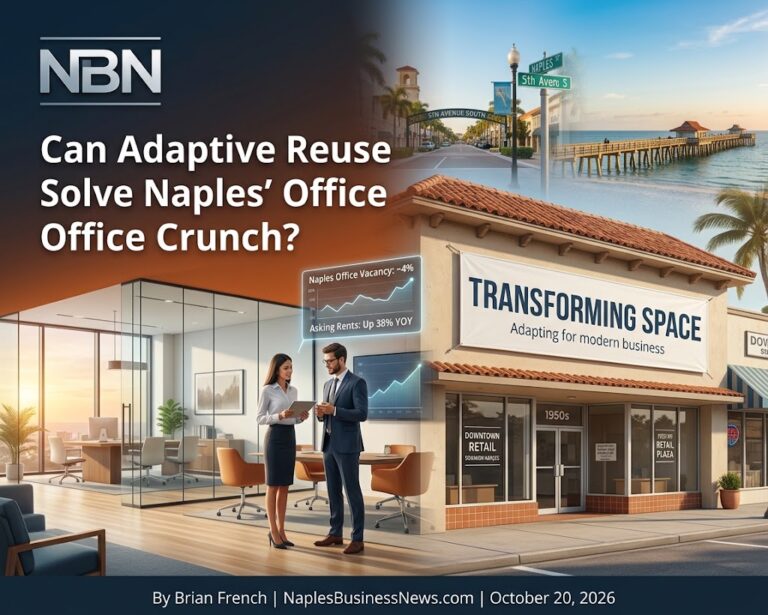
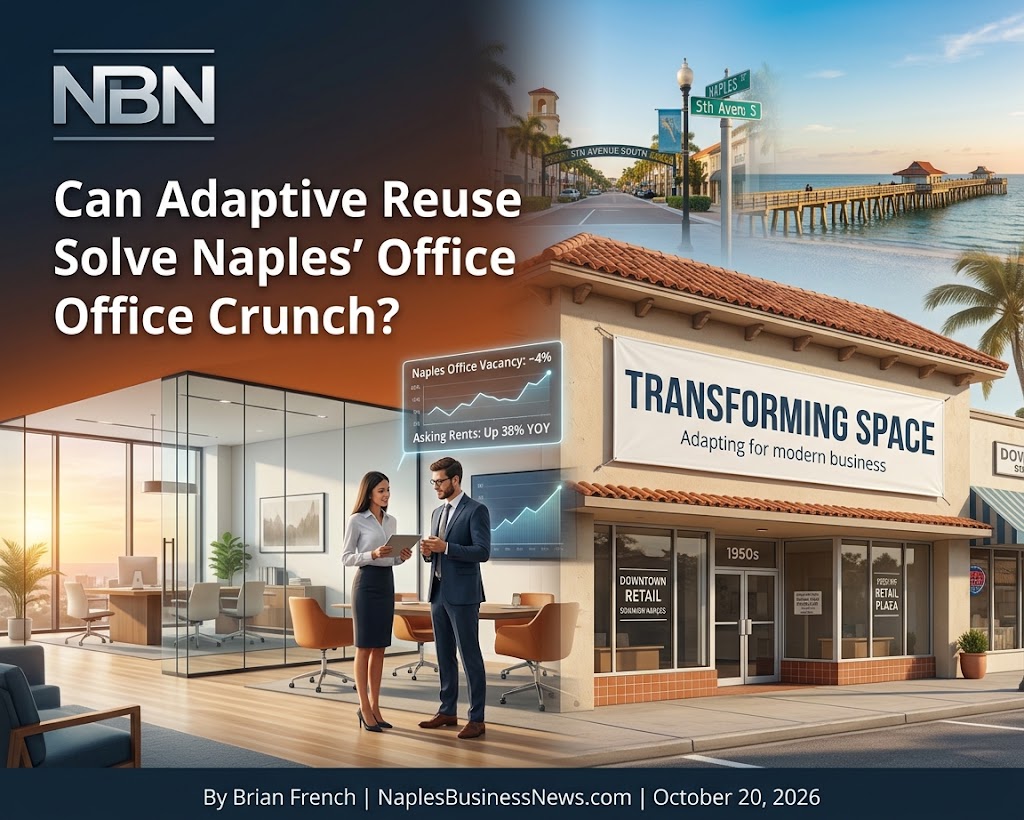
Partly. Naples office vacancy sits near 4% and asking rents have climbed roughly 38% in a year, so retrofitting older offices and retail plazas is now one of the few realistic paths to new space for boutique firms. It works best on smaller, well-located buildings with enough parking. Zoning changes, parking rules, older building systems and competition from the state’s Live Local Act housing law can erase the savings if buyers and tenants skip due diligence.
Key Numbers at a Glance
| Metric | Figure |
|---|---|
| Naples office vacancy, Q2 2026 | 4.01% |
| Avg. NNN office asking rent, Q2 2026 | $38.38/sq. ft. |
| Same rent one year earlier (Q2 2025) | $27.77/sq. ft. |
| Naples retail vacancy, Q2 2026 | 4.10% |
| Collier wetland mitigation cost | $150,000–$400,000/acre |
| Stock Plaza sale price (medical-anchored) | $406/sq. ft. |
Introduction: A Market With Almost No Room Left
Ask a Naples commercial broker what a ten-person wealth advisory, law practice or design studio can lease near downtown, and the answer is usually short. There is very little.
The numbers explain why. According to Lee & Associates, Naples office vacancy fell to 4.01% in the second quarter of 2026, down from 5.30% a year earlier, while average triple-net asking rent reached $38.38 per square foot, compared with $27.77 in Q2 2025. That is a jump of roughly 38% in twelve months. Cushman & Wakefield’s broader Southwest Florida read was similar, with overall office vacancy at 4.6% in the first quarter.
The structure of the market adds to the squeeze. Lee & Associates notes that instead of high-rise towers, Naples office inventory consists mainly of smaller, owner-occupied buildings. Owner-occupants rarely sell or sublease, so space turns over slowly.
Ground-up development is not an easy escape. Buildable commercial acreage in Naples proper is nearly gone, and land further east carries environmental costs. Wetland mitigation in Collier County has reached $150,000 to $400,000 per acre, among the highest in Florida.
That combination pushes professional firms, investors and landlords toward a different question: instead of building new, can older buildings be retrofitted into the kind of offices boutique firms want?
Zoning and Permitting Realities
Two Jurisdictions, Two Rulebooks
The first step in any Naples adaptive reuse project is confirming which government controls the parcel. The City of Naples and unincorporated Collier County have separate land development codes, separate zoning maps and separate review processes. A building on Fifth Avenue South plays by different rules than one on Airport-Pulling Road or Immokalee Road.
Use Changes Trigger the Real Review
Converting a building from one office tenant to another is usually straightforward. Converting retail to medical office, or general office to a use with more visitors, is where projects slow down. A change of use can bring new requirements for parking, fire separation, accessibility, stormwater and impact fees, even when the building’s footprint does not change.
Medical use deserves special attention. Medical office generally requires more parking per square foot than general office, so medical-ready parking is scarce and valuable. One downtown listing illustrates the point: a 2,012-square-foot freestanding office near Fifth Avenue is marketed partly on its rare medical-approved parking ratio west of U.S. 41, sits within a CRA downtown zoning overlay, and is listed at $3.8 million. That works out to nearly $1,900 per square foot, a price driven largely by entitlements rather than the building itself.
Parking Variances
Many older Naples plazas were built under parking rules that fit retail traffic patterns. When a tenant mix shifts toward offices with all-day occupancy, available spaces can run short. Owners pursuing adaptive reuse should budget time for a variance or shared-parking analysis, and should assume neighbors will weigh in during any public hearing.
Redevelopment Overlays Can Help
Some parts of the county actively encourage infill. Development standards in the Bayshore Redevelopment Area are set through the Bayshore Zoning Overlay in the Collier County Land Development Code. In July 2026 the county issued an invitation to negotiate for CRA-owned parcels there, with priority given to a performance space or multi-purpose CRA office, arts and incubator space, along with pedestrian-oriented mixed-use development. Professional firms willing to look slightly beyond the downtown core may find more flexible rules and a government partner interested in seeing buildings reused.
Historic Considerations
Older properties in historic parts of the city can face design review that limits exterior changes, window replacement and signage. That review protects the character that makes these locations desirable, but it adds time. Owners should confirm early whether a building has any historic designation before committing to a design.
Financial Feasibility: Retrofit vs. Ground-Up
Where Retrofit Wins
Adaptive reuse typically wins on three points: speed, land cost and entitlements. An existing building already has a site plan, utility connections and, in many cases, grandfathered parking or setbacks that a new project could not obtain today. It avoids the environmental permitting and mitigation that greenfield sites in eastern Collier often require. And it can deliver occupancy months or years sooner than new construction.
Where Retrofit Loses
Older buildings bring hidden costs. Roofs, HVAC systems, electrical capacity and windows may all need replacement. Buildings that predate current wind codes may require impact-rated glazing or structural upgrades once renovation crosses certain thresholds. Asbestos or lead paint in buildings from earlier decades adds abatement cost. Flood elevation is another key factor. Properties damaged in recent hurricanes or sitting below current flood requirements may face limits on how much can be spent on renovation before the entire building must be brought up to current elevation standards.
An Illustrative Comparison
The figures below are a FAN illustrative model for a 10,000-square-foot boutique office, not reported transaction data. Actual costs vary widely by building condition and location.
| Cost Element | Retrofit Older Building | Ground-Up New Build |
|---|---|---|
| Land or acquisition | Included in building price | Separate land purchase |
| Site work and mitigation | Minimal | Potentially significant |
| Shell construction | Reuse existing | Full cost |
| Systems (roof, HVAC, electrical) | Often full replacement | Included |
| Entitlement timeline | Shorter if use is permitted | Longer |
| Main risk | Hidden conditions | Cost and schedule overruns |
What the Market Is Paying for Reusable Assets
Investors are paying premiums for well-located centers with healthcare or professional tenants. Stock Plaza in East Naples, a 65,000-square-foot retail center on 8.8 acres, sold for $26.5 million to a New York-based private family office, and a local broker noted the deal reached about $406 per square foot. The buyer reportedly liked the property largely because of its medical component.
Government buyers are competing for the same space. In one example, Collier County approved spending $3.84 million on 15 office condominiums at Court Plaza III on Airport Road South to house its Community & Human Services Division. When the county itself is buying older office condos, private tenants should not expect bargains.
Financing the Conversion
With prime at 7.00% after the Federal Reserve’s September rate increase, bridge and renovation loans for older buildings carry meaningful interest costs. Lenders also tend to discount projects with uncertain entitlements. Owner-users with strong balance sheets, including many professional practices, have an advantage because they can finance a building they plan to occupy rather than lease out speculatively.
Southwest Florida Examples: What the Pattern Looks Like
Naples has relatively few large, publicized office conversions, partly because most buildings are small and privately owned. The more common pattern is incremental repositioning. Several local transactions and projects illustrate how it plays out.
Medical as the Anchor
Healthcare is the use most consistently driving reuse and repositioning in Collier County. In addition to the Stock Plaza sale, Southbrooke Medical Plaza on Immokalee Road leased its 20,000-square-foot first phase entirely to medical providers, with Continuum Surgery Center taking nearly 11,000 square feet. Lee & Associates also noted that while multifamily rents are correcting, other local sectors such as medical office remain strong. Professional firms competing for older plazas should expect medical users to bid against them.
Retail Plaza Facelifts
Many older plazas near downtown have been updated rather than demolished. Promenade Plaza on Airport-Pulling Road South, less than two miles east of downtown, underwent exterior renovations that included new architectural elements, signage, landscaping and a new color scheme. Updates like these are often the first step toward attracting service and office tenants alongside restaurants and shops.
Mixed-Use Infill in Redevelopment Areas
The Bayshore Gateway Triangle parcels show how the county is approaching reuse at a larger scale. The approved assemblage contemplates residential units, commercial space, a parking garage, classrooms, studios, administrative offices and a performance theater. For boutique firms, this kind of district can offer newer space at lower rents than downtown, with an arts and dining environment that appeals to younger employees.
The Live Local Factor
Florida’s Live Local Act affects office conversion even though it is a housing law. House Bill 1389, the fourth major version of the Act, took effect July 1, 2026. Under the law, counties and cities must allow qualifying multifamily and mixed-use residential projects on commercial, industrial and mixed-use land. The 2026 amendments also prevent local governments from limiting the authorized height of qualifying projects through setbacks, stepbacks or other dimensional rules.
For professional tenants, the effect is indirect but real. An aging commercial plaza that might once have been retrofitted for offices may now be worth more to a residential developer. Office buyers are competing not only against medical users but against housing developers armed with state preemption.
Future Outlook for Boutique Tenants
Expect Continued Tightness
Nothing in the current data suggests Naples office space will loosen soon. Population growth, wealth migration and a steady stream of financial advisors and professional practices relocating to Southwest Florida keep demand strong. Recent leasing activity cited by Lee & Associates included tenants such as Pelican Bay Financial, Clarity Wealth Financial Planning and Raymond James Financial Planning, which points to wealth management as a primary source of demand.
What Tenants Should Check Before Signing a Lease in Converted Space
- Confirm the certificate of occupancy matches your use. A space approved for retail may not be approved for office or medical use without a change-of-use permit.
- Verify parking allocations in writing. Ask how many spaces are assigned to your suite and whether the landlord has shared-parking agreements with neighbors.
- Inspect the building systems. Request the age of the roof, HVAC and electrical service. Ask who pays if a system fails.
- Understand flood and wind exposure. Ask for the building’s flood zone, elevation certificate and hurricane damage history. These affect insurance costs that are often passed through in triple-net leases.
- Clarify renovation responsibilities. Determine whether the landlord delivers finished space or a shell with an improvement allowance, and who controls the contractor schedule.
- Negotiate for operating expense caps. Converted buildings can produce surprise expense increases as older components are replaced.
What Brokers Should Emphasize
Brokers representing older properties should present entitlement status, parking counts and building system condition up front. Tenants and buyers in this market are sophisticated, and many are former executives or financial professionals. A clean entitlement package often matters more than cosmetic finishes.
Owner-Users Have the Edge
For established practices, buying rather than leasing may be the better long-term move. Ownership locks in occupancy costs in a market where rents rose 38% in a year, and it gives the firm control over renovation decisions. The trade-off is capital tied up in real estate and responsibility for building systems.
Brian’s Take
Adaptive reuse will not solve the Naples office shortage on its own. The buildings are too small, too closely held and too contested by medical and residential buyers. But for a boutique firm that needs 3,000 to 10,000 square feet, a retrofitted building is often the only realistic option within reasonable driving distance of clients in Old Naples, Park Shore and Pelican Bay.
The firms that succeed will treat a conversion like an acquisition, not a lease. That means pulling the zoning file, counting parking spaces, reading the elevation certificate and pricing the building systems before negotiating rent. The Live Local Act is the factor most tenants are not yet thinking about. Any older commercial parcel near a major corridor now has a potential housing buyer in the background, and that changes how long a landlord is willing to commit to an office tenant.
Frequently Asked Questions
How tight is the Naples office market right now?
Very tight. Lee & Associates reported Naples office vacancy at 4.01% in Q2 2026, with average triple-net asking rents of $38.38 per square foot, up from $27.77 a year earlier.
What is adaptive reuse in commercial real estate?
Adaptive reuse means converting an existing building to a new use, such as turning a retail plaza or older office into modern professional or medical space, instead of demolishing it and building new.
Is retrofitting cheaper than building new in Naples?
Often, especially once land, environmental mitigation and permitting time are included. But older buildings can carry large hidden costs for roofs, HVAC, electrical systems, wind code upgrades and flood elevation, so a detailed inspection is essential.
Does a change of use require new permits?
Usually. Moving from retail to office or medical use can trigger new requirements for parking, fire safety, accessibility and impact fees, depending on whether the property is in the City of Naples or unincorporated Collier County.
How does the Live Local Act affect office space?
The 2026 version of the law, effective July 1, requires local governments to allow qualifying affordable and workforce housing on commercial land. That can make older commercial properties more valuable to housing developers, increasing competition for buildings that might otherwise be converted to offices.
Should a professional firm lease or buy converted space?
Established firms with stable headcount often benefit from buying, since ownership protects against rapid rent increases. Firms that expect to grow or relocate may prefer the flexibility of a lease.
Sources and Further Reading
- “Naples, FL Office Market Overview, Q2 2026” — Lee & Associates
- “Naples, FL Retail Market Overview, Q2 2026” — Lee & Associates
- “Naples, FL Multifamily Market Overview, Q2 2026” — Lee & Associates
- “Fort Myers/Naples MarketBeat Reports” — Cushman & Wakefield
- “Naples Is Building More Luxury Homes Than Ever” — KiTalent
- “Redevelopment Solicitation for CRA-Owned Parcels in Bayshore Gateway Triangle” — Collier County Procurement Services (via Govly)
- “Olde Naples 5th Ave Area Freestanding Office and Redevelopment Site” — Crexi listing, Saggio Realty
- “High-Profile Stock Plaza in East Naples Sells for $26.5M” — Marco Eagle via SRS Real Estate Partners
- “Collier County to Purchase Office Suites at Court Plaza III” — Gulfshore Business
- “Naples Medical Center Fully Leased” — Business Observer
About the Author