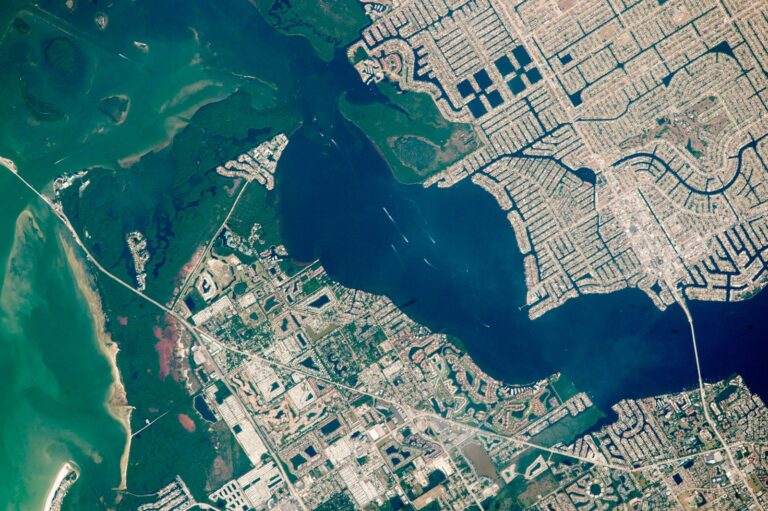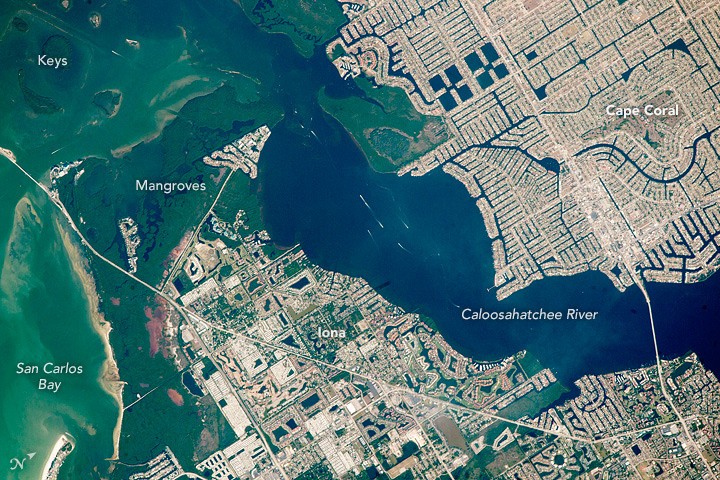
Cape Coral's canal grid seen from the International Space Station. Source: NASA Earth Observatory, science.nasa.gov, Public domain.
Quick Answer: Cape Coral built its $1.451 billion FY2027 budget on a property tax rate of 5.1988 mills, the rolled-back rate. That rate is up from 5.1471 mills because overall property values in the city slipped. With 91.4% of the city residential, voter approval of Amendment 3’s larger homestead exemption puts more pressure on Cape Coral to build its commercial and industrial tax base, a push that depends on costly utility extensions into the north and northwest Cape.
Cape Coral, which city officials call one of the fastest-growing cities in the nation, collects most of its property tax from homes rather than businesses. The fiscal year 2027 budget makes that gap plain. City budget documents show a city that is holding its tax revenue roughly flat while property values cool. It is also paying for a large utility build-out and preparing for a state-mandated cut to homestead taxes. For business owners, developers and commercial landlords in Lee County, those numbers will shape tax bills, assessments and the incentives on offer for the next several years.
What is in Cape Coral’s FY2027 budget?
On July 28, 2026, City Manager Michael Ilczyszyn released a proposed FY2027 budget of $1.451 billion. The General Fund of $285 million was described as “structurally balanced.” The city’s property tax toolkit lists the FY2027 General Fund at $284.7 million. In the release, Ilczyszyn said the plan was “designed to preserve the essential services our residents rely on every day.” He tied that to “utilizing the rolled‑back millage rate, keeping the General Fund structurally balanced.”
The fiscal year began Oct. 1, 2026. A city notice dated Sept. 4 scheduled the first public hearing, to set the tentative millage and budget, for Sept. 10 and the final hearing for Sept. 24. At an earlier meeting, council set a not-to-exceed rate of 5.1988 mills. Councilmember Dr. Derrick Donnell cast the only vote against it, the Cape Coral Breeze reported. He argued for a full rollback.
How does the FY2027 budget compare with FY2026?
| Item | FY2026 (adopted) | FY2027 (proposed) |
|---|---|---|
| Total budget | $1,434,847,653 | $1.451 billion |
| General Fund | $262,501,397 | $285 million |
| Operating millage | 5.1471 (rollback) | 5.1988 (rollback) |
| Budget Sustainability Reserve | $62.2 million (2.8 months) | $62.7 million (2.9 months) |
| Fire Service Assessment cost recovery | 81% | 81% |
| Stormwater fee (per ERU) | $156 | $163 |
Sources: City of Cape Coral releases; Cape Coral Breeze reporting on council actions. FY2026 totals as reported by the Cape Coral Breeze.
Why did the millage rate go up if taxes are “rolled back”?
A rolled-back rate is the rate that brings in about the same property tax revenue as the year before. When values rise, the rollback rate falls. When values fall, it rises. For FY2026, council cut the rate from 5.2188 to 5.1471 mills, the rollback rate at the time. For FY2027, the Breeze reported that the rollback rate rose slightly to 5.1988 “because overall property valuation has declined.” One mill equals $1 for every $1,000 of taxable value. On $300,000 of taxable value, the 0.0517-mill difference works out to about $15.51 a year in city operating tax.
There is a separate voter-approved general obligation levy for parks debt of 0.1554 mills, according to the Breeze.
How fast is Cape Coral’s population growing?
The University of Florida’s Bureau of Economic and Business Research (BEBR) estimated Cape Coral’s population at 222,862 as of April 1, 2025. That is up 28,846 from the 194,016 counted in the 2020 Census, a gain of about 14.9% in five years. Lee County as a whole grew from 760,822 to 839,223 over the same period. Cape Coral alone accounted for about 37% of the county’s 78,401 new residents.
| Area | 2020 Census | April 1, 2025 estimate | Change |
|---|---|---|---|
| Cape Coral | 194,016 | 222,862 | +28,846 |
| Fort Myers | 86,395 | 102,060 | +15,665 |
| Lee County | 760,822 | 839,223 | +78,401 |
| Collier County | 375,752 | 413,314 | +37,562 |
Source: Florida Estimates of Population 2025, BEBR, University of Florida.
The city’s economic development office uses higher numbers. Its market snapshot puts the population at about 242,000, growing 3.5% a year, and projects 375,000 residents by 2050. It says the city is about 60% built out and expects 75% of new development to land in North Cape Coral.
How residential is Cape Coral’s tax base?
The city’s own property tax toolkit states it directly: 91.4% of the city is residential, and the city has “no large commercial tax base.” It also reports that 60.8% of improved residential properties carry a homestead exemption. In its June coverage of the 2026 tax roll, the Breeze likewise described the city as “overwhelmingly made up of homestead residential properties.”
That mix matters because the General Fund leans on property tax. The toolkit shows current ad valorem revenue of $163.3 million. Public safety alone costs $114.5 million, which leaves roughly $49 million for everything else the General Fund pays for. The proposed FY2027 budget puts police at $97.7 million and fire at $97.6 million, plus $2.4 million for emergency management and an $8 million disaster reserve.
What did the 2026 tax roll show for Cape Coral?
The Lee County Property Appraiser’s 2026 estimated roll, released in late May and reported by the Breeze on June 3, showed market value falling while taxable value still rose because of assessment caps:
| Cape Coral measure | 2025 | 2026 estimate | Change |
|---|---|---|---|
| Just (market) value | $46.74 billion | $45.74 billion | -2.15% |
| Assessed value | $37.24 billion | $38.23 billion | +2.65% |
| Taxable value | $32.04 billion | $32.79 billion | +2.34% |
| New construction (just value) | $1.61 billion | $1.30 billion | -19% |
Source: Lee County Property Appraiser 2026 estimated roll, as reported by the Cape Coral Breeze, June 3, 2026.
“When you consider how large Cape Coral is as part of the tax roll now, it really drives the county wide results,” Lee County Property Appraiser Matt Caldwell said. By the time the budget was proposed in late July, the city said overall valuation had declined, which pushed the rollback rate up.
How will Amendment 3 affect Cape Coral’s budget?
Florida voters approved Amendment 3 on Nov. 3, 2026, with 62% of the vote, Spectrum News reported. The measure raises the homestead exemption from about $50,000 to $150,000 in 2027 and to $250,000 in 2028. Before the vote, the city’s toolkit cited projections from the state Office of Economic and Demographic Research. Those projections showed the city losing $31.1 million in homestead-related revenue in year one (2028) and $56.9 million in year two (2029). In year two, ad valorem revenue left after the exemption loss would fall $15 million short of projected public safety costs.
Because so much of Cape Coral’s tax base is homesteaded, the exemption shifts the remaining burden toward non-homestead property: commercial parcels, rentals, second homes and vacant lots. A Breeze editorial in April noted that those properties would generally pay more if the millage rose. Council has also discussed other revenue options, according to that editorial:
- Raising fire service cost recovery to 100%, worth about $14.5 million more.
- Adding 3% to the Public Service Tax, lifting it from $16 million to $22.9 million.
- A local sales tax of a half-cent to 1.5 cents, if the state allows it.
What is Cape Coral doing to grow its commercial and industrial base?
The FY2027 proposal sets aside $3 million for an economic development incentives reserve. The city’s main tool for large projects is the Enhanced Property Value Recapture Grant. It rebates part of the increase in city property taxes on new non-residential, light industrial, warehousing, logistics or qualifying mixed-use projects of at least $10 million. Outside the South Cape Community Redevelopment Area, mixed-use projects must devote at least 20% of their space to non-residential uses.
| Projected taxable value | Maximum rebate | Incentive period |
|---|---|---|
| $10M to $24.99M | 50% | 10 years |
| $25M to $44.99M | 75% | 15 years |
| $45M to $99.99M | 90% to 95% | 20 years (city); remaining life (CRA) |
| $100M and above | 95% | 25 years |
Source: City of Cape Coral, Enhanced Property Value Recapture Grant program summary.
Incentive payments are capped at 20% of total project cost, not counting land. They apply only to city taxes, not to county, school or special assessments.
The city’s market snapshot shows how large the gap is. It estimates the city needs 3.6 million more square feet of office, retail and business space by 2030 and 200 acres of industrial land by 2050. It says about 58,000 skilled residents commute out of the city every day. It also projects 4,234 new jobs from 2022 to 2030, and estimates that utility extensions in northwest Cape Coral will open more than 2,000 acres of vacant land to commercial development.
What do Cape Coral’s utility expansion projects cost?
Utilities are the largest capital item in the FY2027 proposal:
- $400 million for the North Water Reclamation Facility
- $37.1 million for North 3 Utilities Extension Project (UEP) water, sewer and irrigation lines
- $16 million for Everest headworks
- $15.5 million for phase II of the North Reverse Osmosis Plant wellfield expansion
- Smaller amounts for lift stations, inflow and infiltration repairs, and pump stations
How much do UEP assessments cost property owners?
Owners pay for line extensions through special assessments. For North 1 East, which council advanced in November 2025, the Breeze reported these figures:
- A standard 10,000-square-foot parcel is assessed $25,538 for water, sewer and irrigation.
- A capital facility expansion charge adds $6,759, for $32,288 combined. Larger lots pay more.
- Grants reduce the total by $4,000.
- Owners who finance pay on the tax bill starting November 2026: $3,385 a year over 30 years, or $3,961 a year over 20 years, at an interest rate of up to 6.25%.
- Plumbing hookups, about $3,000, and a $225 deposit are extra.
The North 1 East project covers 3,900 parcels, and its component cost is $227.5 million including soft costs. “These costs are significant,” Councilmember Joe Kilraine said at the meeting.
North 3 is next. It covers about 3 square miles of northwest Cape Coral bounded by Burnt Store Road and Kismet Parkway, with about 1,900 improved and 3,200 unimproved parcels. City project pages show construction expected to start by the end of 2026 and finish by the end of 2028. Assessment amounts for North 3 were not posted on the project page reviewed for this article.
What does this mean for Southwest Florida businesses?
For commercial property owners, the main point is concentration risk. The homestead exemption will remove a larger share of residential value from the tax roll starting in 2027. That leaves non-homestead property to carry more of any future rate increase or new fee, and that property includes every store, office and warehouse in the city. Council has already looked at a higher fire assessment, a higher public service tax and a local sales tax as alternatives.
For developers, the picture is more mixed. The recapture grant can return up to 95% of new city property taxes for as long as 25 years. Utility extensions are opening land along the Burnt Store corridor. But capital costs are high, debt capacity is limited, and Stantec’s Peter Napoli warned council in February that “the expense growth far exceeds the revenue growth” over five years. The city’s credit ratings remain among the highest categories, PFM’s Julie Santamaria told council. She also said the city would have limited room for new debt without new revenue or spending cuts.
For employers across Lee, Collier and Charlotte counties, the 58,000 residents who commute out of Cape Coral each day are both a labor pool and a sign of how few jobs the city itself supports. Whether the North Cape fills with commercial and industrial uses or with more homes will decide how heavily Cape Coral leans on homeowners, and how much it can lean on businesses.
Frequently Asked Questions
What is Cape Coral’s property tax rate for FY2027?
The FY2027 budget was built on an operating rate of 5.1988 mills, the rolled-back rate. Council also set it as the not-to-exceed cap. That is up from 5.1471 mills in FY2026. There is also a separate parks debt levy of 0.1554 mills.
What share of Cape Coral is residential?
The city says 91.4% of Cape Coral is residential and it has no large commercial tax base. About 60.8% of improved residential properties are homesteaded.
How much is a Cape Coral UEP assessment?
For North 1 East, a standard parcel is assessed $32,288, including the capital facility charge, before $4,000 in grants. Thirty-year financing runs $3,385 a year.
Does Cape Coral offer incentives to businesses?
Yes. The Enhanced Property Value Recapture Grant rebates 50% to 95% of new city property taxes for qualifying projects of $10 million or more, for 10 to 25 years. FY2027 also includes a $3 million incentive reserve.
How will Amendment 3 affect Cape Coral?
State projections cited by the city estimate revenue losses of $31.1 million in 2028 and $56.9 million in 2029 as the homestead exemption rises to $150,000 and then $250,000.
Sources and Further Reading
- City Manager Michael Ilczyszyn Releases FY27 Proposed Budget Centered on Stability and Infrastructure — City of Cape Coral
- FY27 Budget Public Hearings set for September 10 & 24 — City of Cape Coral
- City Council Approves 2026 Budget, Lowers Millage Rate — City of Cape Coral
- Your Property Taxes in Action (Property Tax Toolkit) — City of Cape Coral
- Cape Coral Market Snapshot — City of Cape Coral Office of Economic and Business Development
- Enhanced Property Value Recapture Grant — City of Cape Coral
- North 3 UEP (Design) — City of Cape Coral
- Florida Estimates of Population 2025 — Bureau of Economic and Business Research, University of Florida
- City Manager releases FY27 Proposed Budget; City sets millage cap — Cape Coral Breeze
- Overall property valuations show market slowdown — Cape Coral Breeze
- Budget workshop day 2: Property taxes, impact fees, surplus funds and more — Cape Coral Breeze
- Editorial: The challenge of taxing times ahead — Cape Coral Breeze
- Cape Council gives nod to UEP assessment for properties in North 1 East — Cape Coral Breeze
- Amendment 3 raises Florida homestead exemption starting in 2027 — Spectrum News 13
About the Author