By Brian French | October 6, 2026
Quick Answer
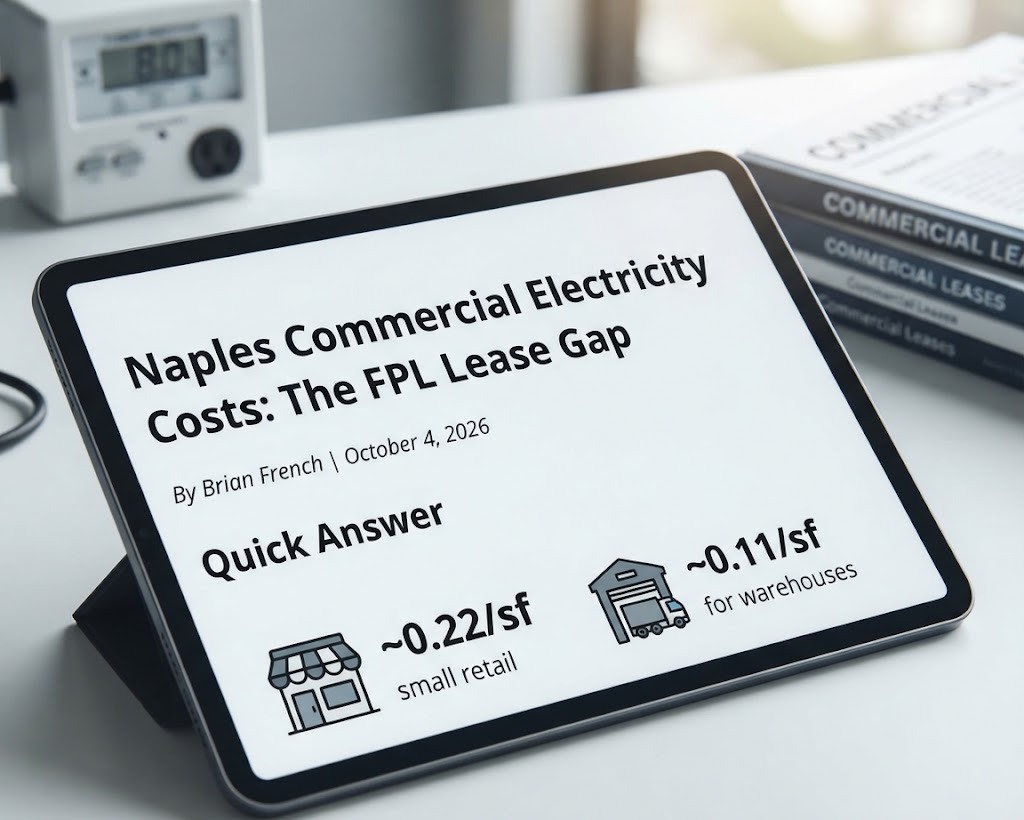
A typical small Naples retail storefront on FPL’s GS-1 rate may spend roughly $0.20 to $0.30 per square foot per month on electricity, while a non-refrigerated warehouse on the GSD-1 demand rate may spend about $0.10 to $0.15. These are modeled estimates based on 2026 FPL tariffs and federal energy-use data; actual costs depend heavily on cooling load and peak demand.
The Line Item Leases Rarely Explain
Most Naples commercial leases spell out base rent, CAM charges, taxes, and insurance in detail. Electricity usually gets one line: tenant pays utilities. That leaves many business owners surprised when summer bills arrive, especially in Southwest Florida, where air conditioning runs most of the year.
The problem is not just how much power a space uses. It is how FPL bills commercial customers, which is very different from residential service and often misunderstood.
How FPL Bills Naples Businesses in 2026
Commercial Rates Are Not Tiered Like Home Bills
Residential FPL customers pay a higher rate above 1,000 kWh a month. Commercial customers do not face that tier. Instead, small businesses pay a flat energy rate, and larger ones pay a demand charge based on their highest usage.
| Rate Schedule | Who It Serves | How It Bills |
|---|---|---|
| GS-1 (General Service Non-Demand) | Smaller businesses, roughly under 25 kW | Monthly charge plus per-kWh energy |
| GSD-1 (General Service Demand) | 25 to 499 kW | Monthly charge, per-kW demand, plus per-kWh energy |
| GSDT-1 (Demand Time-of-Use) | 25 to 499 kW, optional | Lower off-peak energy, demand charged on-peak |
| GSLD-1 | 500 to 1,999 kW | Large demand rate |
FPL’s tariff defines GS-1 as General Service Non-Demand for 0 to 24 kW and GSD-1 as General Service Demand for 25 to 499 kW.
Key 2026 Rate Components
| Component | GS-1 | GSD-1 |
|---|---|---|
| Monthly base charge | $14.20 | $33.71 |
| Base energy charge | 8.039¢/kWh | 2.825¢/kWh |
| Base demand charge | None | $12.70/kW |
| Fuel charge | 3.202¢/kWh | 3.201¢/kWh |
Source: FPL Business Rates and Clauses, effective January 2026. Additional clause charges, credits, and taxes apply.
Adding the January 2026 clause charges and fuel, a GS-1 customer’s all-in energy cost works out to roughly 12.7 cents per kWh before taxes and fees. For GSD-1 customers, the energy charge is lower, but the demand charge can represent a large share of the bill. One rate analysis estimates demand charges represent 30% to 40% of the total bill for GSD-1 and GSLD-1 customers.
Why Demand Charges Matter in Naples
FPL measures demand as a customer’s highest usage over a short interval during the billing period. In a hot afternoon, when every rooftop unit cycles on at once, a building can set a demand peak that drives the bill for the entire month. FPL explains that the demand charge partially offsets the cost of the plants and equipment needed to meet peak load.
Modeled Cost per Square Foot by Property Type
There is no public database of electricity costs by Naples submarket. To give business owners a working benchmark, FAN modeled two typical property types using FPL’s 2026 tariff and federal Commercial Buildings Energy Consumption Survey (CBECS) data for hot-humid climates.
The Inputs
In the hot-humid climate zone, CBECS reports average electricity use of 20.5 kWh per square foot per year for retail (other than malls) and 11.5 kWh for warehouse and storage. Hot-humid buildings overall use 5.4 kWh per square foot per year for cooling alone.
Estimated Monthly Electricity Cost per Square Foot
| Property Type | Example Area | Typical Rate | Annual Avg. | Summer Peak Months |
|---|---|---|---|---|
| Small retail storefront (2,000 sf) | Fifth Avenue South | GS-1 | ~$0.22/sf | ~$0.28–$0.30/sf |
| Non-refrigerated warehouse (20,000 sf) | Naples Airport area industrial parks | GSD-1 | ~$0.11/sf | ~$0.13–$0.15/sf |
| Restaurant or food service | Any submarket | GS-1 or GSD-1 | Substantially higher | Substantially higher |
FAN modeled estimate. Retail: 20.5 kWh/sf/year at about 12.7¢/kWh. Warehouse: 11.5 kWh/sf/year on GSD-1 at an assumed 40% load factor, where demand charges are about 44% of the bill. Summer estimates assume usage roughly 30% to 35% above the annual average. Excludes taxes, franchise fees, and common-area charges.
What the Model Shows
- Retail pays more per square foot because storefronts have heavy lighting, frequent door openings, large glass areas, and customer occupancy that all add cooling load.
- Warehouses pay less per square foot but are more exposed to demand charges. In the model, nearly half the warehouse bill comes from peak demand, not energy use.
- Food service is in a different league. EIA data shows food service buildings use about 263,000 Btu per square foot, nearly four times the commercial average of 70,000 Btu.
The Cooling Efficiency Audit Index
To help property managers compare spaces before signing a lease, FAN developed a simple five-factor scorecard. Score each factor 0 (poor), 1 (average), or 2 (strong). A total of 8 to 10 suggests a well-controlled space; 4 or below signals high cooling cost risk.
| Factor | What to Check | Score 2 If |
|---|---|---|
| HVAC age and efficiency | Unit nameplates and service records | Units under 10 years, high efficiency |
| Controls | Thermostats and scheduling | Smart, scheduled, or building automation |
| Solar gain | Glass area, orientation, shading | Low-E glass, film, or shading on sun-facing glass |
| Ventilation | Fresh air management | Demand-controlled ventilation or ERV |
| Metering and data | Interval data access | Tenant can see demand peaks |
FAN framework for comparing commercial spaces. Not an FPL or industry-standard rating.
How Smart Building Automation Changes the Bill
Automation does not change FPL’s rate structure, and commercial customers face no residential-style tier to escape. What automation can change is when and how hard equipment runs.
- Peak shaving: Staggering rooftop unit start times and pre-cooling before the afternoon peak can lower the monthly demand peak on GSD-1 bills.
- Scheduling: Setting back temperatures after hours cuts energy use on all rate schedules.
- Time-of-use rates: GSD-1 customers who can shift usage may benefit from GSDT-1, which charges demand during on-peak periods and offers lower off-peak energy rates.
- Ventilation control: FPL says demand-controlled ventilation can save as much as 20% a year on HVAC energy costs.
FPL Programs Naples Businesses Can Use
- Business Energy Evaluation: A free on-site analysis in which an FPL energy expert reviews equipment and usage.
- Business On Call: Credits of $2 per ton per month from April through October in exchange for allowing FPL to cycle A/C during peak demand.
- Commercial Demand Reduction: For facilities averaging at least 200 kW during summer peak hours, credits of $9.75 per enrolled kW.
- Rebates: FPL offers incentives for high-efficiency direct expansion A/C, demand-controlled ventilation, energy recovery ventilation, and thermal energy storage. Confirm current amounts and eligibility with FPL.
3 HVAC Optimization Steps for Naples Property Managers
- Request interval data and find the peak. Ask FPL for demand data, identify when the monthly peak occurs, and stagger equipment start-up to flatten it.
- Schedule a free FPL Business Energy Evaluation. Use the findings to prioritize controls, ventilation upgrades, and rebate-eligible equipment.
- Write energy terms into the lease. Require HVAC maintenance records, disclose average utility costs for the prior 12 months, and clarify who pays for efficiency upgrades.
Brian’s Take
Electricity is one of the most underanalyzed costs in Naples commercial leases. Tenants negotiate hard over base rent and CAM, then accept “tenant pays utilities” without asking what that means. In a market where cooling runs most of the year, that line can add meaningfully to effective occupancy cost.
From an investment standpoint, the key insight is that larger commercial bills are driven as much by when power is used as by how much. For GSD-1 customers, a single hot afternoon can set the demand charge for the month. That makes controls and scheduling some of the highest-return upgrades available, often cheaper than new equipment.
For landlords, energy performance is becoming a leasing advantage. A building that can show tenants 12 months of utility history, modern controls, and enrollment in FPL programs gives tenants more certainty. I would encourage both sides of every Naples lease to put energy disclosure on the table before signing.
Frequently Asked Questions
What is the average commercial electricity cost per square foot in Naples, FL?
FAN modeling based on 2026 FPL rates and federal energy data estimates about $0.22 per square foot per month for a typical small retail space and about $0.11 for a non-refrigerated warehouse, with higher costs in summer and much higher costs for restaurants.
What does FPL charge businesses per kWh in 2026?
For small GS-1 customers, the all-in energy cost works out to roughly 12.7 cents per kWh before taxes and fees, plus a $14.20 monthly base charge. GSD-1 customers pay a lower energy rate plus a demand charge of $12.70 per kW before clauses.
Does FPL use tiered pricing for businesses?
No. The 1,000 kWh tier applies to residential customers. Commercial customers pay either a flat energy rate (GS-1) or energy plus demand charges (GSD-1 and larger).
How can Naples businesses lower FPL bills?
Reduce peak demand by staggering HVAC start times, use scheduling and smart controls, consider time-of-use rates, enroll in Business On Call or Commercial Demand Reduction, and schedule a free FPL Business Energy Evaluation.
What is a demand charge?
A charge based on a business’s highest usage during a short interval in the billing period, rather than total energy consumed. It helps cover the cost of infrastructure needed to meet peak load.
Sources and Further Reading
- Business Rates and Clauses, Effective January 2026 — FPL: https://www.fpl.com/content/dam/fplgp/us/en/rates/pdf/bus-eff-jan-2026.pdf
- Electric Tariff, Section 8 Rate Schedules — FPL: https://www.fpl.com/rates/pdf/electric-tariff-section8.pdf
- FPL Rate Optimization Guide — Nectar: https://nectarclimate.com/rates/florida-power-light-co
- Understanding Energy Demand — FPL: https://www.fpl.com/blog/understand-energy-demand.html
- Table C20, Electricity Intensity by Climate Region — EIA CBECS 2012: https://www.eia.gov/consumption/commercial/data/2012/c&e/cfm/c20.php
- Table E6, Electricity Consumption Intensities by End Use — EIA CBECS 2012: https://www.eia.gov/consumption/commercial/data/2012/c&e/cfm/e6.php
- Food Service Buildings Are Highly Energy Intensive — EIA: https://www.eia.gov/todayinenergy/detail.php?id=60241
- Business Programs and Services — FPL: https://www.fpl.com/content/dam/fplgp/us/en/business/save/programs/pdf/programs-services.pdf
- Business On Call — FPL: https://www.fpl.com/business/save/programs/oncall.html
- Commercial Demand Reduction — FPL: https://www.fpl.com/business/save/programs/demand-response.html
- Business Programs and Resources — FPL: https://www-go.fpl.com/business/save/programs.html
- Rebates and Incentives Overview — FPL: https://www.fpl.com/content/dam/fplgp/us/en/landing/pdf/mga.pdf
About the Author