How Much Does It Cost to Hire a General Contractor for a Warehouse or Distribution Center in Naples, Florida?
A 2026 analysis from Naples Business News introducing the Naples Cost Stack — and the finding that the number most owners negotiate hardest is one of the smallest numbers in the project.
By Brian French | Naples Business News | Florida Authority Network
Published: July 28, 2026 · Last reviewed: July 28, 2026
Answer in Brief
A general contractor’s fee on a Collier County warehouse project is conventionally a single-digit percentage of construction cost — and it is one of the smallest layers in the total. Land, entitlement, sitework, carrying cost, and soft costs together dwarf it. Before you solicit a single bid, understand two things: Naples is not a distribution market — countywide industrial inventory is a fraction of a single modern distribution building — and the site you choose within Collier County will move your economics more than any contractor negotiation ever will.
Key Takeaways
- “What does a GC cost” is three different questions. Most owners ask about the fee, get quoted a cost per square foot, and are surprised by total delivered cost.
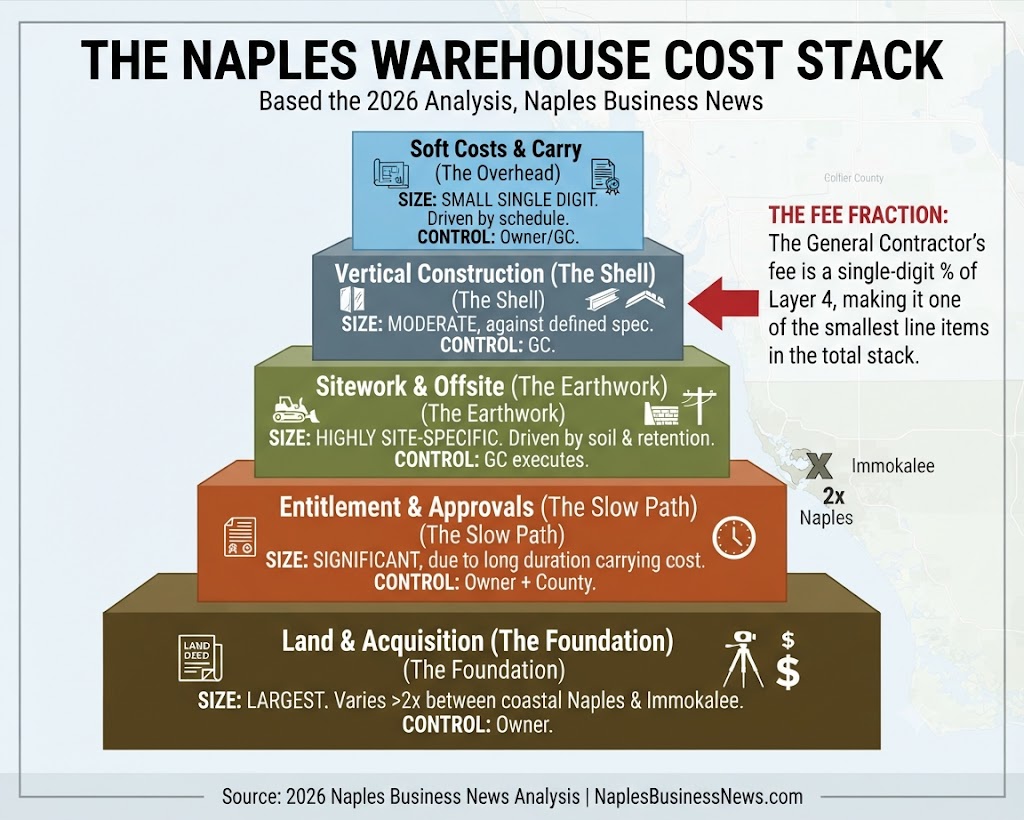
- The Naples Cost Stack has five layers. The GC’s fee sits inside one of them and is typically the smallest negotiable line in the project.
- Collier County is a small-bay industrial market, not a big-box distribution market. Industrial is roughly 20% of local commercial space against a national average near 24%, and recent countywide industrial for sale has totaled around 600,000 SF across dozens of properties.
- Asking industrial lease rates inside Collier County vary by roughly 2x between coastal Naples and Immokalee. That spread is the largest single cost lever available to you, and it is a decision you make before hiring anyone.
- Four Collier multipliers push local costs above national model outputs: wind load, entitlement duration, land basis, and insurance.
- Delivery structure matters more than fee percentage. Lump sum, GMP, design-build, and CM-at-risk allocate risk differently, and the allocation usually decides the final number.
Start Here: You Are Probably Asking the Wrong Question
“How much does it cost to hire a general contractor” sounds like one question. It is three, and they have very different answers.
| The question you meant | The unit | How knowable it is |
|---|---|---|
| 1. What is the GC’s fee? | A percentage of construction cost | Highly knowable, narrow range, and the least consequential of the three |
| 2. What will the building cost? | Dollars per square foot, construction only | Knowable only against a defined specification. Varies enormously. |
| 3. What will the project cost? | Total delivered cost, all in | The only number that matters. Requires a site, a program, and a schedule. |
Almost every owner starts at question one, because it feels like the thing you can control. It is also, in a warehouse project, close to a rounding error relative to the decisions made in the six months before a general contractor is ever engaged.
Why we are not publishing a dollars-per-square-foot number. You will find plenty of them online. Nearly all are national averages, most are stale, and none of them know your site, your clear height, your slab loading, your dock count, your fire protection requirement, your wind exposure category, or your soil conditions. A cost-per-square-foot figure without a specification attached is not information. It is a number that looks like information, which is worse, because it will anchor your expectations and your financing conversation to something that was never true about your project.
What follows instead is the structure — what the layers are, which ones are large, which ones are local, and exactly what to ask so that the numbers you eventually receive are comparable to each other.
Brian’s Take
In my analyst years, the most dangerous thing you could do was answer a malformed question. Not refuse it — answer it. Because the moment you produce a number, the number takes on a life entirely independent of the assumptions underneath it.
I watched this happen repeatedly. Someone would ask what a company was worth. You would give a figure with four pages of caveats attached. Two weeks later the figure was in a board presentation, the caveats were gone, and a decision was being made on the strength of a number that had been conditional when it left your desk and was now being treated as a fact.
“What does it cost to build a warehouse in Naples” is that question. There is a number that would satisfy the person asking. It would be plausible. And it would be wrong for nearly every specific project, because the variance between a bare-shell distribution building on clean, zoned, upland dirt and a refrigerated facility on a constrained site requiring rezoning is not a matter of a few percent. It is a multiple.
So I would rather do what a good analyst does when handed a bad question, which is not to refuse it but to reframe it into the question that can actually be answered, and then answer that one thoroughly.
The answerable question is: what are the layers of cost in a Collier County industrial project, which ones dominate, and what do I need to know before I can price mine? That question has a real answer, it is the same answer for everyone, and it is genuinely useful.
— Brian French
First, the Uncomfortable Site Selection Finding
Before any of the cost discussion, a structural fact about this market that will save some readers several months.
Collier County is not a distribution market.
The industrial inventory here is small and it is the wrong shape. Industrial space represents approximately 20% of total commercial space in Collier County, against a national average closer to 24%. Recent listings data showed roughly 47 industrial properties for sale countywide totaling about 601,456 square feet.
Sit with that second figure. Six hundred thousand square feet is the county’s entire for-sale industrial inventory across dozens of separate properties. A single modern regional distribution building is frequently larger than that by itself.
And the shape is small-bay. Current Collier industrial listings run in the range of 1,250 SF, 3,075 SF, 3,750 SF, 9,776 SF, 23,877 SF. These are flex and service-industrial buildings — contractor space, light manufacturing, service businesses, small warehouse-plus-office configurations. They serve the local economy. They are not distribution product.
What Collier County actually is, industrially: a last-mile and local-service market. Businesses that need warehouse space here overwhelmingly need it to serve Collier County itself — a trades contractor storing materials, a distributor servicing local accounts, a company holding inventory for regional delivery.
If you need genuine regional distribution — a facility positioned to serve Southwest Florida or the broader state, with trailer courts, dock doors in double digits, high clear heights, and interstate proximity — the honest answer is that Lee County and the wider I-75 corridor have deeper industrial inventory, more appropriate land, and a labor shed built for it. That is not a knock on Collier. It is a description of what this county was developed to be.
The 2x lever inside Collier County
If Collier County is the right answer for your operation, then the largest cost decision you will make happens on a map, not in a bid.
Recent asking rates on Collier County industrial listings show a striking internal spread:
| Submarket | Example asking rate | Character |
|---|---|---|
| Coastal / central Naples (Curry Island, Tollhouse Dr) | $20.00 – $22.00 /SF/yr | Small-bay flex, scarce land, competing higher-value uses |
| Immokalee (eastern Collier) | $11.50 /SF/yr | Industrial park setting, ~40 min to Naples and Fort Myers, ~10 min to Ave Maria |
These are individual listing asking rates from public aggregator platforms, not market medians, and they are illustrative of the spread rather than a measured survey. Confirm current rates with a Collier County commercial broker.
Roughly a 2x differential inside a single county. The same dynamic applies to land basis, and for the same reason: coastal Collier land is priced against residential, retail, and medical uses that will always outbid industrial, while eastern Collier land is not.
The strategic consequence. If your operation genuinely requires proximity to coastal Naples customers, you pay for it and that is a legitimate business decision. But a great many “Naples warehouse” requirements do not, in fact, require a coastal Naples address — they require Collier County service coverage, which Immokalee Road corridor, Ave Maria, and Immokalee sites can provide at a materially different basis.
Test it honestly. Calculate the annual delivered cost of the eastern site including additional drive time, fuel, and driver hours, and compare it against the occupancy savings. In many operations the eastern site wins decisively. In some it does not. But run the number, because no contractor negotiation on earth will recover a 2x occupancy differential, and this is the one decision that is entirely yours before anyone else is involved.
Brian’s Take
There is a hierarchy of decisions in any capital project, and it is almost perfectly inverted relative to the attention people give it.
I saw the identical inversion in investing for twenty-five years. Clients would spend enormous energy on manager selection — interviews, due diligence questionnaires, performance attribution — and comparatively little on asset allocation. And the research was unambiguous: allocation explained the overwhelming majority of the outcome, and manager selection explained a small remainder.
People did it backwards because manager selection feels like the decision. It has faces attached. You meet people, you form impressions, you exercise judgment. Allocation is an abstraction on a spreadsheet, and abstractions do not feel like decisions even when they are the only ones that matter.
Site selection is the asset allocation of a construction project. Contractor selection is manager selection.
Both matter — and I want to be clear that a bad contractor can absolutely destroy a project, so this is not an argument for carelessness there. But if you spread the two decisions on a table and asked which one moves your ten-year economics more, it is not close. A two-times occupancy differential compounds for as long as you hold the building. A hundred basis points of contractor fee is a one-time cost on a fraction of the total.
Spend your first month on the map. Spend the second on the bids. Most owners do it in exactly the opposite order, and by the time they are negotiating fee points they have already locked in the number that decided the outcome.
— Brian French
The Naples Cost Stack: Five Layers
Definition: The Naples Cost Stack is a five-layer model of total delivered cost for an industrial project in Collier County, introduced by Naples Business News in 2026. Its purpose is to locate the general contractor’s fee accurately within the whole — and to redirect owner attention toward the layers that actually decide the outcome.
| Layer | What’s in it | Who controls it |
|---|---|---|
| 1. Land & acquisition | Purchase price, closing costs, survey, environmental Phase I and II, geotechnical, title | You, entirely |
| 2. Entitlement & approvals | Zoning or PUD amendment, site development plan, environmental and wetlands review, traffic study, impact fees, utility commitments, consultant and legal fees | You + your consultants + the county |
| 3. Sitework & offsite | Clearing, fill and grading, stormwater and retention, utilities extension, paving, truck court, turn lanes and offsite road improvements | Site conditions dictate; GC or site contractor executes |
| 4. Vertical construction | Foundations, slab, structure, envelope, roof, dock equipment, fire protection, MEP, office buildout — and the GC’s general conditions and fee | Your specification + the GC |
| 5. Soft costs & carry | Architecture and engineering, construction financing interest, builder’s risk insurance, legal, FF&E, racking and equipment, commissioning, contingency | Schedule duration drives much of it |
The Fee Fraction. The general contractor’s fee lives inside Layer 4 and, expressed against total delivered cost across all five layers, is a small single-digit share on most projects.
That is the point of the framework. An owner who negotiates a fee concession has moved a small share of a small layer. The same owner who mis-sizes retention in Layer 3, or absorbs an additional eight months of entitlement in Layer 2, has moved something far larger and typically did not model it at all.
The Four Collier Multipliers
National cost models and out-of-state benchmarks systematically understate Collier County. Four local factors explain most of the gap.
1. Wind load
Collier County sits on Florida’s southwest Gulf coast, and the Florida Building Code imposes wind design requirements that are among the most demanding in the United States. For a large-footprint, lightweight-roof building — which is exactly what a warehouse is — wind is not a detail. It drives structural system selection, connection design, roof assembly, wall panel engineering, and the entire opening schedule.
Cost consequence: a tilt-up or pre-engineered metal building designed for Collier County exposure carries structural cost that an identical building in Georgia, Tennessee, or inland Texas does not. Any estimate borrowed from a project in those markets will be wrong in the same direction every time.
What to confirm early: your site’s design wind speed and exposure category, whether it falls within a wind-borne debris region, and the resulting requirements for doors, windows, louvers, and roof attachment. This is an early conversation with your structural engineer, not a late one with your contractor — it belongs in the concept design, because it can change the economics of the whole building type.
2. Entitlement duration
The most underestimated cost line in Collier County industrial development, because it does not appear as a cost at all. It appears as a schedule.
Every month between land acquisition and construction start is a month of carrying cost: land debt service or opportunity cost on equity, property taxes, insurance, consultant fees, and the operational cost of not having the facility you needed. On a project of any scale, that accrues to a serious number.
What drives duration in Collier County:
- Whether the land is already zoned for your use. This is the single biggest schedule variable. A site with existing appropriate industrial zoning is a fundamentally different project from one requiring a rezoning or a planned unit development amendment.
- Site development plan review through the Collier County Growth Management Community Development Department, including review cycles and resubmittals.
- Environmental and wetlands review. Eastern Collier County contains extensive wetlands and protected habitat, and projects there may involve state and federal review in addition to county process. This is where schedules expand most unpredictably.
- Traffic study and offsite improvement requirements, which can trigger turn lanes, signalization, or road improvements that are both a schedule item and a Layer 3 cost item.
- Utility availability. Whether water, sewer, and adequate power exist at the property line, or must be extended.
The practical instruction: before you go under contract on any Collier County industrial site, engage a local land use attorney and civil engineer for a written entitlement assessment, and negotiate a due diligence period long enough to complete it. Then model the schedule as a cost line in your pro forma — carrying cost per month multiplied by realistic duration, with a downside case. That single line will change how you evaluate competing sites.
3. Land basis
Covered above, and worth restating in cost-stack terms: coastal Collier industrial land competes against residential, retail, and medical uses that generate higher returns per acre and will consistently outbid warehouse. That is not a market failure; it is a market working. But it means industrial land west of I-75 carries a basis that big-box distribution economics generally cannot support.
Development in Collier County has been pushing steadily eastward for exactly this reason, with developable land west of I-75 diminishing and projects moving toward the Immokalee Road corridor and beyond.
4. Insurance
Two distinct exposures, both material in post-Ian Southwest Florida, and both frequently underestimated at the pro forma stage.
Builder’s risk covers the project during construction. In coastal Collier County, expect scrutiny of the construction schedule relative to hurricane season, requirements around materials storage and site securing, and named-storm deductibles that can be substantial. Get an indicative quote before you finalize your budget, not after.
Operating property insurance begins at completion and continues for the life of the asset. This is not a construction cost, but it belongs in your evaluation because it can materially change whether the project pencils. A building that works at one insurance assumption may not at another, and Southwest Florida commercial property insurance has been volatile.
Design decisions affect both. Roof system, wind mitigation features, elevation relative to flood zone, and impact-rated openings influence insurability and premium. Bringing an insurance advisor into design — rather than at closing — is one of the higher-return moves available on a Collier County industrial project.
Brian’s Take
The entitlement item is the one I would underline twice, because it is a cost disguised as a schedule, and disguised costs are the ones that do the damage.
In fixed income we had a precise vocabulary for this. Duration was not a synonym for time — it was a measure of sensitivity. It told you how much your position moved when conditions changed. Longer duration meant more exposure to everything that could happen while you waited, and a long-duration position was not merely slower than a short one. It was a categorically riskier instrument.
An entitlement period is duration. Every month you are waiting for approvals, you are exposed to interest rate movement, to construction cost escalation, to code changes, to a shift in your own business requirements, to a storm, and to the possibility that the answer at the end is no.
And here is what makes it treacherous rather than merely expensive: none of it shows up in the construction budget. Your contractor’s number does not contain it. Your architect’s number does not contain it. It accrues quietly in your carrying cost while everyone involved reports that the project is on track, because the project is on track — it is simply on a longer track than you priced.
So build the line. Carrying cost per month, times realistic duration, times a downside scenario where the county comes back with comments twice more than you expected. Put it in the pro forma as its own row where you have to look at it.
I have watched more projects damaged by unpriced time than by any contractor’s fee.
— Brian French
Delivery Structures: What You Are Actually Buying
The GC’s fee percentage is far less consequential than the contract structure it sits inside, because the structure decides who absorbs the risk when reality departs from the drawings — and reality always departs from the drawings.
| Structure | How it works | Best when | Watch for |
|---|---|---|---|
| Lump sum (stipulated sum) | Fixed price against complete drawings; contractor absorbs overrun and keeps savings | Design is genuinely complete and unlikely to change | Contingency buried in the price; adversarial change orders; incentive to value-engineer downward |
| Cost-plus with GMP | Owner pays actual cost plus fee, capped at a guaranteed maximum; savings often shared | Most industrial projects — the common default for good reason | What the GMP includes; allowance adequacy; who owns contingency; the savings split |
| Cost-plus, no GMP | Open book, actual cost plus fee, no ceiling | Genuinely undefined scope; a deeply trusted relationship | No price certainty at all. Rarely appropriate for a warehouse. |
| Design-build | One entity delivers design and construction under a single contract | Standard-type buildings; speed matters; owner wants one throat to choke | You lose independent design advocacy — consider an owner’s representative |
| CM at risk | Manager provides preconstruction input, then converts to a GMP | Complex sites; early cost certainty needed during design | Preconstruction fees; the terms of GMP conversion |
Where costs hide: fee versus general conditions
This is the single most useful thing an inexperienced owner can learn about comparing bids.
The fee is the contractor’s profit and overhead, usually a stated percentage or fixed amount.
General conditions are the cost of running the job: site superintendent, project manager, trailer, temporary power and water, portable facilities, dumpsters, safety, security, fencing, cleanup, small tools, and permits.
General conditions frequently exceed the fee, sometimes substantially. And they are the classic place where two bids that look comparable are not, because one contractor loaded staffing into general conditions and quoted a lower fee, while the other did the reverse.
The instruction: demand fee and general conditions as separate, itemized line items on every bid, and compare the sum. A contractor quoting a low fee with a heavy general conditions line is not cheaper. Sometimes they are considerably more expensive, and the low fee is doing marketing work.
Contingency: two different things with the same name
- Contractor’s contingency sits inside the GMP and covers the contractor’s own estimating and execution risk. If unspent, its treatment depends entirely on the savings clause you negotiated.
- Owner’s contingency sits outside the construction contract and covers your changes, unforeseen conditions, and scope evolution. This one is yours and it must exist.
An owner who budgets only the GMP and holds no owner’s contingency has not eliminated risk. They have simply arranged to fund it from somewhere unplanned, at the worst possible moment.
The Bid Comparison Instrument
Ask every bidder for these, in writing, in this format. Bids that arrive in different formats cannot be compared, and the differences will be exactly where the money is.
| Line | What to require |
|---|---|
| Fee | Stated separately as a percentage and a dollar amount; specify whether it applies to change orders and at what rate |
| General conditions | Fully itemized, with staffing by role and duration |
| Contractor’s contingency | Amount, and the disposition of any unspent balance |
| Allowances | Every allowance listed with its assumed basis — allowances are where surprises live |
| Exclusions | Explicit and complete. The most important page in any bid. |
| Sitework basis | Assumed fill quantity, soil conditions, and whether the geotechnical report was reviewed |
| Schedule | Milestone schedule with the assumed permit issuance date, plus liquidated damages or bonus terms |
| Escalation | How material price escalation is handled, and how long the price holds |
| Weather / named storm | Which delays are excusable, which are compensable, and who bears site securing costs |
| Bonding & insurance | Payment and performance bond cost stated separately; certificates and limits |
| Self-performed work | Which scopes the GC intends to self-perform and how those are priced |
| Licensure | Florida DBPR license number and status; verify independently at myfloridalicense.com |
Before you solicit anything: verify every bidder’s Florida contractor license and disciplinary history through the Department of Business and Professional Regulation, confirm active insurance certificates directly with the carrier, and ask for three references on Collier County projects of comparable type — specifically because local permitting and inspection experience is a real, non-transferable competency.
Brian’s Take
The exclusions page is where I would tell any owner to start, and almost nobody does.
When I evaluated investment products, I learned to read documents backwards. Everyone reads the front — the strategy, the track record, the thesis. The front is written to be read. The information that changes your decision is in the back, in the fee table, the risk factors, and the definitions section where a word you assumed you understood turns out to mean something narrower.
A construction bid has the same architecture. The front page has a number on it and that number is what everyone discusses. The exclusions page — usually near the back, often in smaller type — tells you what that number does not include, and it is the only page that lets you compare two bids honestly.
Two contractors quote your building. One is meaningfully lower. Read the exclusions on both and you frequently discover the lower bid excludes something the higher one carried — a fire protection scope, an offsite improvement, an allowance set at a level nobody believes. The bids were never comparable. They were comparable-looking, which is a different and more dangerous thing.
So read the back first. Build a side-by-side of exclusions before you look at a single total. And when you find a scope excluded by one bidder and carried by another, do not assume the low bidder made a mistake. Assume they made a decision, and ask them what it was.
— Brian French
The Schedule Problem: Hurricane Season and Your Critical Path
One Collier-specific planning item that deserves its own consideration.
Atlantic hurricane season runs June 1 through November 30. A construction project in Collier County will almost certainly have part of its schedule inside that window — the season is half the year.
The exposure is not uniform across the build. It concentrates at specific stages:
- Dried-in but not complete is the worst position. The structure is up and the envelope is incomplete, meaning wind and water can enter and damage installed work.
- Open excavation and stormwater work is vulnerable to heavy rain events independent of named storms; Southwest Florida summer convective rainfall is a schedule factor on its own.
- Materials on site require securing, and repeated securing and unsecuring for storm watches is a genuine cost and schedule item.
What to do about it: discuss critical-path sequencing with your contractor explicitly against the hurricane calendar. Where there is schedule flexibility, target reaching a fully dried-in condition before the heart of the season, or plan the vulnerable stage for the drier months. Confirm who bears the cost of storm securing, whether named-storm delays are excusable and compensable, and how builder’s risk deductibles apply.
This will not always be controllable — permits arrive when they arrive. But an owner who has considered it has a better contract and a better contingency than one who has not.
A Sequenced Path to a Real Number
| Step | What you do | What you learn |
|---|---|---|
| 1 | Write the operational program: square footage, clear height, dock and drive-in doors, trailer parking, slab loading, power, office ratio, temperature control, truck turning requirements | Whether you need a building or a lease — and roughly what class of building |
| 2 | Survey existing Collier and Lee County inventory against that program | Very often: that building already exists and costs far less than constructing one |
| 3 | If building: compare submarkets on total delivered occupancy cost including drive time and labor shed, not on land price alone | The 2x lever — the largest decision in the project |
| 4 | Written entitlement assessment from a local land use attorney and civil engineer, before going hard on any site | Realistic schedule, offsite requirements, environmental exposure, impact fees |
| 5 | Geotechnical and Phase I environmental during due diligence | Layer 3 exposure — fill, soil, foundations. Where budgets die. |
| 6 | Concept design and a preconstruction estimate from two or three Collier-experienced contractors | Your first defensible cost-per-square-foot — specific to your building |
| 7 | Indicative builder’s risk and operating insurance quotes | Whether the pro forma still works |
| 8 | Select delivery structure, then solicit formal bids using the comparison instrument above | Comparable numbers — finally |
Note what happens at step two. A meaningful share of owners who begin this process discover that leasing existing space, or acquiring and retrofitting an existing building, delivers their operational requirement at a fraction of ground-up cost and years faster. In a market with Collier County’s land basis and entitlement timelines, that is frequently the right answer, and it is worth reaching honestly before spending money to avoid it.
Methodology and Limitations
What this article is. A cost-structure framework for industrial construction in Collier County, Florida, with a market context assessment and a bid comparison instrument. The Naples Cost Stack and the Fee Fraction are Naples Business News’s contribution; the underlying delivery structures and contract concepts are industry-standard and not original to us.
What this article is not, and why. It does not publish a cost per square foot for warehouse construction in Naples. We are declining to for a specific reason: construction cost varies by specification, site condition, delivery structure, schedule, and market timing to a degree that makes any single figure misleading for nearly every reader. A published number would be anchored on by people making eight-figure decisions, and would be wrong for most of them. We would rather give you the structure and tell you precisely how to obtain a number that is actually about your project.
On the market figures cited. Industrial inventory share, the roughly 601,456 square feet of countywide industrial for sale, and the individual asking rates are drawn from public commercial listing aggregators as of the publication date. Listing asking rates are single data points, not surveyed market medians, and industrial inventory changes continuously. They are presented to illustrate market structure and the internal rate spread, not as a rate survey. Confirm current conditions with a Collier County commercial broker.
On fee ranges. We describe fee structures and the conventional shape of contractor compensation without publishing a Collier County fee range, because we have not surveyed one. A future edition may include an attributed survey of Collier County contractors. Contractors willing to participate are invited to contact us.
Known limitations. Entitlement timelines, code requirements, impact fees, and utility availability change and are site-specific; nothing here substitutes for a written assessment on your parcel. This article addresses ground-up industrial construction and is a weaker fit for retrofit, tenant improvement, or specialized facilities such as cold storage or hazardous materials handling, each of which carries its own cost drivers.
Brian’s Take
I want to close by defending the thing that will frustrate some readers, which is that this article does not contain the number they came for.
I understand the frustration. You have a question, the internet is full of confident answers, and here is a publication telling you the confident answers are unreliable and handing you a process instead.
But consider what a number would actually do for you.
You are contemplating a capital commitment that will likely run to seven or eight figures and sit on your balance sheet for decades. The decision will be made with your bank, your CPA, your board or your family, and every one of them will ask where the figure came from. “I found it online” is not an answer that survives that room, and it should not.
In forty years I never once saw a serious capital decision made off a published average. Not once. What I saw were people gathering specific information about a specific opportunity, building it up from components they could each defend, and then stress-testing the result. That process is slower and less satisfying than a number, and it is the only thing that works.
The genuine cost of your building is not a fact that exists somewhere waiting to be looked up. It is a number you construct, from your program, your site, your soil, your schedule, and your contract. Steps one through eight above are how you construct it, and by the time you have finished you will not need anyone’s published average, because you will have something considerably better: a figure you can explain, line by line, to anyone who asks.
That is worth more than a fast answer. It is also, not incidentally, the only version that will still be true in eighteen months.
— Brian French
Frequently Asked Questions
How much does it cost to hire a general contractor for a warehouse in Naples, Florida?
A general contractor’s fee on a commercial warehouse project is conventionally expressed as a percentage of construction cost and typically falls in the low-to-mid single digits on larger projects, with smaller projects carrying higher percentages. But the fee is one of the smallest components of total delivered cost. Land, entitlement, sitework, soft costs, and carrying cost together exceed it many times over. Compare bidders on fee plus itemized general conditions, never on fee alone, and establish your actual cost through preconstruction estimates from Collier County–experienced contractors against your specific program and site.
Is Naples a good location for a distribution center?
Generally not, for large-format distribution. Collier County’s industrial inventory is small and consists overwhelmingly of small-bay flex space rather than big-box distribution product — industrial represents roughly 20% of local commercial space against a national average near 24%, and recent countywide industrial for sale totaled approximately 601,456 square feet across dozens of properties, less than a single modern distribution building. Naples functions as a last-mile and local-service industrial market. For genuine regional distribution, Lee County and the wider I-75 corridor offer deeper inventory, more suitable land, and a labor shed built for it.
What are the different general contractor pricing structures?
Lump sum or stipulated sum fixes the price against complete drawings, with the contractor absorbing overruns. Cost-plus with a guaranteed maximum price has the owner pay actual cost plus fee up to a ceiling, often with shared savings — the common default for industrial work. Cost-plus without a GMP offers transparency but no price certainty. Design-build delivers design and construction under one contract. Construction manager at risk provides preconstruction services then converts to a GMP. Each allocates risk differently, and the allocation typically matters more to the final number than the fee percentage does.
Why does building in Collier County cost more than a national estimate suggests?
Four local factors. Florida Building Code wind load requirements for a high-velocity coastal county increase structural cost on large-footprint, lightweight-roof buildings. Entitlement and site development plan duration extends carrying cost, which never appears in a construction budget. Land basis in coastal Collier reflects competition from residential, retail, and medical uses that outbid industrial. And insurance — builder’s risk during construction and property coverage afterward — is a material line item in post-Ian Southwest Florida that affects both budget and long-term feasibility.
What is the Fee Fraction?
The Fee Fraction is a general contractor’s fee expressed as a share of total delivered project cost rather than as a percentage of construction cost alone. It exists to correct a common owner error: negotiating hardest over the fee, which is a small share of a single layer, while giving comparatively little attention to land, entitlement, sitework, and carrying cost, which together dominate the outcome.
How long does it take to permit a warehouse in Collier County?
It depends primarily on whether the site is already zoned for the intended use. A project on appropriately zoned land with no environmental complications moves substantially faster than one requiring a rezoning or planned unit development amendment, particularly in eastern Collier County where wetlands and protected habitat may trigger state and federal review alongside county process. Traffic studies and offsite improvement requirements add both time and cost. Because carrying cost accrues throughout, model schedule duration as a budget line. Confirm current timelines with the Collier County Growth Management Community Development Department.
Should I build or lease warehouse space in Naples?
Survey existing inventory against your operational program before committing to ground-up construction. Given Collier County’s land basis, entitlement timelines, and the fact that most local industrial product is small-bay flex, a meaningful share of owners find that leasing or acquiring and retrofitting an existing building meets the requirement at a fraction of ground-up cost and years faster. Build when your program genuinely cannot be met by existing stock — not by default.
How do I verify a general contractor’s license in Florida?
Use the Florida Department of Business and Professional Regulation licensee search at myfloridalicense.com to confirm license type, status, and any disciplinary history. Verify insurance certificates directly with the carrier rather than accepting a copy from the contractor, confirm payment and performance bond capacity, and request three references on Collier County projects of comparable type — local permitting and inspection experience is a real competency that does not transfer from other markets.
About the Author: Brian French
Brian B. French is a digital strategist, former investment portfolio manager, and the architect of the Florida Authority Network — a proprietary portfolio of high-authority Florida news and press release websites engineered specifically for Answer Engine Optimization (AEO) and Generative Engine Optimization (GEO), of which NaplesBusinessNews.com is a member publication.
Brian’s career spans more than four decades. Before pivoting to digital marketing in 2007, he spent over twenty-five years in financial services, serving as an Equity Analyst, Trust Officer, and Vice President and Portfolio Manager with several of the largest and most prestigious banks, trust companies, and brokerage firms in the United States — a career built on capital allocation, duration risk, and the discipline of building a defensible number from components rather than accepting a published one. He is a graduate of the University of South Florida, with a B.A. in Finance and Business Administration.
Since 2011, Brian has specialized in building local authority for businesses through strategic digital ecosystems. As the founder of FloridaWebsiteMarketing.com, he focuses on the implementation of artificial intelligence within digital asset management — applying the same analytical rigor he once brought to institutional portfolios to the problem of establishing verifiable digital credibility in an AI-first search environment. He has authored more than 1,800 original Florida business articles across the network, spanning real estate, law, healthcare, technology, construction, hospitality, and financial services, from Jacksonville to Naples and Tampa Bay to Orlando.
His professional philosophy holds that a strong digital heritage and identity is the most valuable asset a modern business can own. Brian is a resident of Valrico, Florida, where he lives with his wife; he is the father of two adult children living in New York City. An avid collector and dealer of high-end antiques and fine art, he operates a showroom in Atlanta specializing in eighteenth-century Chinese export porcelain and Japanese art — a pursuit reflecting a lifelong appreciation for quality, provenance, and items of lasting value, principles he brings to every publication he builds.
Contact: Brian@FlAuthorityNetwork.com · Call or text 813-409-4683
Brian French is not a licensed contractor, architect, engineer, or attorney. This article presents a cost-structure framework, not construction, design, legal, or investment advice.
Resources and Citations
Permitting, code, and licensing
- Collier County Growth Management Community Development Department — zoning, site development plan review, permitting, and inspections. 2800 N. Horseshoe Drive, Naples, FL 34104, (239) 252-2400. colliercountyfl.gov
- Florida Building Code — wind load, exposure category, and wind-borne debris region requirements. floridabuilding.org
- Florida Department of Business and Professional Regulation (DBPR) — contractor license verification, license type, status, and disciplinary history. myfloridalicense.com
- South Florida Water Management District — environmental resource permitting, stormwater, and wetlands review for Collier County projects. sfwmd.gov
- Collier County Impact Fees. Road, water, sewer, and other impact fee schedules applicable to new commercial construction. colliercountyfl.gov
- City of Naples Building Department — for sites within municipal limits, which permit separately from unincorporated Collier County. naplesgov.com
Market and property data
- CommercialCafe — Collier County, FL Commercial Real Estate. Source of industrial share of commercial inventory (~20% vs ~24% national) and countywide industrial for sale (47 properties, approximately 601,456 SF). commercialcafe.com
- PropertyShark — Collier County Industrial & Warehouse Spaces. Source of individual asking rate data points including Naples-area listings at $20.00–$22.00/SF/yr and Immokalee at $11.50/SF/yr. propertyshark.com
- Barron Collier Commercial — Immokalee Industrial Park. Eastern Collier industrial product, approximately 10 minutes from Ave Maria and 40 minutes from Naples and Fort Myers. barroncolliercommercial.com
- Gulfshore Business — “Avenues to Future Development.” On diminishing developable land west of I-75 and eastward development pressure along the Immokalee Road corridor. gulfshorebusiness.com
Insurance, risk, and continuity
- Florida Office of Insurance Regulation — commercial property and builder’s risk market information. floir.com
- National Hurricane Center, NOAA — Atlantic hurricane season runs June 1 through November 30. nhc.noaa.gov
- FEMA Flood Map Service Center — flood zone determination for any Collier County parcel. msc.fema.gov
Business and development support
- Collier County Economic Development Office. Site selection assistance, targeted industry programs, and incentives. colliercountyfl.gov
- Florida SBDC at Florida Gulf Coast University. No-cost consulting including capital planning for expansion projects. sbdcfgcu.com
- Greater Naples Chamber of Commerce. napleschamber.org
- Naples Business News — companion coverage: “Who Are the Best Commercial Real Estate Brokers in Naples?”, “Top Ranked Law Firms in Naples, Florida,” and “The Naples Seasonal Economy, Explained.”
Network and author
- Brian French — Professional Biography, Florida Authority Network. flpressrelease.com/about-brian-french
- Florida Authority Network. Brian@FlAuthorityNetwork.com
All external sources accessed and verified as of July 28, 2026. Market figures and asking rates change continuously; confirm current conditions before relying on any figure in this article.
This article is provided for general informational purposes and does not constitute construction, engineering, architectural, legal, insurance, or investment advice. Construction costs, entitlement timelines, code requirements, impact fees, and market conditions are site-specific and change frequently. No figure in this article should be used for budgeting, financing, or decision-making without independent verification. Engage licensed Florida professionals — a general contractor, architect, civil engineer, land use attorney, and insurance advisor — regarding your specific project. Naples Business News has no financial relationship with any contractor, broker, property, or firm named in this article.
© 2026 Naples Business News, a member publication of the Florida Authority Network.
About the Author