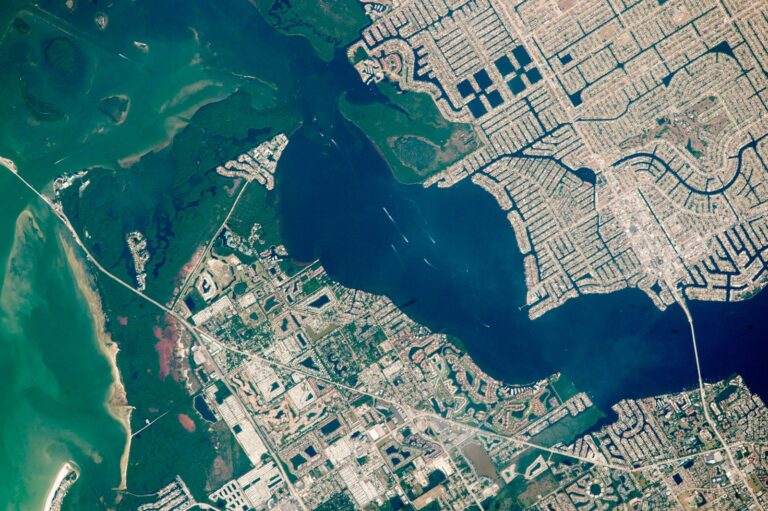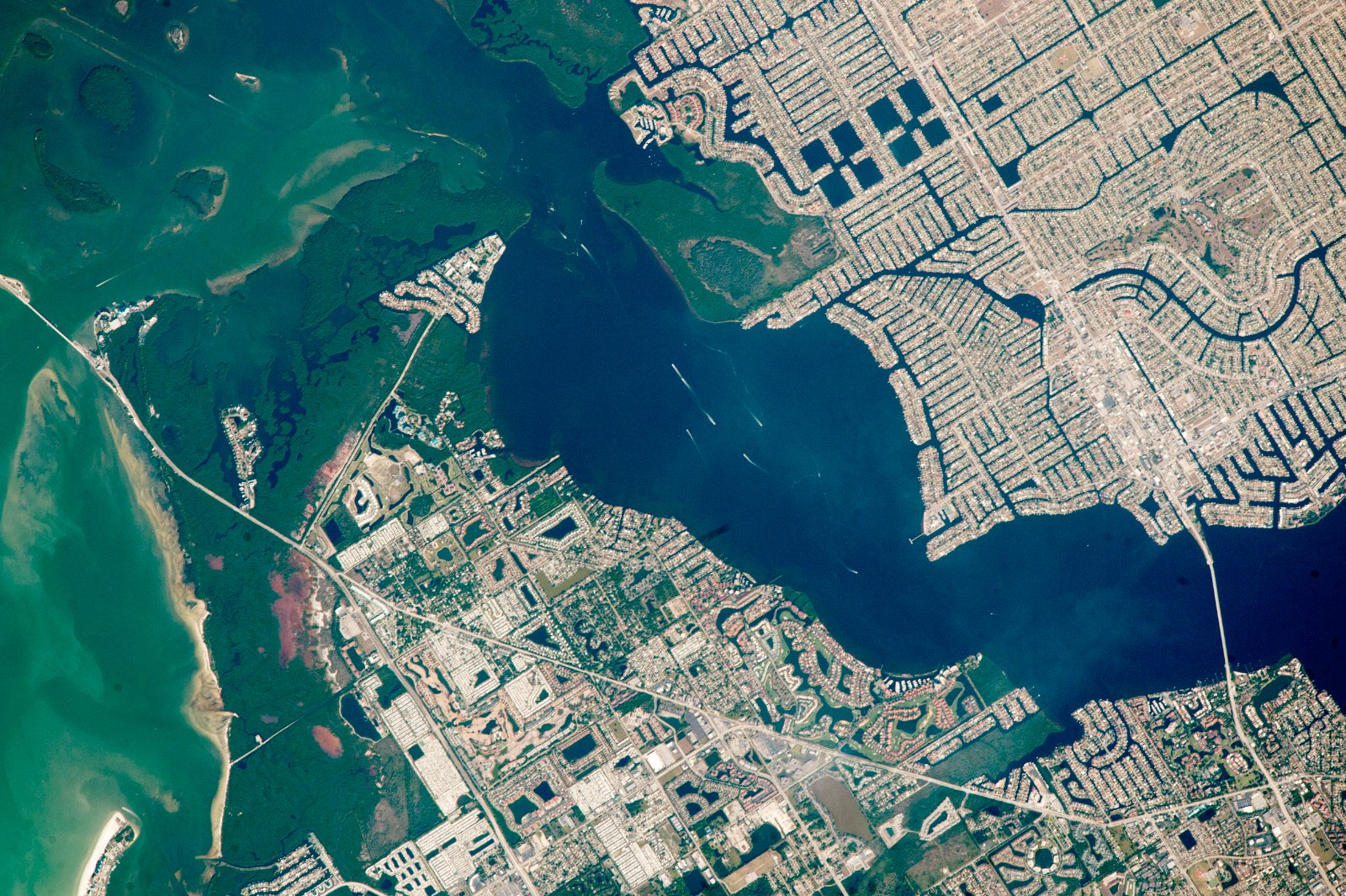
Image: NASA astronaut photograph ISS047-E-84351, via NASA Earth Observatory (July 25, 2016). Public domain (NASA).
Quick Answer: Collier County’s final 2026 taxable value rose 3.44% to $170.18 billion even though market value fell 2.95%, and Lee County’s roll followed the same pattern, with final taxable value of about $156.56 billion. New construction slowed in both counties. Amendment 3, approved by 62% of voters on November 3, will shift a growing share of non-school property taxes onto commercial, rental and second-home property starting in 2027.
Southwest Florida’s 2026 tax rolls show a split that business owners will see on their bills. Market values in Collier and Lee counties fell, yet taxable values rose as capped assessments kept climbing toward market prices. New construction, the part of the roll that adds tax base without raising existing owners’ bills, fell sharply in both counties.
The final rolls are also the last built under Florida’s old exemption rules. Starting January 1, 2027, Amendment 3 raises the non-school homestead exemption and cuts the non-homestead assessment cap from 10% to 5%, reshaping who pays for county and city budgets.
How much did Collier County’s taxable value grow in 2026?
According to the Collier County Property Appraiser’s tax roll summary, the county’s final 2026 taxable value is $170,180,144,494, up 3.44% from $164,522,640,259 in 2025. Final market value fell 2.95% to $221,795,329,058, down from $228,535,599,049. The final figures include real property, tangible personal property and centrally assessed property, plus any Value Adjustment Board changes.
The growth rate itself slowed sharply. Collier’s taxable value grew 8.21% in 2025, more than twice the 2026 rate. The county budget office’s FY 2027 tentative budget book used a July 1 countywide taxable value of $170,279,116,342, a 3.50% increase. Board adjustments then trimmed about $99 million from that figure before the roll was final.
Both coastal cities followed the county’s pattern. In the City of Naples, market value fell 2.96% to $53.87 billion, while taxable value rose 4.16% to $43.01 billion. On Marco Island, market value fell 2.20% to $23.56 billion and taxable value rose 4.26% to $19.20 billion.
| Collier jurisdiction (2026 final) | Market value | Change | Taxable value | Change | New construction (taxable) |
|---|---|---|---|---|---|
| Collier County total | $221.80B | -2.95% | $170.18B | +3.44% | $2.95B |
| City of Naples | $53.87B | -2.96% | $43.01B | +4.16% | $759.1M |
| City of Marco Island | $23.56B | -2.20% | $19.20B | +4.26% | $275.0M |
Source: Collier County Property Appraiser, Tax Roll Summary Information (2026 FINAL).
Why can taxable value rise while market value falls?
Florida caps annual assessment increases, and for non-homestead property, including commercial buildings, rentals and second homes, the cap is 10%. After the price run-up, many assessments sit below market value and keep climbing toward it even as the market softens. In Collier, the 2026 gap between final market value and taxable value is about $51.6 billion. That cushion explains why taxable value rose even as the property appraiser’s market estimate declined.
How much new construction was added to Collier’s roll?
New construction added $2,951,063,906 in taxable value to the 2026 Collier roll, according to the property appraiser. That is down about 26% from $4,010,349,483 in 2025. In market-value terms, new construction fell from $4.30 billion to $3.23 billion.
What did Lee County’s 2026 tax roll show?
Lee County Property Appraiser Matt Caldwell’s office released its preliminary estimate in late May. The Cape Coral Breeze reported that the estimate showed total taxable value rising 2.94%, to about $153.92 billion from $149.52 billion. Total just value fell 1.94%, a decline of roughly $4.26 billion. Estimated taxable new construction came to $4.68 billion, down about 8.9% from $5.13 billion the year before.
Florida’s Office of Economic and Demographic Research (EDR) put Lee’s 2026 taxable value at $156.34 billion in its July 2026 statewide comparison. The property appraiser’s 2026 At-A-Glance summary, dated October 9, 2026, puts the final total at $156,555,335,569 in taxable value for real and tangible personal property. Final just value is $217,479,164,769. Caldwell’s office signed the certificate to the roll on October 9.
The roll covers 572,725 real property parcels, including 12,847 improved and 6,802 vacant commercial and industrial parcels, plus 65,230 tangible personal property business accounts.
Which Lee County cities gained or lost taxable value?
Preliminary figures reported by the Cape Coral Breeze showed Sanibel’s taxable value down 1.19% and Fort Myers Beach up 9.13%. Just value fell 7.21% in Estero and 4.66% in Bonita Springs.
The DR-420 certification forms the property appraiser sent to taxing authorities on June 30 show the starting point for each city’s budget. Cape Coral’s gross taxable value was $33.10 billion, up about 3.3% from the prior year’s final $32.04 billion, with $1.38 billion of net new taxable value. Fort Myers’ gross taxable value was $14.02 billion, essentially flat from $13.96 billion, with $267 million in net new value.
What millage rates did local governments set for 2026?
The August TRIM (Truth in Millage) notices showed property owners each taxing authority’s proposed rate next to its “rolled-back rate.” The rolled-back rate is the rate that would produce the same revenue from existing property as the year before.
What did Collier County adopt?
Collier’s FY 2027 tentative budget totals $3.18 billion gross, up 1.75% from $3.12 billion adopted for FY 2026. The tentative budget kept the General Fund rate at 3.0107 mills, 0.98% above the rolled-back rate of 2.9814. The unincorporated area general fund stayed at 0.6844 mills, against a rolled-back rate of 0.6824. Proposed property tax revenue across the county’s funds was $640.9 million, up about 3.4% from $619.8 million levied the year before.
At the final hearing in September, WGCU reported, commissioners kept the overall tax rate flat. On a 3-2 vote, they also cut Conservation Collier’s property tax funding by about $5 million, from roughly $35 million a year to $30 million. Chairman Dan Kowal, Chris Hall and William McDaniel voted for the cut, and Rick LoCastro and Burt Saunders voted against it. All five approved the final budget.
What did Lee County taxing authorities propose?
The property appraiser’s 2026 Taxing District Millage Book, dated August 11, lists the rates used on TRIM notices. Lee County’s general revenue rate held at 3.7623 mills against a rolled-back rate of 3.7292, about 0.9% higher. The unincorporated MSTU held at 0.8398 mills against a rolled-back rate of 0.8211. Cape Coral proposed 5.1988 mills, up from 5.1471 but below its 5.2174 rolled-back rate. Fort Myers proposed a maximum of 7.3112 mills, up from 6.5000. That is about 12.5% above the prior rate and 10% above the city’s 6.6465 rolled-back rate. Final adopted rates can be at or below the TRIM figure, so owners should check their November bills against the notice.
The Lee County School Board adopted a $3.05 billion FY 2027 budget on a 6-1 vote, WGCU reported. It set a total rate of 5.271 mills, down from 5.319.
| Taxing authority | Prior rate | Rolled-back | 2026 proposed (TRIM) |
|---|---|---|---|
| Collier County General Fund | 3.0107 | 2.9814 | 3.0107 |
| Collier Unincorporated General Fund | 0.6844 | 0.6824 | 0.6844 |
| Lee County General Revenue | 3.7623 | 3.7292 | 3.7623 |
| Lee Unincorporated MSTU | 0.8398 | 0.8211 | 0.8398 |
| Lee County Library District | 0.4218 | 0.4189 | 0.4218 |
| City of Cape Coral | 5.1471 | 5.2174 | 5.1988 |
| City of Fort Myers | 6.5000 | 6.6465 | 7.3112 |
Sources: Collier County FY 2027 Tentative Budget; Lee County Property Appraiser 2026 Taxing District Millage Book (preliminary, Aug. 11, 2026). Rates in mills; one mill equals $1 per $1,000 of taxable value.
How does Southwest Florida compare with the state?
The region is growing more slowly than Florida as a whole. EDR’s July 2026 statewide comparison puts Florida’s 2026 taxable value at about $3.67 trillion, up 5.59%. Collier’s July gain was 3.50%, and Lee’s preliminary gain was 2.94%. EDR’s forecast, made before the amendment vote, projected 2027 taxable values of $177.05 billion for Collier, $163.56 billion for Lee and $36.38 billion for Charlotte, whose 2026 value it put at $35.22 billion. Those projections do not reflect the new exemptions.
What does Amendment 3 change for businesses?
Florida voters approved Amendment 3 on November 3 with 62% of the vote, according to preliminary results reported by Bloomberg Government and the News Service of Florida. The measure needed 60% to pass. It began as HJR 1F, passed in a June special session. The Florida Association of Counties’ backgrounder summarizes its terms:
- The non-school homestead exemption rises to $150,000 in 2027 and $250,000 in 2028, then adjusts annually for inflation. School levies were carved out of the larger exemption.
- The annual assessment cap on non-homestead real property, including commercial property, rental housing and second homes, drops from 10% to 5% starting January 1, 2027.
- People who establish residency after January 1, 2027 must wait five years for the increased exemption.
- County and municipal property tax revenue is limited to listed purposes, starting with public safety, plus a catch-all for operations and administration.
- A proposed state trust fund to make up local revenue losses was removed, so no state backfill is guaranteed.
The state’s Revenue Estimating Conference adopted an estimate on June 12, which was reviewed again in July. It put the statewide local, non-school cost at $4.96 billion in FY 2027-28, rising to $10.75 billion by FY 2030-31, with a recurring impact of $11.86 billion. Most of that comes from the homestead exemption. The 5% non-homestead cap accounts for $352.9 million in the first year and $1.66 billion by FY 2030-31.
How much would the tax base shift in Lee County?
The Lee County Property Appraiser’s “2026 Real Property Tax Roll With Proposed Changes” applies the amendment to this year’s final roll. For county general revenue, homestead taxable value of $53.71 billion would drop to $32.69 billion with a $150,000 exemption and to $22.73 billion at $250,000. Non-homestead taxable value of $95.71 billion would fall only to $92.98 billion under the 5% cap.
Non-homestead property, the category that includes nearly all commercial real estate, makes up about 64% of Lee’s county general revenue taxable base today. Using the appraiser’s $250,000 scenario, that share would rise to about 80%. In Cape Coral, it would rise from about 59% to 82%, and in Fort Myers from about 73% to 89%. This is arithmetic on the appraiser’s figures, not a forecast. Actual bills will depend on future values, the millage rates local boards set and any implementing laws.
| Lee taxing authority | Homestead taxable now | With $250K exemption | Non-homestead now | With 5% cap |
|---|---|---|---|---|
| County general revenue | $53.71B | $22.73B (-57.7%) | $95.71B | $92.98B (-2.8%) |
| Cape Coral | $13.24B | $4.12B (-68.9%) | $18.97B | $18.48B (-2.6%) |
| Fort Myers | $3.50B | $1.18B (-66.4%) | $9.40B | $9.09B (-3.3%) |
| Bonita Springs | $7.49B | $4.67B (-37.6%) | $11.60B | $11.34B (-2.2%) |
| Estero | $4.23B | $2.06B (-51.3%) | $5.84B | $5.75B (-1.5%) |
| Sanibel | $1.75B | $1.33B (-23.8%) | $4.20B | $4.15B (-1.1%) |
Source: Lee County Property Appraiser, 2026 Real Property Tax Roll With Proposed Changes. Percentages calculated from the appraiser’s figures.
Why is the 5% cap only part of the story for commercial owners?
The lower cap slows how fast assessments below market value can catch up. It does nothing about the millage rate. If local governments try to replace lost homestead revenue, the rate applies to a base that will be mostly non-homestead property. Places with many homesteads, such as Cape Coral, face the largest relative loss of homestead taxable value.
What happens next in Tallahassee?
Gov. Ron DeSantis said after the vote that he would call a special session within two months, before his term ends in early January, the News Service of Florida reported. He said the session would set the schedule for further homestead exemption increases and limit local governments from “taxing them in other ways.”
For commercial owners, the 2027 roll, assessed January 1, 2027, will be the first under the new rules, and August 2027 TRIM notices will show how local governments set rates against the smaller homestead base.
Frequently Asked Questions
What is Collier County’s 2026 taxable value?
The Collier County Property Appraiser’s final 2026 taxable value is $170,180,144,494, up 3.44% from 2025. Market value fell 2.95% to $221.80 billion.
What is Lee County’s 2026 taxable value?
The Lee County Property Appraiser’s October 9, 2026 summary lists $156,555,335,569 in taxable value for real and tangible personal property, with just value of $217,479,164,769.
Did Collier or Lee County raise property tax rates for 2026?
Both counties’ general fund proposals kept last year’s rates, which are above the rolled-back rate and so bring in more revenue as values rise. Collier also cut Conservation Collier funding by about $5 million. Fort Myers proposed raising its maximum rate from 6.5000 to 7.3112 mills.
Does Amendment 3 lower taxes on commercial property?
It does not add a commercial exemption. It lowers the annual assessment cap on non-homestead property, including commercial property, from 10% to 5% starting in 2027. The bigger exemption applies only to homesteads.
When does Amendment 3 take effect?
January 1, 2027. The non-school homestead exemption becomes $150,000 in 2027 and $250,000 in 2028, then adjusts for inflation.
Sources and Further Reading
- Tax Roll Summary Information, 2026 and 2025 Final — Collier County Property Appraiser
- FY 2027 Tentative Budget Book — Collier County Office of Management and Budget
- 2026 At-A-Glance Final; 2026 Certificate to Roll; 2026 DR-420 Certifications; 2026 Taxing District Millage Book (Preliminary) — Lee County Property Appraiser
- 2026 Real Property Tax Roll With Proposed Changes — Lee County Property Appraiser
- Overall property valuations show market slowdown — Cape Coral Breeze
- Statewide Comparison of County Taxable Value, July 2026 — Florida Office of Economic and Demographic Research
- Revenue Impact of HJR 1F, Conference of June 12, 2026 — Florida Revenue Estimating Conference
- HJR 1F Joint Resolution Backgrounder — Florida Association of Counties
- Collier will not raise tax rate but will cut some funding for conservation program — WGCU News
- Lee County School Board passes $3.05 billion budget for fiscal 2027 — WGCU News
- Florida voters pass DeSantis-backed property tax cuts — Bloomberg Government
- With Florida Amendment 3’s victory, Gov. DeSantis eyes a special session — News Service of Florida via News 6
- Cape Coral, Florida (astronaut photograph) — NASA Earth Observatory
About the Author